
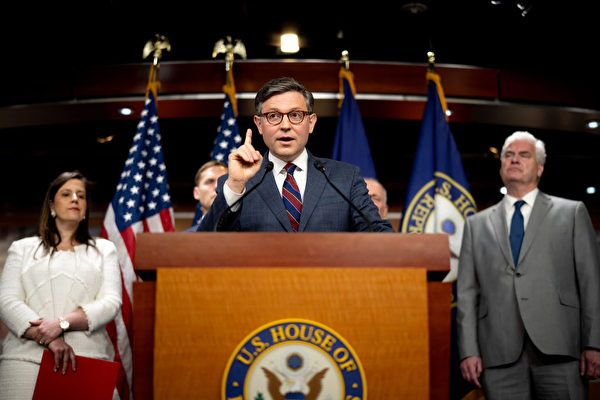
Although the final results of the US House of Representatives elections have yet to be announced, the Republican Party is close to gaining control. Congressional Republicans are preparing ambitious legislative plans for the first hundred days of President Trump’s tenure, aiming to push through some significant legislation.
In the November 5th election, former President Trump won by a landslide, and the Republicans also secured control of the Senate. While no institution has predicted that the Republicans will win enough seats to control the House of Representatives, the possibility of maintaining a slim majority is becoming increasingly apparent.
House Speaker Mike Johnson has been collaborating with Senate Republican leaders and President Trump for months to discuss issues that can swiftly be passed in Congress during Trump’s first hundred days. Senators John Thune and John Cornyn are said to be potential successors to Senate Republican leader Mitch McConnell, and they have participated in these discussions.
Trump is set to be sworn in as the 47th President of the United States on January 20, 2025.
“The Hill” summarized some of the Republican Party’s top legislative priorities. One of these priorities is to make key parts of the “2017 Tax Cuts and Jobs Act” passed during Trump’s first term permanent, along with introducing some positive changes to the tax policy.
In September, Johnson outlined plans to reinstate immediate expensing of research and development costs and ensure robust provisions for foreign-derived intangible income deductions to “encourage American possession of intellectual property.”
Johnson also voiced support for a “strong child tax credit.” “Unlike the proposals from the Democrats, we will ensure that our tax policy respects workers and does not reward those who do not work,” he said, indicating that tax relief eligibility would require meeting certain work requirements.
However, some details of the tax policies are expected to cause divisions within the House Republican Party.
Republicans from high-tax states have long sought to repeal the $10,000 state and local tax (SALT) deduction cap signed by Trump during the TCJA passage, while other Republicans support maintaining it.
In September, Trump expressed willingness to repeal the SALT deduction cap.
House Republican leader Steve Scalise previewed Republican plans for addressing border issues in a letter to colleagues as he seeks support to continue as the House Majority Leader.
“President Trump can take immediate action through executive orders to halt the catch and release policy, reinstate the ‘Remain in Mexico’ immigration policy, and stop the blatant abuse of asylum and parole programs to ensure border security,” Scalise said.
If Republicans succeed in securing the House along with the White House and Senate, they will play a crucial role in funding Trump’s plans.
“We will deploy resources to the southern border, construct the Trump border wall, procure new detection technologies, enhance border patrols, and impede the flow of illegal immigrants,” Scalise said.
Republican leaders plan to repeal parts of the “Lowering Inflation Act” signed by President Biden, particularly funds allocated for climate projects.
But the Republican goal is not to entirely abolish this law. Johnson stated in a CNBC interview in September that he would take a surgical approach, rather than a sledgehammer, towards provisions related to clean energy and economic packages, mentioning that “some terms are generally useful.”
Some regions represented by Republicans directly benefit from the green energy tax credits in the “Lowering Inflation Act.”
A $27 billion plan of interest to Republicans was distributed to local governments and non-profit organizations.
House Republicans express support for expanding school choice measures, allowing students and families to use public funds for private or alternative school programs.
Johnson stated in his speech at the America First Policy Institute, “We can maximize school choice for parents and hold woke college administrators accountable to reform our education system.”
Earlier this year, the House Ways and Means Committee passed the “Child Education Choice Act,” aimed at expanding school choice. According to Rep. Adrian Smith, the bill’s sponsor, the legislation would provide “charitable giving incentives for individuals and corporations to fund scholarships that would cover costs related to K-12 public and private education.”
Scalise also referenced school choice in the letter, stating that Republicans will prioritize parental and choice in child education over union bosses.
Republicans also plan to continue questioning university presidents on anti-Semitic policies.
In September, House Republicans passed the “Ending Woke Higher Education Act,” which includes requiring universities to adopt free speech policies as a condition to receive Title IV university funds.