
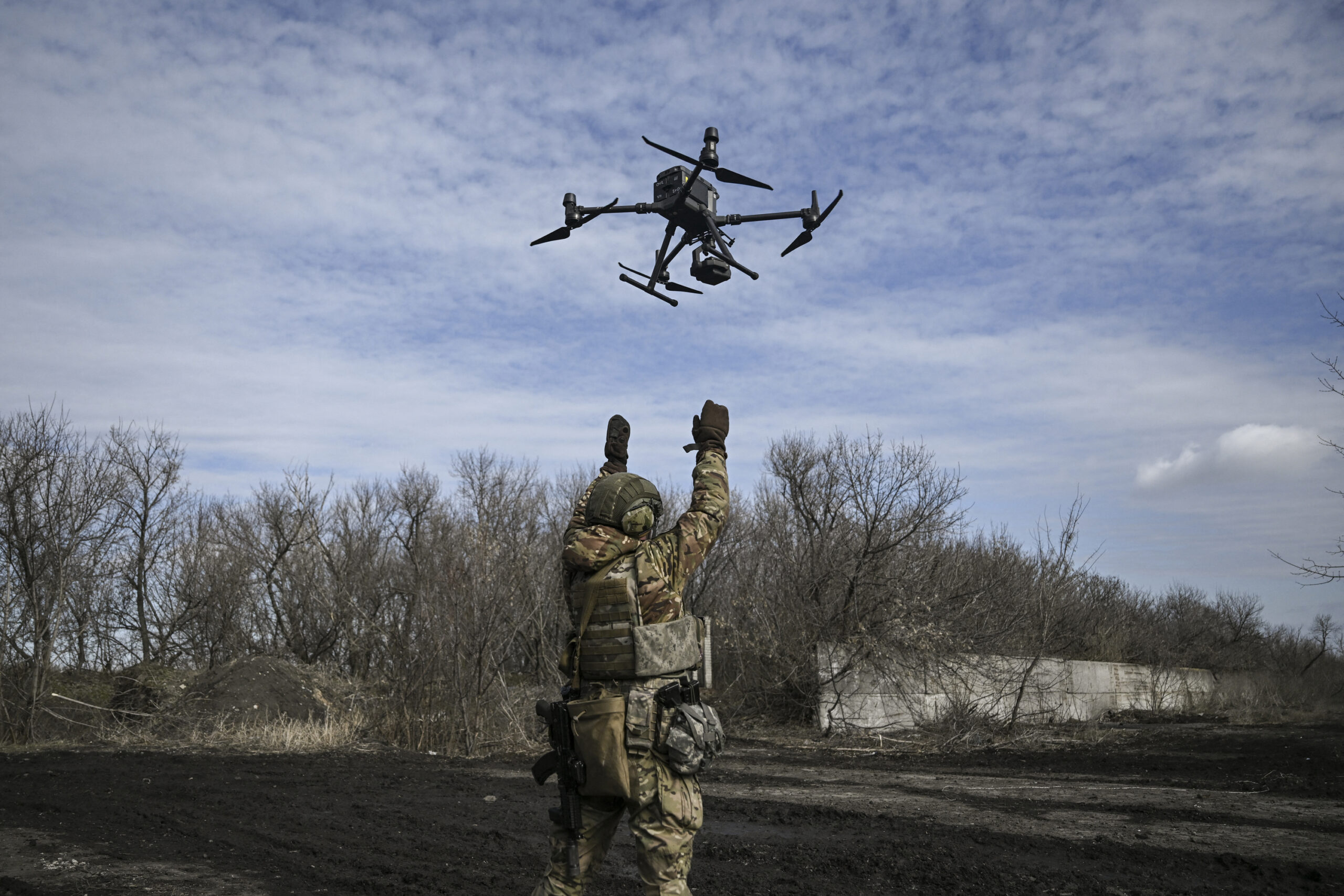
Ukrainian military forces and defense enterprises have released a video on Monday (October 19) showcasing their successful execution of what is claimed to be the world’s first rescue mission to evacuate wounded soldiers directly from the front lines using unmanned aerial drones.
The infantryman involved, whose name has not been disclosed, belongs to Ukraine’s 30th Independent Mechanized Brigade. He had previously held the front line under constant threat of death for nearly 500 days, with his comrades continuously airdropping food, water, ammunition, and medications to him using drones.
After suffering severe injuries, it was deemed extremely dangerous and impractical to evacuate the soldier by foot or using ground-based robot vehicles (UGVs) due to frequent enemy drone activity and landmines in the area.
With conventional methods deemed ineffective, military experts decided to attempt an unprecedented operation – utilizing aerial drones for direct humanitarian evacuation.
According to Business Insider, the operation was jointly carried out by Ukraine’s 92nd Independent Assault Brigade, 30th Independent Mechanized Brigade, 10th Corps, and Ukrainian drone manufacturer Gurzuf Defense. The 30th Brigade was responsible for operating the drones.
The mission utilized a heavy hexacopter called the “Heavy Shot AYUDAG 6”. Originally designed as a bomber by a Ukrainian manufacturer, the drone gets its name from its six engines and Mount Ayudag near Gurzuf in Crimea.
Weighing approximately 98 kilograms (215 pounds), the drone can carry between 70 to 90 kilograms (150 to 200 pounds), roughly twice the size of an injured soldier. It has a range of up to 25 kilometers and operates at altitudes of 150 to 300 meters.
First, the rescue team air-dropped specialized equipment with climbing harnesses to the wounded soldier. Then, a drone equipped with a winch was dispatched to remotely guide the soldier in securing himself to the system. Throughout the evacuation operation, the drone covered a total distance of 62 kilometers in 75 minutes, with the actual life-threatening distance of the wounded soldier being over 14.5 kilometers (9 miles).
Experts had to modify and test the drone beforehand to ensure it would not overturn or oscillate excessively when carrying a person. Continuous airspace monitoring and electronic warfare (EW) protection were also essential throughout the mission.
As reported by NBC citing a statement from Ukraine’s 92nd Independent Assault Brigade, “This mission once again proves that Ukrainian soldiers collaborating with Ukrainian manufacturers are leading a new trend in global warfare.”
The rescued soldier is currently undergoing treatment and rehabilitation with no life-threatening condition. The programmer behind the operation, codenamed “Napalm” from the 92nd Brigade, praised the soldier as a hero for bravely agreeing to carry out the mission upon seeing the machine sent to retrieve him.
The drone operator from the 30th Brigade, codenamed “Chornyi” (Black), also expressed relief at the success of the operation.
Ukrainian Army stated that its drone units are executing operations previously considered science fiction. “Napalm” mentioned that this marks the next stage in the wounded evacuations, with upcoming rigorous and systematic work to ensure such missions become routine.
According to Kyiv Independent, Gurzuf Defense co-founder Pavlo Feldblium emphasized that aerial rescue should be seen as a last resort in the absence of other options, not a standard practice.
Samuel Bendett, a drone specialist at the CNA, pointed out the evident dangers of slow-moving large aerial craft in executing missions, with Russian forces such as the elite “Rubicon” battalion devoting resources to targeting and shooting down such heavy drones.
Since the beginning of 2026, Ukraine’s Ministry of Defense reported that the use of ground robots for casualty evacuation and logistics tasks has more than tripled, from about 7,500 missions in January to over 25,000 by August. Other domestic companies like SkyFall are also in the development stage of large hexacopter drones for casualty evacuation.
Moreover, Ukrainian Prime Minister Serhii Koretskyi recently approved an experimental project using drones for medical logistics, enabling rapid transport of medications, blood samples, and organs between hospitals.