
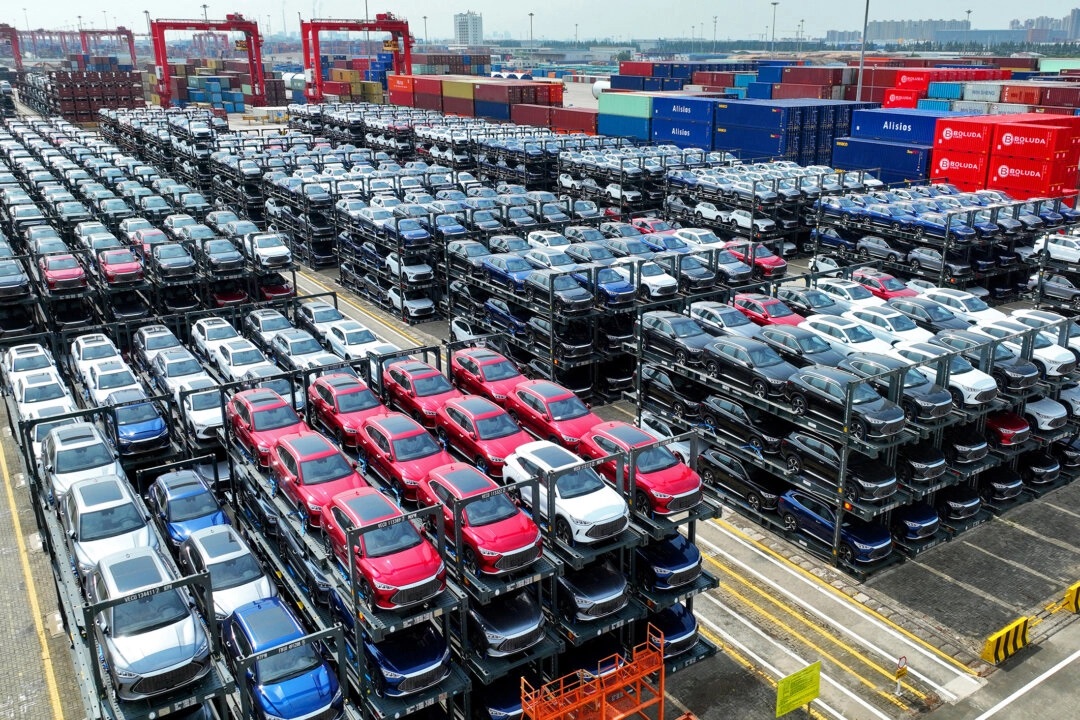
In October 16, 2026, according to the data from the Chinese customs, China’s exports in September showed strong performance and the trade surplus for this year is expected to break the nearly $1.2 trillion record set last year. In fact, in 2024, China’s merchandise trade surplus of nearly $1 trillion set a record in international trade history, but the momentum in 2025 and 2026 has been even stronger. However, the question remains, what costs are being paid behind this prosperity? This article delves into three points.
According to the data from the Chinese customs: (1) In September, measured in US dollars, China’s exports surged by 36.3% year-on-year, while imports expanded by 31%, resulting in a monthly trade surplus of $133.5 billion; (2) This year, the import and export volume continued to grow rapidly, with growth rates of 15.3%, 18.3%, and 22.3% in the first, second, and third quarters, respectively (measured in RMB); (3) By the end of September, China’s accumulated trade surplus for the first three quarters of the year had reached $938.1 billion, possibly breaking last year’s record of nearly $1.2 trillion for the full year.
Behind China’s strong export performance lies the sustained weakness in domestic demand. Consider these two sets of data: (1) From January to August 2026, the total retail sales of social consumer goods in China amounted to 32.7569 trillion yuan, an increase of only 1.1% year-on-year. This not only falls far behind the growth rate of imports and exports, but is also significantly lower than the official GDP growth rate during the same period. (2) From January to August 2026, fixed-asset investments nationwide (excluding rural households) totaled 29.3092 trillion yuan, a decrease of 7.2% year-on-year. This decline continues from the 3.8% contraction seen for the whole year of 2025.
The sustained weakness in domestic demand and the serious imbalance in China’s macroeconomy have become a consensus in the domestic and international economic and policy circles. Moreover, it is widely believed that addressing this imbalance cannot rely on exports alone, but rather requires structural reforms. For example, on October 13, the International Monetary Fund (IMF) lowered its economic growth forecast for China in 2026 by 0.1 percentage points to 4.5%, and projected a further slowdown to 4.0% in 2027. The IMF warned that robust exports cannot fully offset the weakness in domestic demand. Conversely, the Chinese authorities’ reliance on exports, akin to a desperate measure, has further exacerbated the macroeconomic imbalance.
China’s massive trade surplus is something the international community cannot ignore. Since 2024, the “China Shock 2.0” theory has gained widespread popularity, suggesting that against the backdrop of a bursting bubble in the Chinese real estate market and inadequate domestic demand, Chinese manufacturers have expanded production capacity and flooded global markets with low-priced goods, electric vehicles, green energy equipment, steel, chemicals, and machinery amounting to trillions of dollars.
Regarding the “China Shock 2.0” theory, the international community reached an unprecedented peak in 2026. For instance, at ministerial-level meetings and summits held in May and June, the G7 highlighted “China’s overcapacity and export expansion” as a core economic issue. The G7’s joint statement pointed out that opaque government subsidies continue to distort markets and exacerbate economic reliance, also warning for the first time that attempting to use economic dependence as a bargaining chip will inevitably fail. European Commission President Von der Leyen stated that “some countries produce too much and consume too little,” posing an “increasingly serious risk” to global economic stability, directly labeling China’s huge trade surplus as “unsustainable.”
Furthermore, a report released by the Federal Reserve specifically titled “China Shock 2.0: How China’s Current Export Wave Differs from the Early 2000s” emphasized that China’s current trade surplus shock has exceeded 1% of the global GDP outside China and is shifting comprehensively from low-end labor-intensive products to capital-intensive industries such as electric vehicles and precision machinery, squeezing developed economies’ markets. On September 28, the European Central Bank (ECB) and the Bank of Italy jointly held a rare academic and policy seminar in Rome titled “China Shock 2.0: Causes, Consequences, and Policy Response,” officially recognizing that “China Shock 2.0” is driven by government industrial policy support, price competitiveness, and technological upgrades.
In terms of policy responses, the United States not only maintains and intensifies tariffs on Chinese electric cars and semiconductors, but also focuses on preventing China from conducting “transshipment and tariff evasion” through third countries; the European Union has issued a “final ultimatum” to China, forcing a four-year “mutual understanding” agreement in early October, setting an annual cap of 350,000 units for plug-in hybrid cars exported from China to the EU. Additionally, unlike the first wave of the “China Shock,” this time even BRICS countries and emerging markets in Latin America and Asia have joined the anti-dumping measures.
It can be said that in response to the “China Shock 2.0,” the international community is witnessing two fundamental transformations: in terms of industry, this is no longer just the impact of cheap textiles, but a direct industrial substitution and struggle for dominance by China in high-tech sectors such as aviation, AI, robotics, electric vehicles, and biopharmaceuticals; in terms of response strategies, major Western economies no longer rely on traditional rules like the WTO, but instead engage in collective containment through mechanisms such as the G7: simultaneously negotiating, building walls, and implementing precise countermeasures.
While the trade surplus has reached an unprecedented trillion-dollar level, what is the true economic benefit? Here are two breakdowns:
Firstly, the bad debts within financial support.
Without official credit support, China’s foreign trade could not have achieved its current scale. For example, in the first nine months of 2026, the China Export-Import Bank issued nearly 1 trillion yuan in new loans in the field of foreign trade; its loans to countries participating in the “Belt and Road” initiative exceeded 2 trillion yuan. In the first eight months of 2026, the China Export & Credit Insurance Corporation (Sinosure) covered an amount of $854.18 billion in insurances for export credit, accounting for over 25% of China’s total exports during the same period. According to a comprehensive tracking report released by the international research institution AidData, China’s total global overseas credit and lending volume (including both developed and developing countries) currently ranges from $1 trillion to $2 trillion, ranking among the top globally.
Officially, the overall bad debt risk is said to still be within the manageable scope of the government, but the actual situation may not be so. The low non-performing loan rate is partly due to banks widely adopting the practice of “allowing deferred payments/extensions” for some import-export traders, local platforms, or small and micro enterprises, or using Sinosure insurance as a safety net. If all these “deferments, reorganizations, and refinancings” were treated as non-performing assets based on international norms, it is estimated that the hidden non-performing loan rate within the entire Chinese banking system (including broad domestic and international shadow debts) could range from 5% to 10%, significantly higher than the reported 1.2% to 1.5%.
Moreover, the insurance provided by Sinosure merely transfers the risk within the national balance sheet rather than eliminating it. When a Chinese exporter or overseas buyer defaults, leading to a failure to recoup the credit, Sinosure, having insured the project, will compensate the lending bank accordingly. The bank will then write off or neutralize the loan on its books, preventing an increase in the bad debt ratio. This essentially shifts the “financial risk of banks” into the “loss provision of Sinosure.” As a policy-oriented insurance company, with the ultimate backers and guarantors being the Chinese Ministry of Finance, this mechanism effectively turns the financial risks in import and export into a hidden fiscal burden of the central Chinese government.
Secondly, the overall deterioration of the Terms of Trade (TOT).
Terms of Trade refer to the ratio of export prices to import prices in a country. Worsening Terms of Trade mean that China now needs to export more quantities of cars, solar panels, and lithium batteries to exchange for the same quantities of oil and iron ore.
Currently, China’s exports display a clear polarization. On one hand, for instance, in September, the export value of integrated circuits soared by 136.8% year-on-year while the quantity only marginally increased by 1%. This belongs to a “significant improvement in terms of trade,” or more accurately, a typical case of “structural high-end upgrading” and “technological dividend explosion.” However, this trend is only applicable to specific products or industries. By way of illustration: (1) Chinese new energy vehicles proactively lowered prices overseas—prior to the imposition of tariffs in Brazil, the implementation of quotas in the EU, and the reduction of domestic tax rebates, through phased price reductions, they quickly opened the gates of emerging markets; (2) Consumer electronics and appliances stimulated overseas “bulk purchases” through price reductions, leading to a surge in sales in September; (3) Green power energy chains (solar energy, wind power, energy storage) generally adopted an aggressive pricing strategy of “pricing along the cost line” when going abroad, offering ultra-low prices in filling European and Belt and Road Initiative countries’ power grids and energy storage stations; (4) Traditional labor-intensive products (like toys, clothing, furniture) are securing business by accepting orders based on the ultimate cost-effectiveness for restocking in Europe and the U.S.
In summary, except for AI chips and high-price computing hardware enjoying the profits from global tech frenzy, the vast majority of Chinese manufacturing is struggling to survive in the midst of global geopolitical frictions and subdued domestic consumption by actively lowering prices, offering discounts, and reducing profit margins.
The Epoch Times first published this news.