
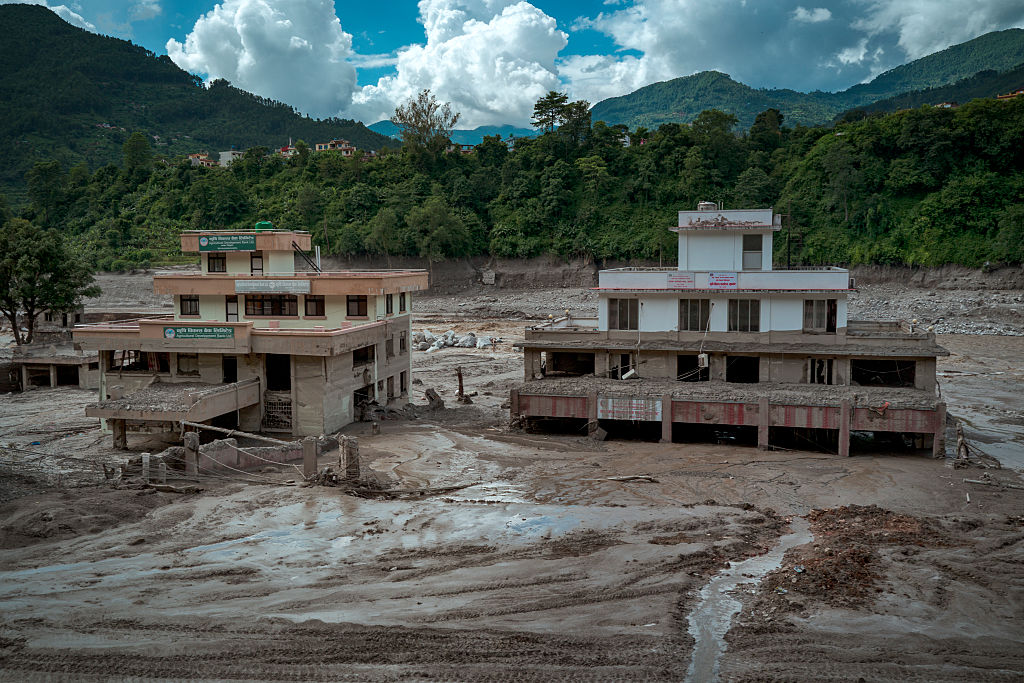
On August 26th, a flood occurred at the China-Nepal border, leading to severe damage from mudslides at the Jilong Port in the Tibet’s Xigaze region, where multiple buildings and roads were covered by mud. The upstream dammed lake has overflowed, with an anticipated influx of about 3 million cubic meters of water in the next three days, posing a high risk of bursting. Studies suggest that this disaster was triggered by a glacier collapse.
It has been reported that many construction workers, truck drivers, and border inspectors are missing following the incident, with some family members unable to approach the port area after rushing to Jilong town. The Chinese authorities have been revealed to have requested strict control over reporting and downplaying the casualties on the Tibetan side, with related videos and posts being deleted or restricted across various mainland platforms.
A woman from Chengdu, Sichuan, shared her concern with the media about her cousin working at a construction site near the Jilong Port, whom she has been unable to contact since the disaster struck. Her cousin resides with relatives who operate a supermarket near the port building.
During the incident, the male head of the family was out taking his child to the airport when he encountered road closures on his return, leaving his wife and the woman’s cousin at the location unreachable. The status of the supermarket remains unclear. The woman expressed, “The heavy feeling in my heart is profound, hearing that my sibling, whom I grew up with, has brought tears to us all.”
Another man from Sichuan mentioned that his brother works as a truck driver for an international logistics company in Lhasa, running the Nepal route regularly. The day before the disaster, his brother had mentioned road collapses in Nepal, awaiting near the national border. Company personnel later informed him that his brother was about 200 meters from the border at the time and remains uncontactable.
A relative rushing from Lhasa to Jilong shared that both her brothers operate excavators near the port and their dormitories were swept away by the flood. Upon reaching the site with her parents and other relatives overnight, they were stopped at a checkpoint approximately 26 kilometers from the port.
She estimated that around 200 people were gathered near the checkpoint awaiting news, with many in tears. The relatives had to seek and pay for accommodation on their own, but most local hotels were already fully booked. She mentioned, “We can’t reach the scene; the police won’t let us. When the helicopter took pictures from above, there was no one down below (in the affected area), it was all mud.”
Furthermore, a man from Inner Mongolia informed the media about his comrade from the third squad on duty at the Jilong border inspection station who is missing, though the exact number of missing individuals is uncertain.
The owner of a specialty store in Jilong town stated that traffic in the direction of the national border still remains under control, with priority given to the passage of relief personnel and supplies, making it inaccessible for the general public.
In addition, a disclosure on the Chinese Q&A platform “Zhihu” claimed to have previously worked at the port unit, indicating that the missing individuals might include over forty border inspectors, around ten customs officers, and several dozen border defense personnel, with some of them being recent graduates hired in July this year.
By 8 a.m. on the 27th, official reports stated that three people have died on the Tibetan side, 558 individuals are missing, out of which 260 are foreign nationals, with two villagers from Heso Village being rescued. As reported by the Associated Press on the 27th, Nepalese authorities declared that 389 people have died, and 910 individuals are missing.
The danger is not yet averted, as reported by Reuters on the 27th, new dammed lakes have formed on both sides of the China-Nepal border. Nepalese authorities have urged downstream residents, travelers, and rescue personnel to stay away from riverbanks and high-risk areas.
Data from the Chinese Ministry of Water Resources disclosed through satellite and aerial imaging demonstrate clogging near the confluence of the Zongqu River with the Purang River, forming a dammed lake.
As of the morning of the 27th, the estimated water storage volume on the Tibetan side reached approximately 2 million cubic meters, which has already started overflowing. An additional 3 million cubic meters of water are projected to flow in over the next three days, with a high risk of bursting; the inflow rate may peak around early September.
The latest weather forecast indicates that local rainfall may intensify on the 29th, with periods of moderate to heavy rain, underscoring the ongoing risks of secondary mudslides and landslides.
Daniel Shugar, a geomorphologist from the University of Calgary in Canada, based on satellite image analysis, identified a collapse of about 0.2 square kilometers of ice mass from an altitude of approximately 5,200 meters on the Nepalese side, vertically plummeting about 1,200 meters.
Experts from the Chinese Ministry of Natural Resources tentatively deduced that this disaster initiated with a high-altitude glacier collapse within Nepal. The rapid downstream flow of ice, carrying rocks, soil, and ice chunks, morphed into debris flow and later transformed into mudslides.
Guo Zhaocheng, Director of the Geological Hazard Investigation and Monitoring Center at the China Geological Survey’s Remote Sensing Center of Natural Resources, mentioned that the debris flow from the ice fall reaches a speed of approximately 50 meters per second, equivalent to 180 kilometers per hour, impacting an area over 20 kilometers away.
Initially labeled as a 4.4-magnitude earthquake by the United States Geological Survey (USGS), further analysis indicated that the tremors were actually a consequence of partial glacier and rock mass collapses, equivalent to a 5.2-magnitude earthquake and not a tectonic one; the debris cascade resulted in downstream flooding subsequently.
Around 10:30 a.m. on August 26th, a torrent mixed with ice blocks, rocks, and soil surged towards the Jilong Port. Comparative images released by the Chinese Ministry of Water Resources displayed before-and-after the disaster, showing multiple buildings and roads at the port covered with mud.
According to Reuters, military helicopters captured images revealing the comprehensive destruction within the port complex, including the national gate, customs, and border inspection facilities, all obliterated and covered in thick mud, making the region barely recognizable.
Following the disaster, the port experienced temporary interruption of water, power, roads, and communication. By 4 p.m. on the 27th, communication signals were restored approximately 3 kilometers from the national gate, yet ordinary individuals still could not access the port.
After the disaster, an alleged disaster report directive from the Chinese Cyberspace Administration spread on overseas social platforms. The leaked content mandated that apart from state-owned major media such as Xinhua News Agency and CCTV, other media outlets and individuals were not allowed to report independently but could only repost content from major official media. It further stipulated that all related reports must enable comment moderation or prohibit comments.
The directive also emphasized portraying the mudslides as originating in Nepal, listing Nepal before China in reports, focusing heavily on the disaster on the Nepalese side, downplaying the situation on the Tibetan side, and highlighting casualties of Chinese nationals in the Nepalese disaster area.
Some internet users discovered that even simply reposting on platforms like Weibo the on-site images and disaster information already publicized by Chinese official media such as CCTV and Xinhua, the relevant posts were deemed to contain “politically sensitive information” and restricted to “visible to self only.” Subsequent screenshots of these actions circulated on overseas social media.
According to “Voice of Tibet,” videos and posts about the disaster on WeChat, Douyin, Xiaohongshu, Zhihu, and Weibo have been gradually deleted or blocked. Investigations by the media revealed that videos regarding the Jilong Port on August 26th have become inaccessible.
In July 2025, severe floods hit Jilong Port and the Hessoa area in Nepal, causing the destruction of the China-Nepal Friendship Bridge and several hydropower facilities, resulting in casualties and missing persons.
The International Centre for Integrated Mountain Development noted that the same valley experienced two severe floods within 14 months; last year’s disaster was triggered by the sudden drainage of a glacial lake, while the exact events of this disaster are yet to be confirmed.
After the flood disaster last year, China and Nepal had agreed to enhance cross-border information sharing to mitigate glacial lake outburst risks. Following this latest disaster, Parshuram Kaphle, a Nepalese journalist focusing on diplomatic and strategic affairs, criticized China for failing to issue timely warnings to downstream areas in Nepal.