
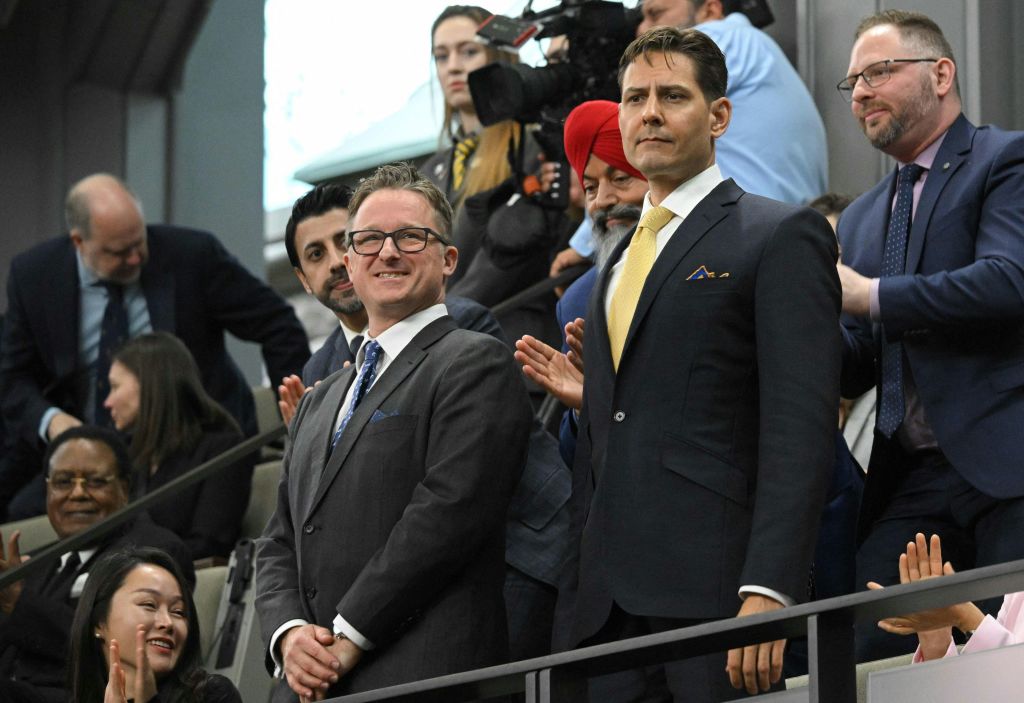
A recent statement from Canadian scholars focusing on China-related issues has raised concerns regarding the government’s diminishing public criticism of human rights abuses in China. Critics argue that this change in stance could undermine the collective position of democratic nations in defending human rights globally. There are calls for Canada to work closely with its allies to apply pressure on Beijing, advocating for the release of Canadian citizens who have been unjustly detained, as well as other political prisoners.
In an opinion piece featured in the Globe and Mail, an analysis was presented regarding the plight of Michael Kovrig and Michael Spavor, two Canadians who have gained significant recognition among the public. The two were kidnapped by China’s Ministry of State Security and held as hostages, a move seen as retaliation for the arrest of Huawei executive Meng Wanzhou.
Notably, Kovrig wrote a thought-provoking preface in the third edition of “The People’s Republic of the Disappeared,” a publication edited by the non-governmental organization Safeguard Defenders. This book details the harrowing experiences of numerous foreigners and Chinese citizens, capturing the abrupt and traumatic nature of their detainment: being forcibly taken off the street, blindfolded, and incarcerated in padded rooms for months while enduring relentless interrogation.
In such dire circumstances, individuals are left uncertain about whether they will ever reunite with their families, gradually succumbing to despair. The Chinese authorities refer to this practice as “Residential Surveillance at a Designated Location” (RSDL), a euphemism that masks the nature of the ordeal. Detainees are often coerced into confessing to any charges the government raises against them, contributing to the staggering 99.97% conviction rate in China.
The hostage situation involving innocent Canadian citizens has shocked and incensed the Canadian populace. In 2014, Kevin Garratt and Julia Garratt, residents of British Columbia, experienced similar unjust detention under Chinese authorities.
According to the article, during the period when the two Michaels were imprisoned, a Chinese official based in Shanghai informed the author that there existed a list of 100 Canadians that the Chinese authorities could detain and interrogate at any time.
Among those potentially on this list is Cheng Lei, an Australian Chinese journalist who previously served as a finance anchor for CGTN. She was detained in 2020, during the time when Australia was demanding an investigation into the origins of the COVID-19 virus. After spending over three years in detention, she was released on October 11, 2023, and returned to her home in Melbourne.
Cheng has two young children who went more than three years without seeing their mother, a tormenting aspect of her detainment.
Others, like Peter Dahlin of Safeguard Defenders, have also suffered under similar circumstances, where they were forced to produce detailed “confessions” for televised broadcast aimed at intimidating NGO members and foreigners in China. Such practices starkly contradict the values Canada professes to uphold.
The accounts recorded in “The People’s Republic of the Disappeared” shed light on the distressing experiences faced by countless Chinese citizens, whose situation is often more dire than that of the internationally recognized foreign nationals. While foreign detainees endure severe psychological distress, Chinese citizens frequently suffer physical torture as well, often leaving them with lifelong trauma from their experiences.
In a notable gesture, a declaration against arbitrary detention, led by Canada and supported by 82 countries, highlights international efforts to combat such abuses. During the trials of the two Michaels, over twenty foreign diplomats stood alongside Jim Nickel, the former acting head of the Canadian embassy in China, outside the courthouse to express solidarity.
However, the recent approach taken by the Canadian government signals a retreat from a strong stance on human rights issues. On October 23, during an engagement in Turkey, Prime Minister Mark Carney said that his focus is on human rights issues within Canada and described his government’s approach as a balanced form of “values-based realism.” He emphasized that engagement should not be mistaken for endorsement.
Failure to address human rights concerns during diplomatic engagements amounts to tacit approval of the host nation’s actions. As Carney noted, it is crucial to “confront the real world, not the world we wish for” and to refrain from remote critique.
The article further critiques that while Foreign Minister Anita Anand may bring up human rights issues in private meetings, indications hint at a growing hesitation among Canadian ministers, Liberal MPs, and government officials to publicly criticize the Chinese Communist Party across various topics.
If Canada ceases to prioritize human rights overseas, what incentive is there for countries such as Germany, the United Kingdom, or Australia to care? These nations similarly pursue trade expansion and may be swayed to follow Canada’s lead, opting to refrain from discussing torture in secret detention facilities. The Prime Minister may inadvertently be setting a precedent for democratic nations, retreating from the commitment to human rights. He should be collaborating with allies to advocate for the release of all wrongfully detained individuals.
The grim reality remains: approximately 100 Canadians are currently confined in Chinese prisons, subjected to conditions that may mirror the suffering experienced by the two Michaels. Notably, last year Beijing executed four Canadians on drug-related charges. This serves as a grim reminder of what is often referred to as a “strategic partnership.”
Taking decisive action to rescue detainees cannot be merely a show of goodwill or posturing. It requires direct dialogues with top Chinese officials, employing strategic leverage and negotiation to facilitate the release of those unfairly held, such as Huseyin Celil, who has been isolated for 20 years, and political advocates like Jimmy Lai, who has been imprisoned for his pro-democracy stance.
The article concludes by stressing that the Prime Minister must personally engage in these serious and direct negotiations rather than delegating the responsibility to ministers or officials, who may only issue vague statements of concern.
According to Kovrig, a concerted effort involving sanctions in trade, finance, and other essential domains is necessary to create continuous deterrence and pressure, rendering torture-prone detention facilities a liability for Beijing.
Ultimately, the government owes at least an explanation to the two Michaels regarding its lack of action on their behalf.