
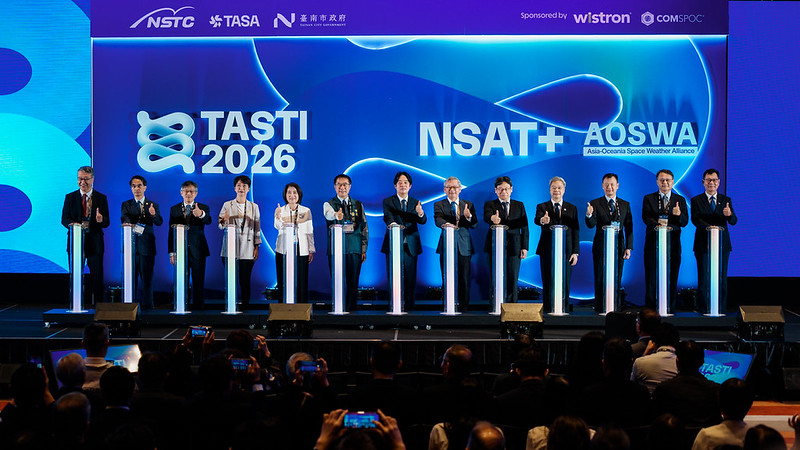
On November 9, 2026, President Lai Ching-te of the Republic of China attended the opening ceremony of the “TASTI 2026 Taiwan Space International Conference” held in Tainan. During his speech, he stressed the government’s commitment to supporting the autonomous development of space research and enhancing international cooperation to strengthen Taiwan’s capabilities in the space sector.
This morning, as President Lai addressed the audience at the conference, he expressed his enthusiasm for the grand event taking place, known as the “Taiwan Space International Conference and Industry Expo.” He extended a warm welcome to international friends who traveled from afar and expressed gratitude to all those involved in organizing and participating in the conference. He acknowledged the valuable opportunity for Taiwan’s space technology industry elites to exchange ideas and collaborate with counterparts from around the world.
Reflecting on the past three decades, President Lai highlighted Taiwan’s journey from having no space research initiatives to gradually building its capacity for independent development. He acknowledged that every achievement has been the result of years of dedication by researchers, as well as the collaborative efforts of industries and academia. He took this opportunity to convey his sincere gratitude to all partners contributing to Taiwan’s space development.
Lai stated that the advancements made in research, combined with the long-established technologies and manufacturing capabilities of the semiconductor and information communication industries, have laid a solid foundation for the development of Taiwan’s space industry. In his inaugural speech two years ago, he outlined the country’s direction toward “competing in space and exploring the oceans.” The government aims to support domestic teams in the independent development of satellites and rockets, while also establishing necessary testing and launch facilities. This initiative is designed to enable Taiwan to progressively achieve the capability of launching domestically-made satellites into space and to encourage greater participation from local companies in the space industry.
Over the past two years, the government has actively promoted the “Third Phase National Space Technology Development Program,” increasing the total budget to NT$71 billion and extending the execution timeline to 2031. Through collaboration with the National Science Council and relevant ministries, the government is supporting the autonomous development of satellites and rockets, fostering the growth of the domestic supply chain, and nurturing the talent needed to enhance Taiwan’s space capabilities.
In terms of infrastructure, Lai mentioned that the government has approved the establishment of a rocket research and assembly test base in Tainan’s Shalun area and has selected Jiupeng in Pingtung for the construction of a national rocket launch site. With these related facilities gradually coming online, Taiwan is moving steadily toward the goal of independently launching its satellites.
Lai further noted that such initiatives require long-term planning and cooperation across various ministries. To facilitate this, he established the “Space and Technology Development Committee” within the National Security Council to integrate resources from different departments, coordinate policy planning and execution, and collaboratively develop a national space strategy. This effort aims to ensure that all construction and research endeavors work together seamlessly and continue to progress.
President Lai emphasized that investing in space is essentially an investment in a shared future. Every government expenditure needs to translate into the safeguarding of the nation and the improvement of citizens’ lives. Through the analysis and application of satellite data, Taiwan can monitor environmental issues and climate change, providing rapid assessments in the aftermath of disasters to assist in rescue and recovery efforts. The development of satellite communications also plays a crucial role in maintaining essential communication during ground-based disruptions. Space technology is closely linked to daily life, enabling Taiwan to be better prepared when facing various challenges.
This aligns with the theme of the current conference: “Space Trust, Local Resilience.” Enhancing local resilience requires support through international cooperation. By engaging in technical exchanges and information sharing on a routine basis, countries can establish a foundation for collaboration that becomes crucial when responding to crises. In light of shared challenges such as climate change and natural disasters, Taiwan is eager to share its expertise in satellite technology and data applications with democratic partners worldwide to jointly enhance environmental monitoring and disaster response capabilities, while clearly demonstrating its willingness to take on greater international responsibilities.
Moreover, Lai mentioned that this conference integrates the “15th International Nano-Satellite Conference” and “9th Annual Meeting of the Asia-Oceania Space Weather Alliance,” fostering an environment where Taiwan and other countries can exchange research findings and establish closer cooperative relationships. This could lead to the realization of more creative ideas and technological innovations in the future.
President Lai stressed the importance of the government’s continued role as a robust pillar in support of the rapidly developing global space industry. He reiterated the commitment to supporting technological development and deepening international cooperation, envisioning Taiwan’s scientific prowess as a new driving force for humanity’s exploration into the cosmos.
In conclusion, President Lai once again welcomed all distinguished guests to Taiwan and Tainan, expressing his hopes for fruitful outcomes and cherished memories. He concluded with well wishes for the success and smooth execution of both the conference and the exhibition.