
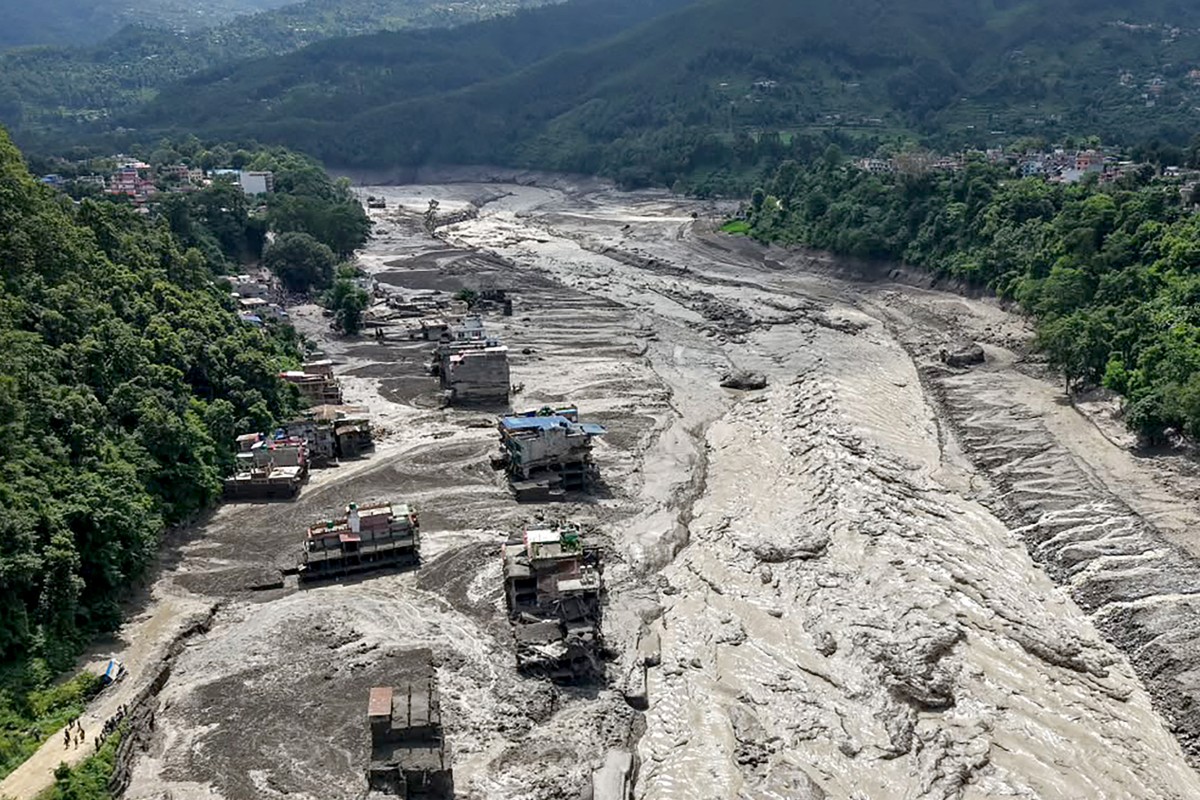
On Wednesday, August 26, unprecedented flash floods and mudslides hit the border areas between Nepal and Tibet, with scenes of devastation that left pilots witnessing waves as high as 6 meters. This disaster has resulted in at least 95 deaths and over 600 people missing, as the floods destroyed villages and caused severe damage to roads and infrastructure.
Among the missing tourists were citizens from India, Nepal, the United States, the United Kingdom, South Korea, Malaysia, South Africa, Australia, and the Netherlands.
The floods struck the Rasuwa region north of the Nepalese capital, Kathmandu, on Wednesday. Preliminary reports suggest that the floods were triggered by an avalanche caused by an earthquake, leading to melted snow surging into the Bhote Koshi River.
Helicopter pilot Aman Budathoki witnessed the deadly flash floods from the air, estimating waves as high as “five to six meters.”
“About five minutes before landing, we saw dust rising from the river,” Budathoki told CNN. “Initially, it looked like a landslide. We even speculated if the military was using explosives for road construction.”
However, within seconds, Budathoki saw dark waters carrying a large amount of debris rushing down, mixing with the clear river water.
“We could see water waves as high as five to six meters… We started hovering over local villages, where we could see large trees and some vehicles being swept away by the flood,” he said. “It was a very terrifying scene. We even tried following the flood for a while just to assess the disaster unfolding.”
He concluded by stating that he had never witnessed the power of nature displayed in such a violent manner before.
According to Nepalese military sources, rescue operations have been initiated on both sides of the border, with 88 people already rescued.
Tibet also felt the impact of the floods, with official Chinese media warning of possible “significant casualties.” Mudslides hit the Tibetan entry port of Gyirong, a crucial land border crossing between China and Nepal which suffered severe damage in this incident. The port has been developed as a key trading hub for China and Nepal, regarded by Beijing as an important node under the “Belt and Road” global connectivity initiative.
Videos shared on social media platform X by Reuters depict the scenes of the devastating floods hitting Nepal and Gyirong in Tibet, resembling an apocalyptic scenario with buildings and people disappearing in an instant.
Several downstream areas along the Bhote Koshi River that flows from Tibet into Nepal are now on high alert. Local transportation, communication, and power supplies have been affected. Authorities have announced the closure of the main highway leading to Kathmandu.
A Chinese businessman, Yee Liang, based in Kathmandu, informed the BBC that his logistics company had seven container trucks with Nepalese employees in the affected region.
“We have lost contact with all of them. There is no signal there, so we cannot reach anyone,” he said.
“To my knowledge, there were no warnings before the incident. Landslides and mudslides occasionally occur in the area, especially during the rainy season, but this situation appears to be much more severe this time.”