
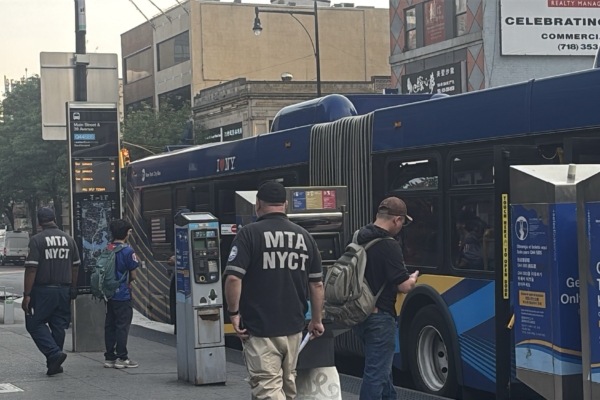
New York City Mayor Mamdani advocates for making buses in the city free of charge. However, the reality is that many passengers already treat buses as if they were free. Ms. Qing Lan, a frequent Chinese rider on the Flushing Q44 bus, told New Epoch that she sees people skipping fare payment almost every day. The latest data from the Metropolitan Transportation Authority (MTA) also shows that the fare evasion rate on New York City buses has reached nearly 50% in the first half of this year.
According to the MTA’s most recent data, from January to June this year, approximately 48% of bus riders in New York City did not pay the fare, remaining consistent with the fourth quarter of 2025 and increasing from the previous 44%, meaning that almost every two passengers, one did not pay the fare.
This situation has posed a significant challenge for the MTA. The agency had hoped to reduce bus fare evasion by about 2% this year through a series of reforms, but the results have not met expectations.
Bloomberg reported that Neal Zuckerman, Chairman of the MTA Finance Committee, acknowledged the appeal of free buses from a political and burden-easing perspective, but he believes now is not the right time. He pointed out that merely discussing free buses has already impacted the MTA financially because people are beginning to perceive buses as inherently free.
Fare evasion also directly impacts MTA revenue. Documents show that bus farebox revenue in the first half of this year was $35.7 million less than budgeted. However, despite the significant fare evasion, the MTA still generated about $850 million in revenue from bus fares last year.
Earlier this month, Mayor Mamdani, along with the MTA and New York State Governor Hochu, announced the “Faster Buses Plan,” which includes measures such as the addition of dedicated bus lanes, improved traffic signals, and expanded all-door boarding to enhance bus efficiency, but it does not include making buses entirely free of charge. Mamdani emphasized that he will continue to push for free bus policies, believing that transportation should not be a burden on people’s lives.
During the pandemic, the MTA temporarily allowed free bus rides in New York City. By the end of 2020, about 23% of passengers did not pay the fare. The fare evasion rate then continued to climb, reaching a historical high of 50.6% in the second quarter of 2024. Strengthening enforcement, the MTA managed to reduce the fare evasion rate to 44% in the third quarter of 2025, but it surged back close to half afterward.
Jai Patel, Chief Financial Officer of the MTA, admitted that the agency had expected fare evasion to continue improving, so they had included higher fare revenue in their financial planning, but the actual improvement rate fell far below expectations.
To combat fare evasion, the MTA has deployed unarmed inspection personnel known as “Eagle Teams” to conduct random checks on buses. They not only issue fines to fare evaders but have also started using handheld devices in the past two months to directly scan passengers’ phones to confirm payment, similar to public transportation inspection systems in many European cities. The MTA hopes that this will further reduce fare evasion rates.
Regarding the idea of free buses, Mamdani’s camp believes that it is one of the essential measures to address the high cost of living in New York. Mayor’s spokesperson Jeremy Edwards stated, “If people can’t even afford bus fares, it reflects the crisis of the cost of living in New York. Citizens should not have to choose between taking the bus to work, sending their children to daycare, and paying other bills.”
However, if bus fares were indeed completely eliminated in the future, the state government, city government, and the MTA would have to find new sources of funding to fill the gap, especially since the MTA still has a $16.2 billion debt burden, a substantial portion of which relies on subway and bus fare revenue for repayment.
Ms. Qing Lan, a Chinese resident in Queens, almost rides the Q44 bus every day. She noted that fare evasion has become almost a norm on this route, especially for the Q44 Select Bus, which has three bus doors, making fare evasion even more prevalent. She expressed her concerns that even though she has noticed increased ticket inspections by the MTA, with encounters with inspection personnel twice in the past ten days, fare evasion still persists. She believes that relying solely on random checks is insufficient to address the problem.
Regarding the MTA’s plan to expand all-door boarding, she expressed skepticism. “While allowing boarding through all doors may speed up the process, how will fare collection be managed?” She believes that without an effective ticket inspection mechanism, it will only exacerbate fare evasion issues.
Ms. Qing Lan argues that fare evasion is not just a matter of money but a social order issue. “Law-abiding citizens pay, while others evade fares, which is clearly unfair. What is more crucial is that if everyone does not follow the rules, it damages the overall social atmosphere.”
Regarding the Mayor’s proposed free bus policy, she unequivocally opposes it. She is concerned that once fares are entirely removed, the bus environment will deteriorate further. “After becoming free, the buses could become dirtier and chaotic, and some people may even see buses as a place to sleep or hang out, eventually turning into something like a shelter.”
She believes that solving the fare evasion problem is not simply a matter of increasing ticket checks but more about fostering a sense of legal compliance among the public and establishing social order. “Without a concept of rule adherence, fare evasion will be challenging to stop no matter how many checks are conducted.”