
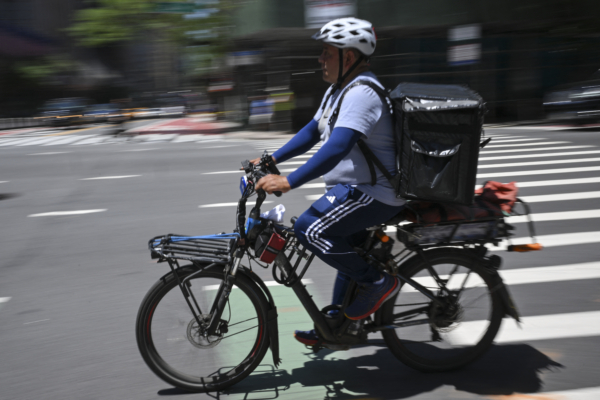
On July 29th, New York City Mayor Mamdani and the Commissioner of the Department of Consumer and Worker Protection (DCWP), Samuel Levine, released a latest report revealing the success of the city government’s crackdown on deceptive practices such as hidden tips by delivery platforms since January this year. According to the report, over 70,000 delivery workers in the city have collectively gained more than $104 million in tip income. However, Chinese delivery workers have not felt the increase in tips; on the contrary, their earnings are declining.
Since the implementation of the new transparency regulations for tips in New York City on January 26, 2026, delivery workers have seen their tips “double”. The city government stated that this enforcement action will bring an additional $184 million in income for delivery workers annually, averaging about $2,287 per worker per year. Furthermore, with the combination of minimum wage guarantees and tip income, the average total hourly wage for delivery workers has significantly increased from $10.48 at the end of 2023 to $27.32, a growth of 161%.
However, a random survey conducted by this newspaper interviewed two Chinese delivery men who work for delivery platforms established by Chinese immigrants and local American platforms. Their accounts starkly contrasted with the city government’s statements, with one saying, “Now I can’t even earn a penny in tips”; and another remarking, “It feels like the delivery platforms are squeezing us more than before”.
Mr. Hu, a delivery worker on a Chinese food delivery platform for five years, mentioned that before the new policy, a portion of the meal price paid by customers explicitly included a tip. This means that customers saw a mandatory tip portion in the meal price, and when the platform paid workers, there was a clear distinction between “company pay” and “tip”.
“At that time, tips accounted for more than 50% of my income,” Mr. Hu said. “Now the policy has changed. When customers place orders, there is no longer a separate ‘tip’ item, and in reality, I may not receive a tip for half a month.”
Mr. Hu suggested that perhaps due to his experience, he received some preferable business from the company, so his income did not significantly decrease but definitely did not increase.
“The city government’s claim of ‘doubling tips’ is definitely not true. They did not consider the detailed structure and calculation methods of platforms,” he said. “But regarding tips, previously, 100% of orders had tips, but now, I might receive a tip only once a month.”
Another former delivery worker on a Chinese food delivery platform, now employed with an American platform, Mr. Chen, explicitly stated that his income has decreased rather than increased.
“I disagree with the government’s claim; in fact, I feel that the platforms are now more exploitative than before,” Mr. Chen said. “These platforms always find ways around government policies. Whenever the city announces a new policy, platforms introduce multiple ‘penalty systems’; last year, I could receive $100 orders, but this year, they are non-existent. I haven’t heard of people around me earning more tips; we only know that our current income is lower.”
However, Mr. Chen mentioned that the delivery industry is truly one where diligence leads to prosperity. As an example, working 12 to 13 hours a day, even without tips, he can rely on the minimum wage and still make five to six thousand dollars a month. “If a couple works in delivery, buying a house is not a problem,” he said.