
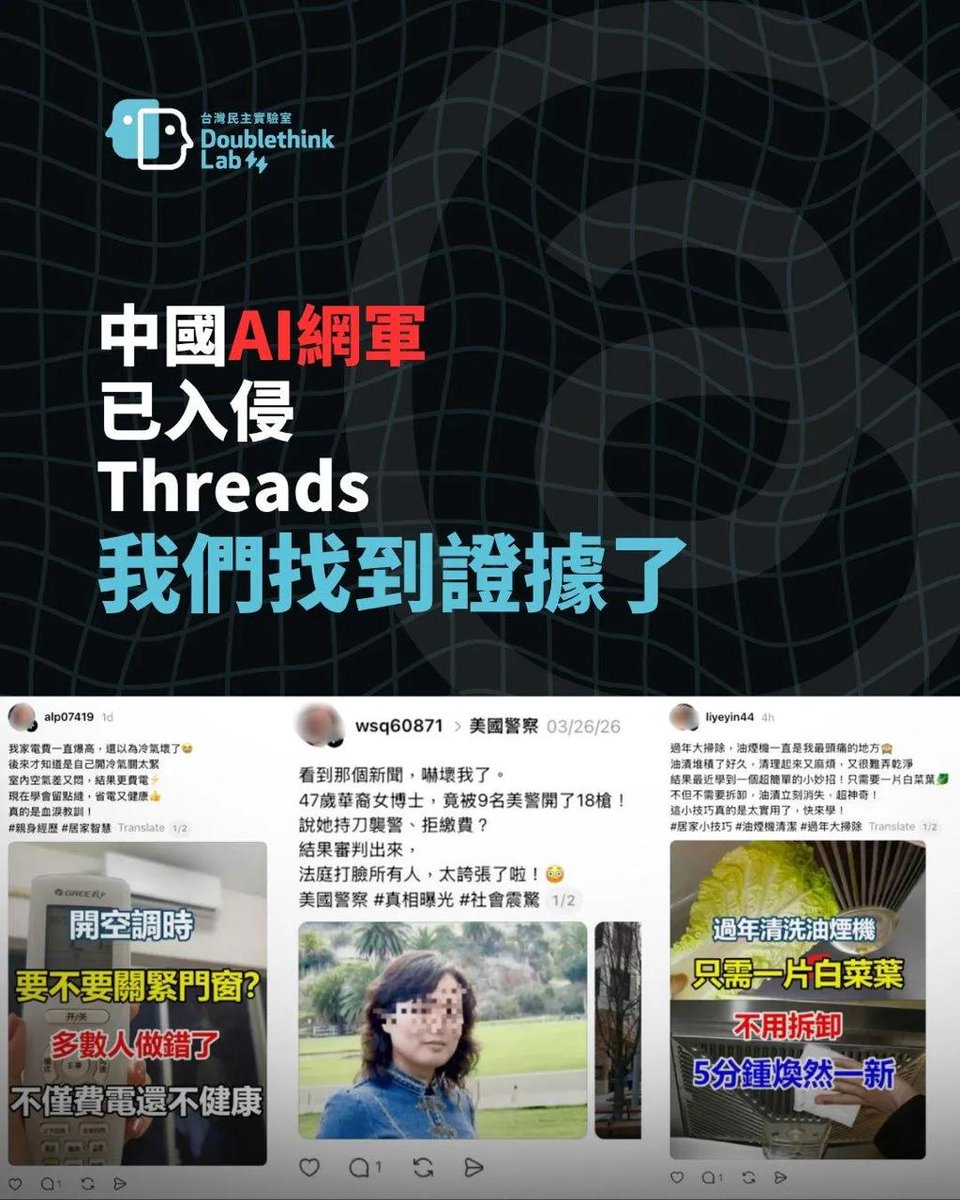
Recently, a report released by the Taiwan Democracy Lab in June exposed the “Borderless Group,” a Chinese network company with ties to the Chinese Communist Party (CCP), using bulk accounts, automatic posting, and imitation news websites to establish a dissemination network on the Threads platform. These accounts had increased political posts during the election period, and the related accounts, websites, and automatic posting systems were found to be used for CCP’s influence operations against Taiwan.
According to the report, the “Borderless Group” is headquartered in Qinhuangdao, Hebei Province, China. Researchers identified that out of the 1217 fake news website domain names operated by the group, 475 are still active, with content primarily in Traditional Chinese, as well as Japanese, Portuguese, and small amounts of English, German, Finnish, and Czech versions.
Mr. Zhao, a research fellow in Taiwan’s Internet information research, told reporters, “Initially, we found that these accounts used entertainment news, life tips, and sensational content to attract clicks from netizens. They also used cyber troops to like their own posts, creating interaction. After reaching a certain number of followers, they started mixing in political content, using tactics like pretty girls dancing, elderly people dancing to attract netizens of different ages, and then playing songs praising the CCP, trying to make Taiwanese users familiar with these tunes in an attempt to mislead them into pro-CCP sentiments.”
The report identified 549 fake Threads accounts related to the group, with creation dates ranging from July 2023 to February of this year, collectively publishing at least 467,547 posts and replies, with 83% aimed at directing users to websites controlled by the group. These accounts primarily targeted users in Taiwan and Japan.
The network was found to exhibit characteristics such as mass account creation, content duplication, and automatic posting. Just in August 2024, 176 accounts were created. 97.72% of fake accounts had published content identical to at least one other account, with some posts’ summaries appearing to have been generated by artificial intelligence.
These accounts mainly posted entertainment gossip and easily shareable internet materials, with some content directly taken from Taiwanese and mainland Chinese media. The accounts reposted and interacted with each other to redirect real users to websites filled with advertisements. The Taiwan Democracy Lab classified such behavior as coordinated deceptive activities.
On average, related posts received 65 likes, with over 1000 likes for 4338 posts, and a single post reaching as high as 1.2 million views and 90,000 likes. Approximately 566 real Threads users had shared links related to the group’s domain, exposing the content to authentic users’ feeds.
Chinese network engineer Li Xiangqun told reporters, “Internet propaganda has become the most important tool for the CCP against Taiwan. Many contents on Xiaohongshu, Douyin, and WeChat videos are designed specifically for Taiwanese netizens. They can use Mandarin, Hokkien, and AI technology to create many videos and establish cultural identity with Taiwan people. A friend of mine just quit this job because all they did was deceive people all day, feeling it had no future.”
The report revealed that out of the 467,547 posts, only 1779 were related to political issues, accounting for less than 0.4%. The related content was not unified in stance, featuring posts criticizing both the Democratic Progressive Party in Taiwan and the CCP, in contrast to past networks continuously attacking a single target in information manipulation.
The Taiwan Democracy Lab pointed out that the “Borderless Group” had previously increased political content during election periods. With local elections in Taiwan approaching this year, the network might once again escalate related posts.
The report suggests a verifiable historical association between the group and the CCP government, with existing accounts, websites, and automatic posting systems posing risks for political purposes.
The cited associations include CCP officials visiting the group to discuss overseas media broadcasting issues; the group had also collaborated with Qinhuangdao Radio and Television Station and engaged in operating related enterprises.
Some netizens commented on the news, stating that the CCP’s cyber troops often use the tactic of “criticizing small matters while helping on bigger issues.” Accounts might outwardly criticize the CCP or Xi Jinping but only touch on permitted minor issues, aiming to build credibility, conceal their identities, skirt larger CCP responsibilities.
These accounts do not need to maintain a unified political stance. Some accounts may support the CCP, criticize the CCP, or appear as ordinary Taiwanese users. This mixed stance makes it harder for platforms and users to identify the source of accounts based on individual posts, leaving room for changing directions during political missions.
Li Xiangqun stated that this is a cognitive battle launched by the CCP against Taiwan: “An account criticizing the CCP doesn’t mean it’s not a CCP cyber troop. People doing this kind of propaganda might criticize a few officials, policy shortcomings, or some social issues, or even use harsh words against Xi Jinping deliberately to attract anti-CCP individuals. However, they generally avoid the legality of the CCP regime, how power functions, how it persecutes people, or how it expands externally until they’re ready to shift the narrative, relying on reposts, selectively reporting certain content, or inciting emotions to divert attention as they wish.”