
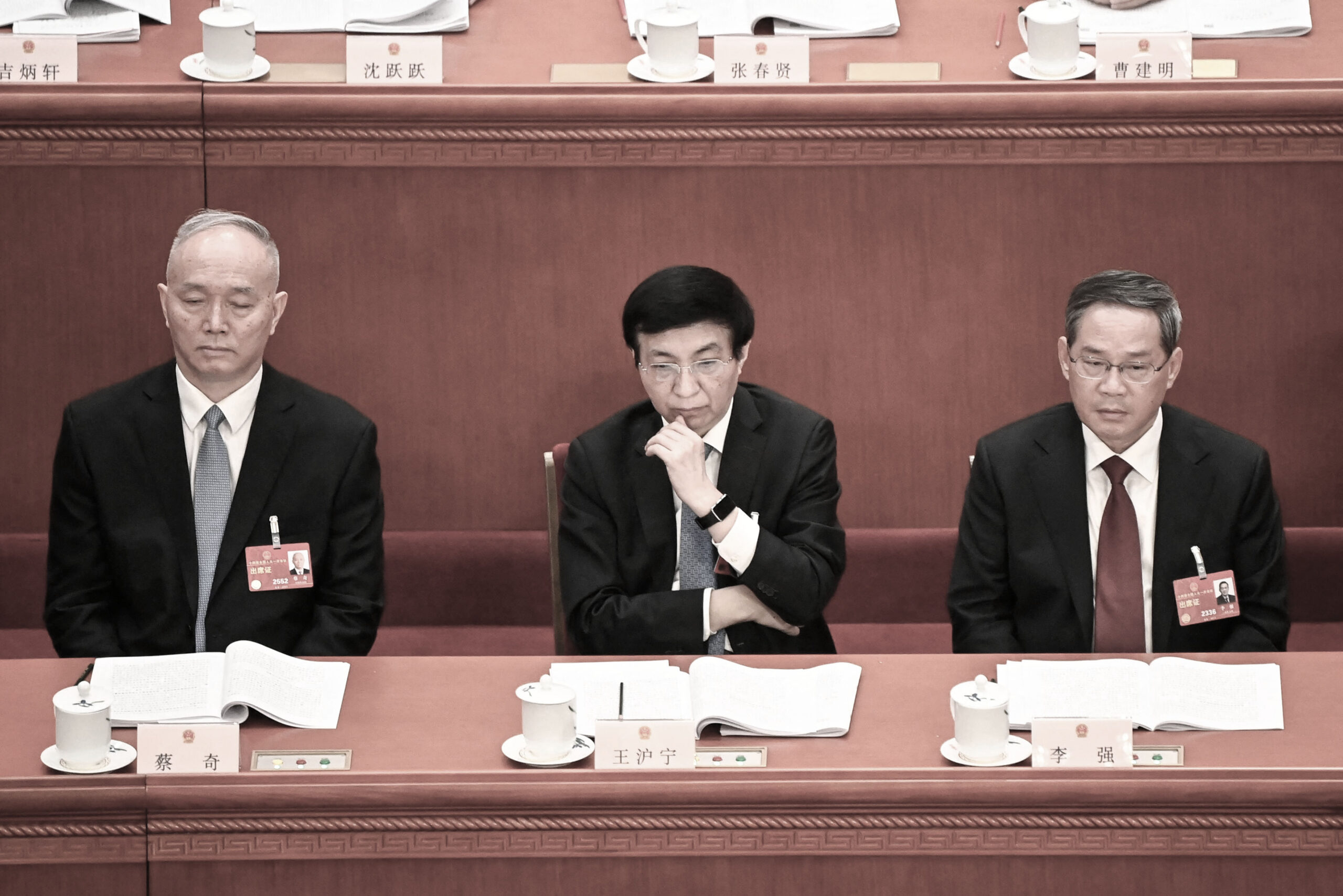
The Chinese Communist Party (CCP) has recently announced plans during its 20th Central Committee’s fifth plenary session that the significant 21st National Congress will take place in the latter half of 2027. Commentators suggest that, traditionally, such announcements are made during the sixth plenary session. This shift indicates that the political arrangements within Zhongnanhai—the political hub of China—are advancing more rapidly than expected, revealing various internal strategies among high-ranking officials.
Independent commentator Du Zheng published insights on this development, analyzing the situation surrounding personnel assignments for the upcoming 21st National Congress. He notes that different factions within the CCP leadership are formulating their own strategies in light of the anticipated shifts in power.
An important aspect of the fifth plenary session’s discussions was a focus on intra-party democracy. The session emphasized that party leaders should not adopt authoritarian practices or familial control over decision-making. This focus could be interpreted as a retreat on Xi Jinping’s part, who has historically been wary of party democracy. He had previously criticized discussions surrounding intra-party democracy as “strange theories,” indicating a potential compromise to garner support for his re-election in 2027.
During this session, Xi also made a strategic decision to appoint Zhang Shengmin, the Vice Chairman of the Central Military Commission, to the Politburo. This move appears aimed at consolidating military support while simultaneously sending a warning to other party members against destabilizing actions. Du Zheng posits that Zhang has his own ambitions and that Xi may be naïve to rely on him for military personnel decisions, which could crystallize the emergence of a faction loyal to Zhang.
Further, Du Zheng examines the ambitions of other prominent CCP leaders. For instance, Li Qiang, the current Premier, is widely speculated to retain his position going into the 21st Congress. Xi has not positioned a successor, and in the event of his sudden departure, Li would traditionally be the first in line. However, Li faces significant vulnerabilities due to recent revelations about his family’s financial dealings, including allegations involving his wife Lin Huan, who has been accused of leveraging his political connections for personal gain.
Additionally, the exposure of Li’s daughter, who is rumored to have ties with Xi’s family and is thriving in a construction design firm backed by her father’s influence, could pose a threat. Du Zheng believes that the focus on combating familial corruption within leadership ranks, highlighted in the fifth plenary session, could serve as an avenue for political adversaries to launch attacks against Li in the critical period leading up to the 21st Congress.
Another senior official, Zhao Leji, born in 1957, has served two terms and is anticipated to retire. Du Zheng indicates that Zhao desires assurances from Xi to avoid scrutiny regarding his involvement in corruption cases, notably the notorious Qinling villa scandal and interference in judicial matters linked to a significant mining rights controversy in Shaanxi. While Zhao’s retention in the Politburo during the last Congress was seen as a compromise for Xi’s reelection, his complete retirement could expose him to attacks.
Wang Huning, born in 1955, is also unlikely to stay on as a standing committee member for the 21st Congress. Instead, he may seek a position as Vice President. Despite potential retirement, Du Zheng suggests Wang might pursue a model of semi-retirement, continuing to wield influence behind the scenes given his experience and loyalty.
Du also points out that Cai Qi, also born in 1955, might aim for another term in the Standing Committee. The fifth plenary’s insistence on personnel selections based on capability rather than age likely reflects considerations for older officials seeking extended tenure, aligning with Cai’s support. Nonetheless, Cai’s prospects could be undermined by allegations concerning his son’s involvement in corruption tied to corporate interests.
The youngest Politburo Standing Committee member, Ding Xuexiang, who was born in 1962, has been seen as a candidate to retain his position. With Xi’s declining health, Ding reportedly hopes to position himself as a successor, emulating how Mao Zedong designated Hua Guofeng prior to his passing.
Recent developments have also seen Ding’s associate, Zhu Hexin, the head of the State Administration of Foreign Exchange, overlooked during the fifth plenary’s appointments due to reporting from unknown sources, further complicating Ding’s standing.
Li Xi, born in 1956 and serving as Secretary of the Central Commission for Discipline Inspection, faces potential retirement amidst personal and professional controversies. Allegations from his tenure in Guangdong could result in punitive measures against him if significant scrutiny continues.
Du Zheng concludes his analysis by noting that high-ranking officials are likely engaged in intense strategizing as they prepare for the 21st Congress, with the outcome remaining uncertain until the very last moment. He expresses that in the realm of politics, plans are ever contingent on unforeseen developments, highlighting that if the CCP were to suddenly dissolve before their scheduled congress, the event would naturally not occur.