
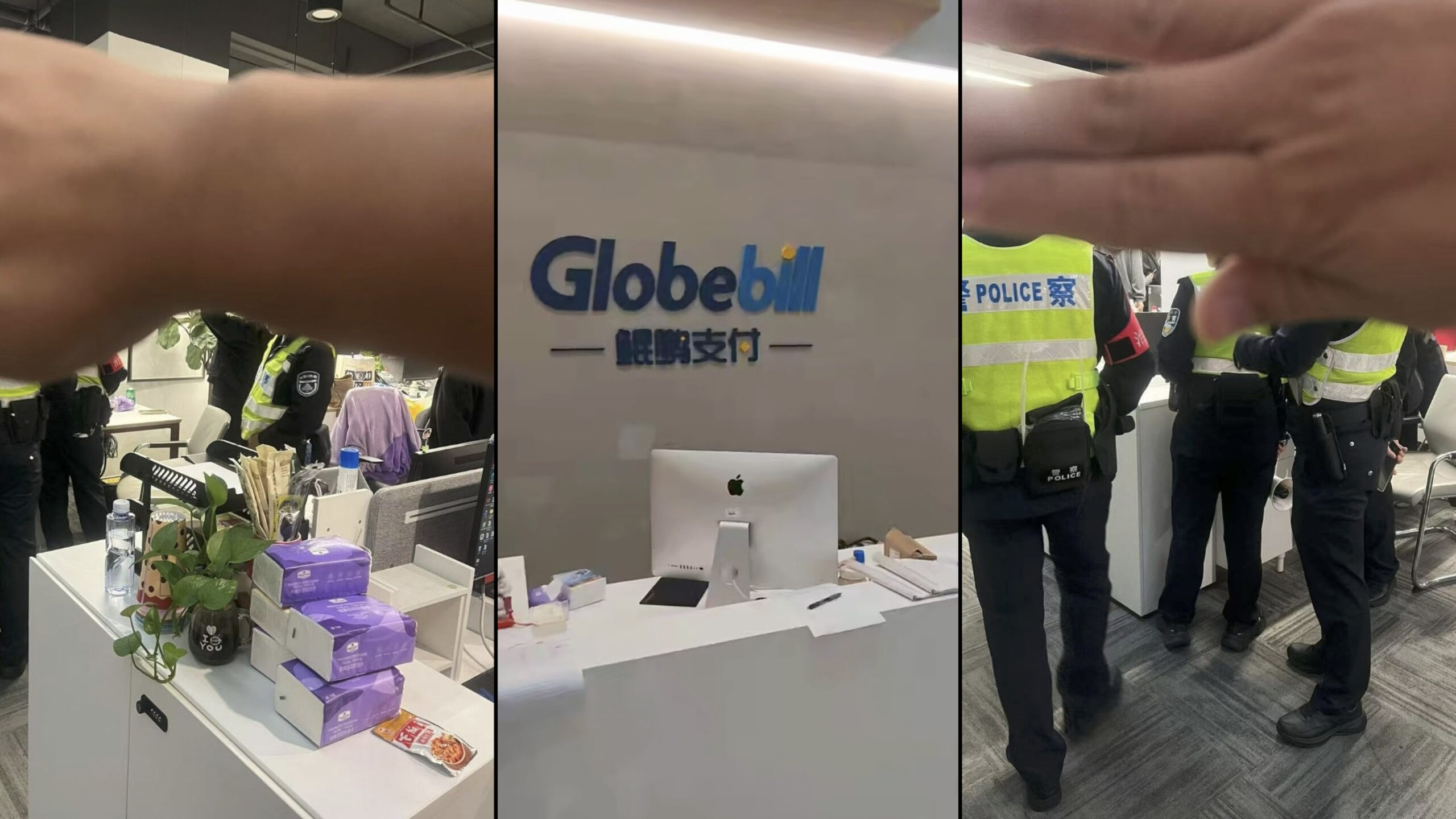
On November 5, a dispute over merchant rights erupted in front of the People’s Bank of China’s Chongqing branch located in the Liangjiang New Area. The incident was triggered by a crisis involving the licensed third-party payment company, Kunpeng Payments, which faced a severe funding shortfall that left merchants questioning the adequacy of central bank oversight. In response to their concerns, a number of merchants organized a protest, only to be met by police, resulting in the detainment of several individuals.
Industry analysts have suggested that this event may be linked to a breakdown in Kunpeng Payments’ financial operations, highlighting the payment industry’s reliance on licensing, transaction fees, and credit card cash-outs as profit-generating mechanisms. This situation mirrors the increasing debt pressures faced by the public amid economic downturns.
Since October of this year, Kunpeng Payments has been embroiled in a widespread funding non-availability crisis, with merchants reporting receivables that range from thousands to hundreds of thousands of yuan being unpaid.
The crisis deepened when the company’s general manager suddenly resigned and rumors of “fund misappropriation” began circulating. In the following days, hundreds of merchants and agents from across the country gathered at the company’s headquarters in Chongqing, demanding accountability.
After several days of fruitless attempts to secure their payments, the merchants redirected their frustration toward the regulatory authorities at the People’s Bank of China in Chongqing on November 5. Their protests, however, were met with additional police presence, leading to the removal of several protestors from the scene.
As the wait for a resolution stretched on, the mounting frustration among creditors led them to seek answers from regulatory agencies rather than from the company itself, although the scale of the debts remains unclear without official figures.
Zhou Hongwei, an agent from Zhengzhou in Henan Province, recounted that upon arriving in Chongqing on November 2, he found the protest attended by at least several hundred people, with the number likely to grow.
“The situation has been dragging on, and they keep delaying and placating us. Many agents are missing funds in the millions, even over ten million yuan. Personally, I’m short a few tens of thousands,” Zhou explained.
He noted that most of the claimants were agents, with some merchants also represented, as agents were more familiar with the payment operations and financial settlement processes, and thus took the lead in advocating for merchants’ rights.
At present, there are no precise official figures available, but Zhou estimates the total amount involved to be around 500 million yuan. He also shared a rumor circulating in the industry that Kunpeng Payments had approximately 50 million yuan in reserve at the bank, a sum that is manifestly insufficient given the overall debts.
“Fifty million is a drop in the ocean compared to the size of this deficit. It’s far too little,” Zhou stated.
Jiang Mingyuan, a service provider from Huaian in Jiangsu Province who does not work with Kunpeng Payments, informed sources that as of the 26th of last month, significant deposits had yet to be processed, estimating that the amount of unpaid funds could exceed hundreds of millions.
“The key concern for merchants is whether they can reclaim the transaction amounts that have already been finalized, which hinges on the payment company’s settlement mechanisms and how relevant regulatory bodies will handle the situation,” Jiang commented.
Opinions differ among those interviewed regarding the whereabouts of the funds. Zhou believes the issue is not merely due to delayed bank settlements, but rather that the payment company has failed to disburse funds to merchants after receiving the settlement amount.
“The money has already reached their company, but due to internal problems, they refuse to pay us merchants. The money is stuck in their system,” he elaborated.
This predicament places merchants in a double bind: consumers have completed their payments, yet merchants cannot access their revenues. Meanwhile, merchants and agents lack direct channels to trace the flow of funds, forcing them to perpetually pursue resolution through the payment company and regulatory authorities.
In contrast, Jiang argues that the core issue likely lies in the breakdown of Kunpeng Payments’ financial chain, which has left the company unable to generate necessary funds for quick settlements. Drawing from his years of experience in the industry, he explains that after a merchant swipes a card or scans a payment code, the funds do not immediately transfer to the payment company director’s personal account, thus refuting claims that a company leader absconded with all funds overnight.
He noted that payment companies typically need to have sufficient capital on hand to facilitate immediate settlement services for merchants. If a payment company lacks adequate funding, settlements can be delayed even after transactions are completed.
Recalling an incident from March of this year when Kunpeng Payments was fined 10 million yuan for regulatory violations, Zhou suggested such a penalty would not suffice to precipitate a breakdown in financial operations for a large-scale payment company.
“Ten million is relatively small change for these payment companies; they can manage that. After all, Kunpeng has significant business volume and is licensed,” he remarked.
Zhou believes the current payment shortfall is more likely related to internal management or financial issues within the company. “Later, internal issues caused a financial breakdown, leading to this situation. No one dares speak out about the specifics,” he noted.
Regardless of the underlying cause, the intervention of regulatory agencies has left creditors awaiting solutions, a process characterized by prolonged delays.
Zhou remarked that police, local government officials, and representatives from the central bank have engaged in the situation but have largely focused on registration and coordination rather than offering concrete solutions.
“Every day there’s new registration, more coordination, another request for us to come back. Honestly, they are just placating the agents; there’s still no result,” he stated.
He acknowledged that no one can currently ascertain whether the company will be able to resume normal operations or if merchants will ultimately recover their funds.
“At the moment, no one can gauge whether there’s hope or not; we can only wait for their side. It’s agents pressing them to respond,” he explained.
Regarding the scene on November 5, Zhou described the presence of roughly twenty police officers, with most participants being agents and relatively few direct merchants. He expressed concern that any potential conflict during the rights protection process would only complicate resolution.
Nevertheless, he remains disappointed with the lack of tangible progress following the regulatory intervention.
“Agents have registered and met with the central bank, but we have not received a confirmed timeline for repayment nor any concrete measures to resolve the funding gap,” Zhou said.
Jiang revealed that he had sent friends to Chongqing to assess the situation, largely due to concerns that after the company goes under, existing revenue shares may cease to be distributed.
He speculated that the company might gradually resolve the issues of unpaid debts through transaction verification, asset liquidation, and by seeking potential buyers; however, the ability for merchants to recover their funds remains contingent on the company’s asset management and actual repayment capabilities.
Adding to the agents’ worries, it is reported that Kunpeng Payments’ operational license is set to expire in December of this year. If the company fails to rectify its current debt situation, the question of its ability to renew its license looms as a new variable.
Zhou noted, “If the license can’t be renewed, the funds may well be lost. If it can be extended, there remains hope. After all, they need to continue their business.”
He also recalled a similar funding crisis in 2024 involving a payment company called “Jin Kong,” which allegedly absconded with client funds. Over two years have lapsed, and some clients still have not recovered their money.
This precedent has heightened anxiety among both agents and merchants of Kunpeng Payments. If the company’s financial chain breaks down completely, subsequent collection efforts could devolve into a long-term battle.
The unpaid funds from Kunpeng Payments affect not only merchants directly using POS machines but also pose risks to the agents responsible for promoting and facilitating business.
Zhou underscored the fact that many clients do not understand the relationship between payment companies and agents, leading them to believe that if funds cannot be processed, the agents ought to offer reimbursement.
“Some clients think it’s an agency issue and demand that agents compensate them for unpaid funds. This type of customer is prevalent,” he described.
He continued, indicating that agents are also victims in this scenario, facing not only the burden of the debts owed by the payment company but also the pressure of being held accountable by customers who are demanding restitution. Some agents may find themselves compelled to exit the industry entirely, particularly if they are unable to honor customer financial obligations.
“To illustrate, some agents may have substantial amounts, in the millions, tied up in this. If something goes wrong, it’s likely that they will withdraw from the industry immediately. Normally, even a few hundred thousand yuan is beyond what many can afford to lose,” Zhou observed.
He particularly emphasized that some clients facing financial difficulties might consider even a few thousand yuan as vital to maintaining their household.
Zhou reminisced about a female client from two years ago, who was unable to secure a loan due to credit issues and had to use another person’s credit card, only to find that about 7,000 yuan of her charges had not been processed.
“She told me that she was counting on that few thousand yuan to cover her expenses; with two children and an elderly family member at home, it truly saddened me to hear her struggles,” he recounted.
Among the clients Zhou has encountered, many have only one or two thousand yuan available while juggling mortgage payments, car loans, daily expenses, and caring for elderly relatives. “An ordinary person makes about three to four thousand yuan a month, and the pressure is immense,” he articulated.
The Kunpeng Payments incident also exposes the intricate profit chains behind the third-party payment industry.
Jiang explained that the licenses issued for payment services by the central bank hold high market value, with some licenses trading for hundreds of millions, and those for larger companies exceeding one billion.
He noted that at one time, the total number of payment companies reached several hundred in the country, but there are currently nearly two hundred licenses active, with only a handful of major players like Lakala, Guotong, and Yinsheng holding market sway.
Unlike traditional physical businesses that require substantial investments in storefronts or production equipment, payment service providers primarily grow their market through merchant development, promoting POS machines and payment codes to earn a continuous share of transaction fees.
Jiang elucidated, “As long as the merchant collects money, you get your cut; for every ten thousand yuan they collect, you might see six to a dozen yuan in return.” He gave the example of agents with a long-standing presence and sizable client bases earning monthly incomes that can reach tens of thousands or even hundreds of thousands of yuan.
This model has created a layered profit distribution system within the payment industry. Payment companies provide the gateway, agents are responsible for market expansion, and lower-tier service providers rely on high transaction volumes from numerous merchants for long-term revenue sharing.
Zhou estimated that the national credit card cash-out market could be valued at over two trillion yuan, though this is a personal estimate and has not been substantiated by independent verification.
He noted that if used wisely, credit cards can address short-term funding needs, but over-reliance on overdrafts can plunge one into debt if income decreases or cash flow problems arise.
“Properly used, credit cards can lead you to wealth; mismanaged, they can lead to complete financial ruin,” Zhou cautioned.
Jiang believes that the crisis faced by Kunpeng Payments is not an isolated incident, but instead reflects broader issues such as increasing debt burdens on merchants and declining consumer spending in the current economic climate.
He observed that many physical stores that once thrived in his region are now being sold or closed, indicating a decline in commercial vitality compared to the past. “The overall environment is poor; jobs are hard to find, and making money is challenging,” he remarked.
Jiang also pointed out that falling real estate prices have left many families grappling with shrinking assets and burgeoning debts. The slump in property values not only diminishes household wealth but also exacerbates repayment pressures for those holding mortgages.
Concurrently, stagnating income growth and unstable employment further constrict daily consumption. He noted a noticeable decline in dining out among families who used to frequent restaurants.
To illustrate the impact on the financial system, he cited rising bad debts as a consequence of business failures and dwindling individual repayment capabilities, which heightens risks within the financial realm.
The chain of economic pressures is vividly illustrated in the journey from Kunpeng Payments’ merchants seeking owed funds, to payment agents worrying about revenue interruptions, and to consumers relying on credit card advances to keep up with repayments.
Those interviewed contend that while the payment industry initially revolved around merchant transactions and fund settlements, the risks quickly affect merchants, agents, and ordinary consumers once companies can no longer maintain their funding capabilities.