
The establishment of the blacklist for the “52 types restricted from exiting and preventing re-infiltration” is just the first step. Faced with the huge population and complex social relationships, how do public security authorities accurately “screen” these targets in the vast sea of people and implement monitoring and crackdown on them?
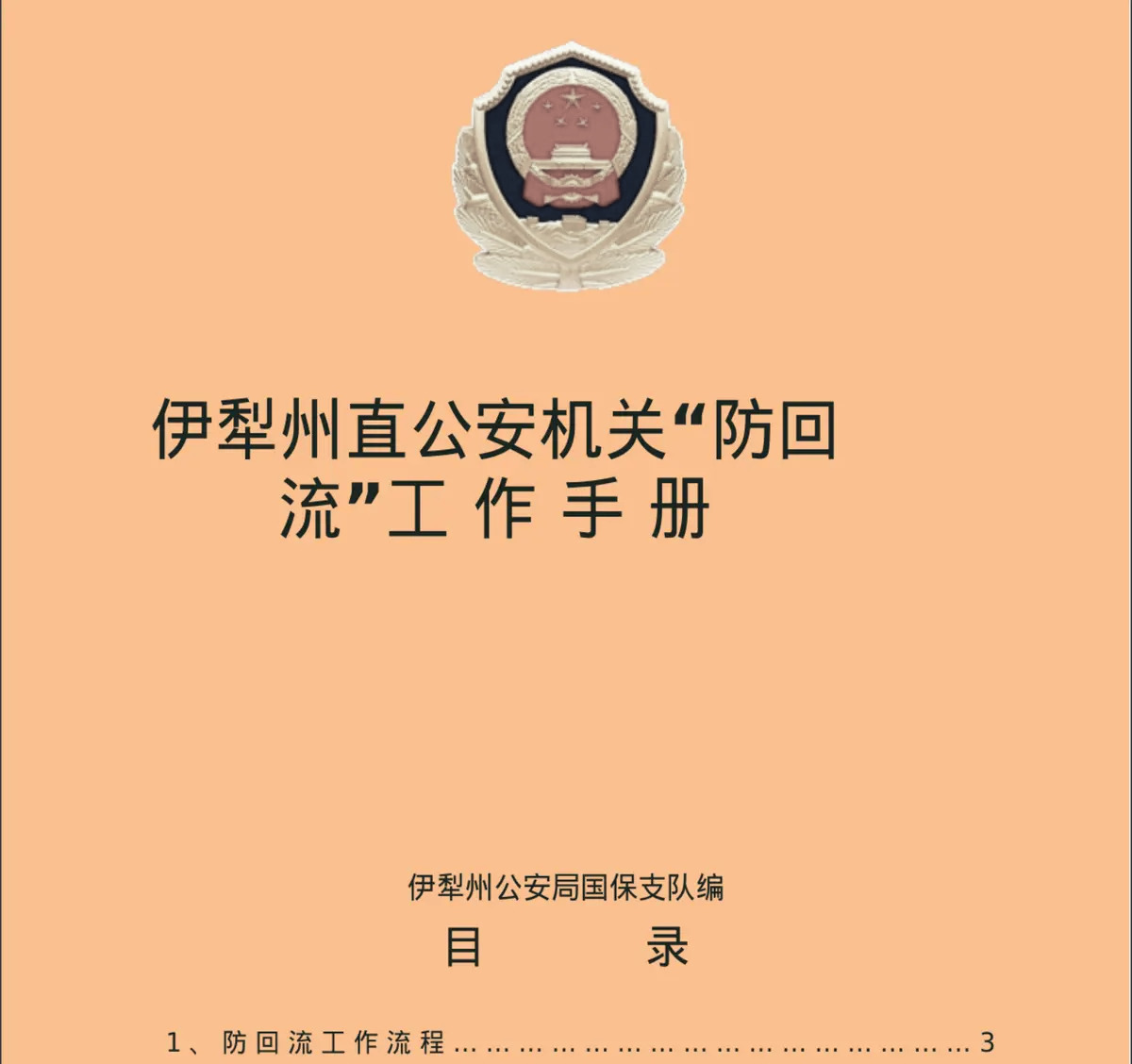
《Epoch Times》 has obtained a confidential document from the public security authorities in Xinjiang in 2017, titled “Guidebook on ‘Preventing Re-infiltration’ Work by Yili Public Security Bureau (2017)”. The document reveals that the Chinese Communist Party’s public security system has established a strict control mechanism combining big data penetration and grassroots grid personnel control.
This mechanism consists of three interlocking parts: “precision identification”, “key tracking and control”, and “judicial crackdown”, with its core goal being to cut off communication channels and funding channels between domestic and foreign entities, implementing the so-called “severing internal and external links” and “preventing re-infiltration”.
To accurately screen the 52 target categories from the massive population, public security authorities first initiate a dual-track inspection process of “online + offline”.
1. Online “electronic inspection”: Penetration of 7 major platforms with big data
According to the confidential flowchart provided by the Yili authorities, suspicious personnel data aggregated by the entry and exit department, national security brigade, border inspection ports, and police stations must be transferred to the “anti-re-infiltration task force” of the county public security bureau within 12 hours, and the task force must complete the “electronic inspection” within 3 days to support the subsequent “manual inspection” at police stations.
The so-called “electronic inspection” here involves utilizing 7 major network warfare systems including the “Integrated Joint Operations Platform”, entry and exit platform, national security platform, online operations platform, online comprehensive platform, anti-terrorism major intelligence platform, and technical investigation platform to comprehensively retrieve entry and exit records, photos, accommodation, internet cafes, online virtual identities, and communication data of the targets. Through the “electronic enclosure (base station) data”, they track the communication of the targets after entry, conduct technical reviews of online chat records, focus on investigating the activity trajectory, true intentions, and ideological dynamics of the targets for any “abnormalities” (note: abnormal here is according to the standards of the Chinese Communist Party).
2. Offline “manual inspection”: Frontal interrogation at police stations and special situation contacts
When clues are found during the online “electronic inspection”, the task force will issue instructions to grassroots police stations to initiate the offline “manual inspection”.
Upon receiving the instructions, police officers at the stations must complete preliminary investigations and report within 3 days, and summon the targets to the police stations for “frontal contact” within 7 days.
During this process, Chinese police officers, as per the requirements of the “Sensitive Country Personnel Verification List for Entry and Exit” listed in this confidential document, conduct detailed and intrusive “interrogation-style transcripts” on various individuals such as students studying abroad, business operators, medical seekers, and visitors, demanding extensive personal information.
For students studying abroad, they must disclose their school, major, provide names, phone numbers, WeChat IDs, QQ IDs, and addresses of all Uyghur students in their school, and the source of their study fees and overseas addresses.
For those engaged in overseas business or employment, they must disclose the overseas company names, partner and referral information, sources of goods, business situation, income, and personal bank account numbers.
As for those seeking medical treatment overseas, besides tracing hospital names, attending doctors, and medications, the Chinese Communist Party also requires them to provide the “paper-based medical records from domestic hospitals” for comparison.
For individuals visiting relatives or traveling abroad, the Chinese police meticulously investigate specific dates of overseas relatives’ settlement, social media accounts, tour guide information, source of funds, and travel itineraries.
In addition to the interrogations conducted at police stations, the police also deploy community and village work staff, as well as individuals closely related to the subjects under investigation, for additional information. When necessary, public security authorities directly deploy special situation operatives around the targets to collect in-depth intelligence through contacts.
When discrepancies are identified through cross-referencing the results of “electronic inspection” and “manual inspection”, the network switches quickly to a long-term dynamic control and tracing process.
1. Comprehensive background investigation and “90-day tracking and control” mechanism
After receiving personnel information statistics forms from the police stations, the “anti-re-infiltration task force” must input the information into the “Integrated Joint Operations Platform” within 2 days. Building upon the earlier dual-track inspection, the police will conduct a thorough background check on the subjects identified, including basic information, family members, domestic and foreign relatives, occupation, activities, personal and family impact handling situations, and commonly used phones and internet communication tools. Based on this, the task force will accurately classify the re-infiltration group into “monitored personnel” and “suspected personnel”.
Regular visits are required for general monitored subjects to dynamically assess their daily performance, social interactions, and travel intentions. Meanwhile, for “suspected personnel,” public security authorities will initiate a minimum of 90 days of tracking and control checks, monitoring their phone communications and online activities comprehensively to prevent unauthorized disclosures or private communications.
2. Dynamic monitoring of trajectories and routine assessments on a weekly/monthly/seasonal/yearly basis
This tracking mechanism involves long-term dynamic data cycling, requiring the police to constantly monitor the daily trajectories of target individuals, with relevant data being re-entered into the “Integrated Joint Operations Platform” within 2 days. Authorities are mandated to rigorously implement weekly, monthly, quarterly, bi-annual, and annual risk assessments on the re-infiltration groups, recording the assessment content in real-time on the platform to ensure dynamic adjustments to control strategies.
The ultimate goal of this “online screening, offline interrogation, long-term tracking and control” control mechanism is to crack down severely on what the Chinese Communist Party deems as “internal and external links” and “covert terrorism financing” individuals.
The communication records, base station trajectories, financial transactions obtained during “electronic inspection”, and exhaustive transcripts, special situation contact intelligence gathered during “manual inspection” are further expanded through the task force’s “deep analysis and judgment” process.
Once suspicions are confirmed, the leads are handed over to the national security brigade for investigation, ultimately transforming into legally valid judicial evidence. Public security authorities then conduct investigations, border closures, detentions, and sentencing in accordance with the Chinese Communist Party’s Criminal Law, Anti-Terrorism Law, and local regulations for crackdowns.
In May 2019, the international human rights organization, Human Rights Watch (HRW), released a groundbreaking investigative report titled “China’s Algorithms of Repression: Reverse Engineering XUAR Police Surveillance App”. The report meticulously described and analyzed a mobile application used by Xinjiang police and other officials, which connects to the Xinjiang “Integrated Joint Operations Platform” to collect various types of information from the public. The app targets individuals based on 36 behaviors, automatically pushing investigation orders to officers’ mobile devices.
The report suggests that this system surveils everyone, not only specific “terrorists”, indicating that counter-terrorism is not the core goal; the real purpose is to predict, control, and “engineer” the daily lives of the population.
The vast data collection process by the App and its algorithmic matching conducted by the “Integrated Platform” is the foundation of the data gathering and warning engine revealed in the Yili police’s confidential document on “anti-re-infiltration electronic inspection”.
If the report from 2019 unveiled astonishing technical details of Xinjiang police’s comprehensive public control, then the recent exclusive access obtained by Epoch Times to the Yili public security’s confidential document sheds light on the processes and means for the Chinese Communist Party’s entry and exit control in Xinjiang.
From receiving orders within 12 hours, completing the “electronic inspection” on 7 major platforms within 3 days, to the police officers conducting frontal interrogations and special situation contacts within 7 days at stations, and the re-entry within 2 days, a minimum of 90-day long-term tracking and regular risk assessments, these three confidential flowcharts present a model of “data screening – grid control – judicial crackdown”.
Under this mechanism, citizens’ personal privacy, asset flows, and social relationships are completely shattered and reorganized into risk indicators in the database. Any legal activities such as studying abroad, engaging in cross-border trade, seeking medical care, or visiting relatives may be deconstructed as “suspicions” detrimental to the security of the Chinese Communist Party under close scrutiny and algorithms.
With the implementation of the new version of the Chinese Communist Party’s “Entry and Exit Administration Regulations” and the upgrading of interrogation methods at various ports and police stations nationwide, both in terms of technological applications and control models, this network of entry and exit control practiced in Xinjiang is undoubtedly expanding across the country.