
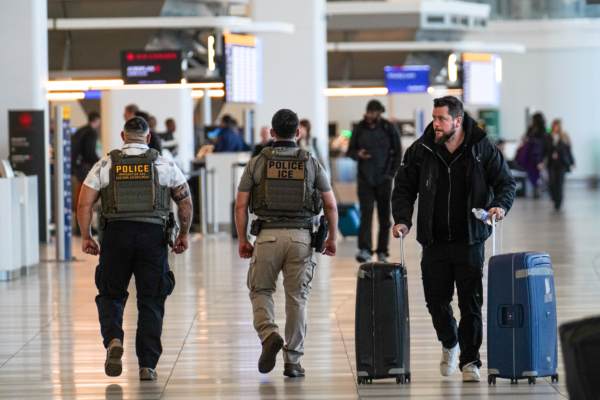
In the United States, the Immigration and Customs Enforcement (ICE) continues to intensify immigration enforcement at airports nationwide. Those with expired visas, pending asylum with C8 work permits are targets of enforcement. Recently, there have been multiple incidents where Chinese individuals waiting for asylum interviews or court hearings have been detained at airports, causing many to fear traveling across states and especially by air.
Their concerns are not unfounded. On the 20th, a Chinese individual with an expired F1 visa was detained by ICE at Newark Airport while on a business trip. His family had to urgently contact a lawyer to secure a restraining order for him. Immigration lawyer Zhang Jinrui, interviewed by this newspaper last month, advised individuals with expired visas or pending status not to travel by plane.
According to a report by Time magazine on August 19th, multiple airline boarding gate staff members have reported that ICE officers not only directly arrest passengers at airports but also ask airline staff to assist in locating or identifying specific passengers, providing passenger information from internal systems, and even requesting access to restricted areas such as boarding bridges and aircraft. ICE currently arrests around 20 to 40 people at airports per day, including passengers with expired visas and asylum cases still pending.
One significant factor behind the expansion of ICE airport enforcement is the increased sharing of passenger information among federal agencies. ICE has obtained passenger information from the Transportation Security Administration (TSA) through a previously undisclosed data-sharing program. According to a declassified memo released by the non-profit organization American Oversight, this mechanism allows ICE to access passenger names and dates of birth that they believe may be subject to immigration arrest.
Nayna Gupta, policy director of the American Immigration Council, stated that in the past, individuals who did not pose other public safety threats and were taking steps to ensure their status complied with immigration law requirements were not usually prioritized for deportation. She pointed out that the backlog of immigration cases and delays in processing could lead some applicants to lose their legal protections while waiting for their cases. With ICE expanding airport enforcement, airports are no longer just places where immigrants may face identity checks when entering or leaving the country; for passengers taking domestic flights within the United States with immigration status issues or cases still pending, airports themselves are becoming crucial sites for immigration enforcement.