
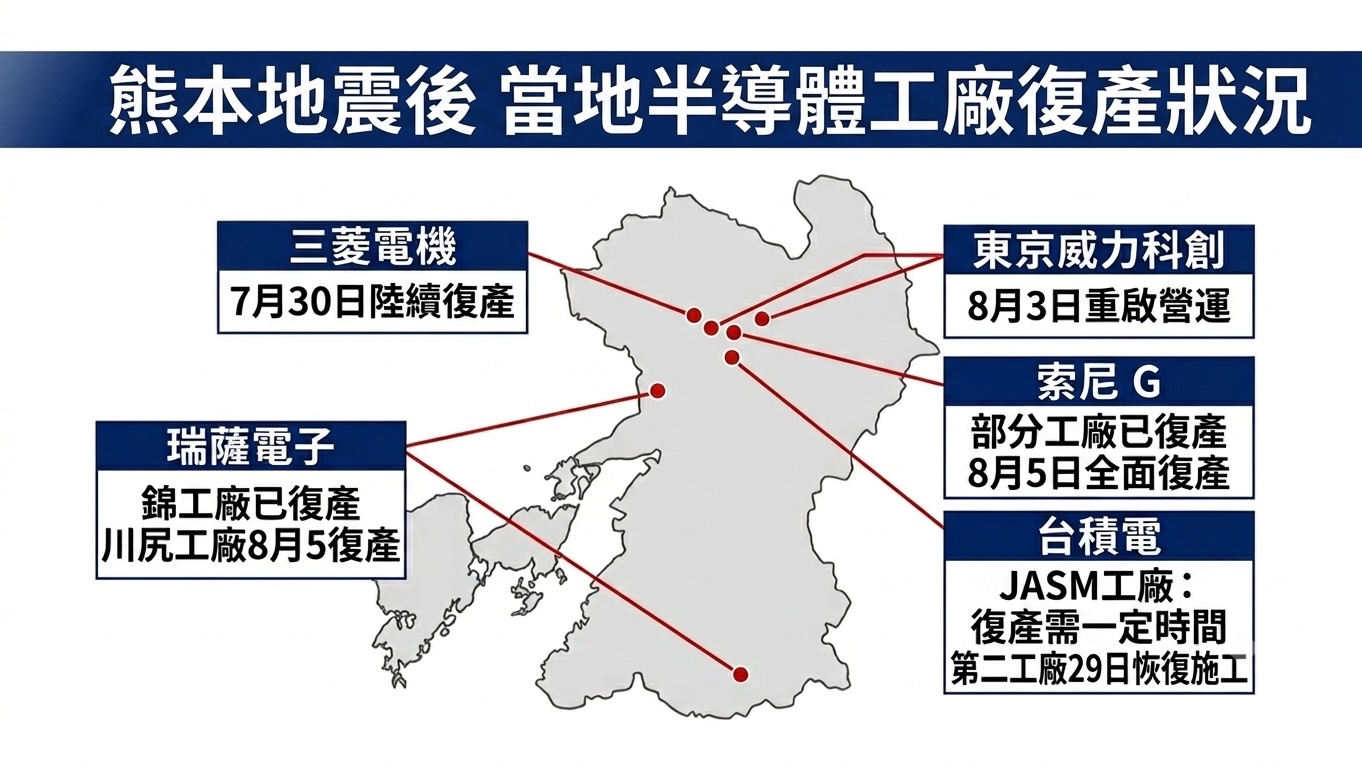
Japan’s Kyushu region, known as the “Silicon Island,” was hit by a powerful 7.1 magnitude earthquake in Kumamoto, impacting the semiconductor industry chain. Major manufacturers are rapidly conducting safety inspections and striving to resume production as soon as possible. Leading companies like Tokyo Electron and Sony are preparing to restart operations, with TSMC’s Kumamoto factory also beginning equipment adjustments. The market is closely monitoring the progress of resuming operations and assessing the substantial impact on the global supply chain.
The Kyushu region in Japan is home to approximately 1,000 semiconductor-related companies, earning the reputation of being the “Silicon Island.” Kumamoto Prefecture, in particular, hosts major semiconductor manufacturers producing various products, playing a critical role in the global supply chains of industries like AI, smartphones, cameras, and automobiles. Long delays in the resumption of these companies’ operations could potentially impact downstream industries.
In a financial program on Tokyo TV BIZ, the president of a market research consultancy specializing in the electronics industry, Satoshi Oyama, mentioned that while Kumamoto houses many semiconductor factories, those with “irreplaceable” unique characteristics are relatively few, hence the short-term impact of delays may be limited. However, a delay in the resumption of operations for Tokyo Electron, a leading semiconductor equipment manufacturer, could have significant repercussions.
It is reported that Tokyo Electron holds over 90% market share globally in the production of Coater/Developer equipment, with nearly 100% dominance in the most advanced process sectors.
Oyama pointed out that during the Kumamoto earthquake ten years ago, Tokyo Electron took about a month to resume production, but at that time, the entire semiconductor industry was in a downturn. With the semiconductor market currently thriving, major semiconductor manufacturers are eagerly awaiting equipment deliveries. Any delays in resuming operations could lead to significant consequences.
Amid high external scrutiny on the progress of resuming operations, Tokyo Electron announced on July 31st that after confirming no major damage to its buildings and equipment, it is expected to restart operations on August 3rd, emphasizing that the earthquake’s impact on the company’s performance is minimal.
Benefiting from the AI industry boom, Tokyo Electron has shown strong operational momentum. Its financial report for the quarter from April to June this year indicated an operating income of approximately 732.4 billion yen (about 34.4 billion RMB), a growth of over 30% year-on-year, setting a new record for quarterly performance.
TSMC, a major semiconductor foundry giant, stated that its JASM factory in Kumamoto is safe, with water and power systems operating normally. The team is currently conducting manufacturing equipment inspections, with equipment adjustment operations expected to take some time.
Furthermore, while construction on the second factory was briefly halted, operations resumed on the 29th.
Since announcing the establishment of a factory in Kumamoto in 2021, TSMC has continuously driven the convergence of the Japanese semiconductor industry towards Kyushu. Data from the Kyushu Economic and Industrial Bureau shows that the IC (integrated circuit) output value in Kyushu reached 1.931 trillion yen in 2025 (about 514 billion RMB), accounting for 36% of Japan’s total output value, marking a nearly 50% growth over the past five years.
Additionally, Sony’s image sensor factory in Kikuyo-cho, Kumamoto, ceased operations immediately after the earthquake. The team is currently assessing detailed damage to the plant and manufacturing equipment, with the resumption date still undetermined. Nevertheless, preparation for restart is complete at the newly constructed second factory in Kashiwa City, as well as other Kyushu locations like Nagasaki and Oita.
Renesas Electronics stated that its Kinashi plant in Kumamoto has resumed operations, with the Kawashiri plant expected to restart production on August 5th. Mitsubishi Electric’s power semiconductor factory in Kumamoto has gradually resumed equipment operations since the afternoon of July 30th and is currently undergoing final adjustments before full production resumes.