
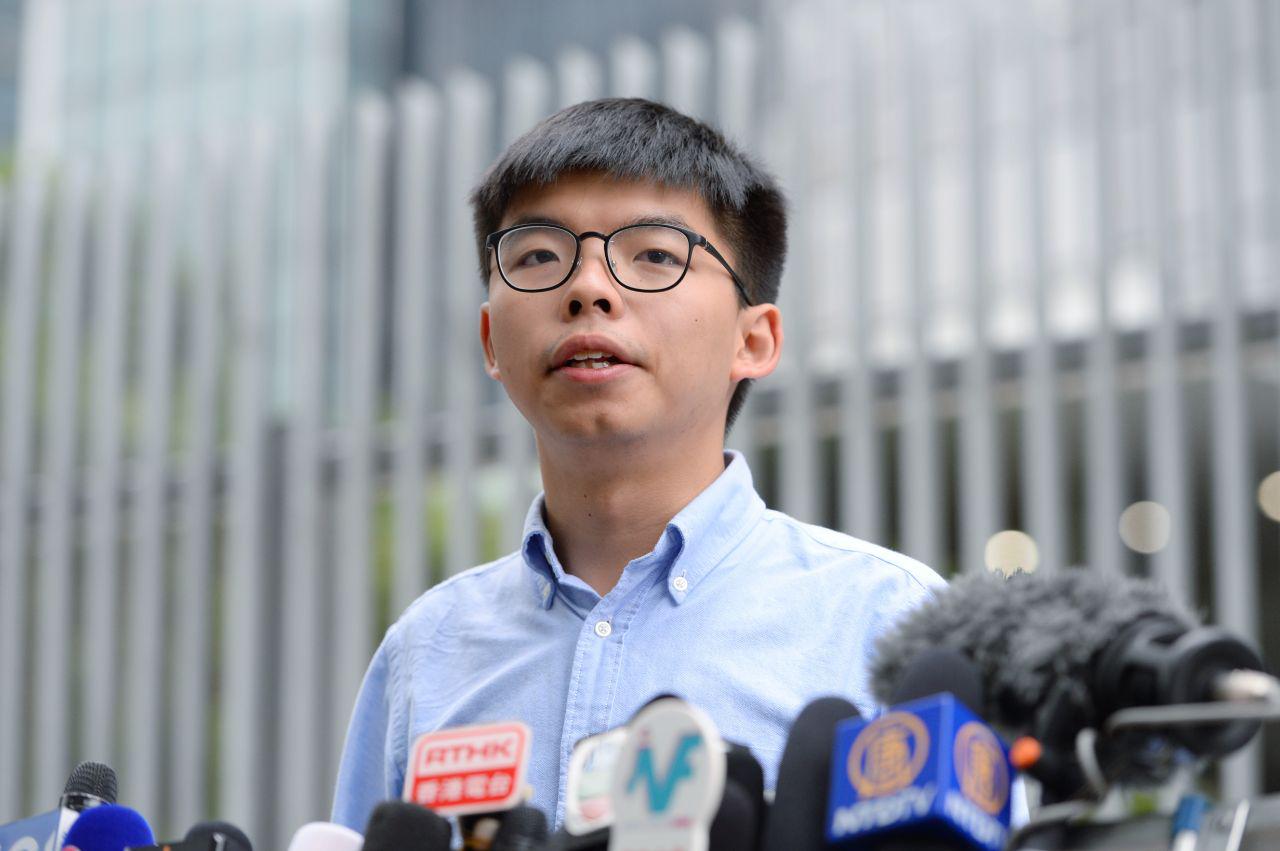
On November 5, 2026, Joshua Wong, a prominent pro-democracy activist in Hong Kong, was sentenced to ten years in prison by the High Court of Hong Kong for “conspiring to collude with foreign or external forces to endanger national security.” This severe ruling has drawn significant attention from international human rights organizations and foreign governments, reigniting global concern over the state of democracy and human rights in Hong Kong.
Wong’s name became internationally recognized at a young age when he was featured on the cover of TIME magazine’s Asia edition on October 20, 2014. At that time, he had just turned 18. The cover story was titled “The Face of Protest,” questioning whether Wong and the youth of Hong Kong, who stood up for democracy, could succeed in their endeavors. Following his harsh sentencing, the question raised by TIME looms larger than ever. Under the oppressive regime of the Chinese Communist Party, the Hong Kong pro-democracy movement finds itself in dire straits.
Since his initial arrest in November 2020, Wong has faced a series of legal challenges, including a previous sentence of four years and eight months for participating in the pro-democracy legislative primary. The recent charges brought against him in connection with foreign collusion were introduced in 2025, exposing him to the potential for further long-term imprisonment.
This latest case implicates Wong and former members of the now-disbanded political party Hong Kong Indigenous, including the exiled activist Nathan Law. The prosecution alleges that from 2016 to November 2020, Wong and his peers lobbied foreign governments and urged sanctions against Chinese and Hong Kong officials through international media and social platforms.
Human Rights Watch has indicated that Wong could remain incarcerated until the latter half of 2036, when he will turn 40. The organization has called on the Hong Kong authorities to release him immediately and unconditionally, urging global governments to take note of the human rights issues stemming from the implementation of the national security law in Hong Kong. In a similar vein, the U.S. Consulate General in Hong Kong and Macau has issued a strong condemnation of the verdict, demanding Wong’s release.
In the wake of the court’s decision, both the United States and the United Kingdom expressed their opposition and concern. The U.S. government has called for Wong’s immediate release, while the British government has remarked that this case illustrates how the Hong Kong national security law is being employed to target individuals engaged in political expression and activism.
Born in 1996 in Hong Kong, Wong was raised in a middle-class Christian family that instilled in him a sense of social justice. His father took him to visit low-income families and grassroots communities, which exposed him to issues of social inequality at an early age and cultivated his interest in public affairs.
At just 14 years old in 2011, Wong co-founded the student organization Scholarism, initiating his involvement in social movements. He campaigned against the Hong Kong government’s implementation of moral and national education, which he believed contained political indoctrination.
In 2012, Scholarism organized protests outside the Hong Kong government headquarters, where Wong and other student leaders went on hunger strikes. As more citizens joined the cause, the demonstrations continued to grow, ultimately leading the government to withdraw its plans for the mandatory national education curriculum.
This significant victory for the student movement marked an important milestone in Wong’s activism and garnered international media attention. A retrospective by Reuters showcased his journey from founding Scholarism to becoming a key figure in Hong Kong’s pro-democracy movement.
In 2014, controversy surrounding the Chief Executive election escalated. On August 31 of that year, the National People’s Congress of China announced its decision on electoral reform, stipulating that candidates for Chief Executive must be nominated by a broadly representative nomination committee and limiting the number of candidates.
Democratic factions and student groups in Hong Kong viewed these arrangements as falling short of genuine civil liberties and demanded that Beijing reconsider the election plan. On September 22, the Hong Kong Federation of Students initiated a citywide strike to protest the proposed electoral reforms, leading Wong, as the convener of Scholarism, to emerge as a key organizer for the student-led actions.
On September 26, students breached police barricades and occupied areas outside the government headquarters, resulting in multiple arrests, including Wong. The protests intensified on September 28, as police deployed tear gas in the Admiralty area, provoking an influx of citizens to the streets and sparking what would become the 79-day Umbrella Movement.
A report by the U.S. Congressional Research Service on October 24 characterized this movement as a non-violent civil disobedience campaign driven by student groups and democratic organizations, centered on calls for democratic elections and genuine universal suffrage.
Wong became a vital leader in this student-led struggle and gained further international prominence when he appeared on the cover of TIME magazine in October 2014, once again underscoring his status as a symbol of resistance for the pro-democracy movement.
According to TIME, Wong organized student protests against moral and national education as early as 2012, establishing him as a representative figure among Hong Kong’s youth movements. A subsequent interview with the magazine in 2017 also revisited his experience of being featured as the “Face of Protest.”
In 2016, as Scholarism disbanded, Wong joined with Nathan Law and others to found the political party Demosisto, transitioning from student activism to political engagement, advocating for democratic reforms and self-determination for Hong Kong. He continued to participate in political activities, making numerous trips abroad to discuss the Hong Kong democracy movement with political figures.
The documentary “Joshua: Teenager vs. Superpower,” released in 2017, brought Wong’s personal story to a wider audience, showcasing his evolution from a regular schoolboy to a prominent leader during the Umbrella Movement at just 17 years old. Yet, despite the film immortalizing him as a heroic figure, Wong has consistently rejected this framing of his character.
In interviews, Wong has emphasized, “I am not a hero; the heroes are the ordinary Hong Kong citizens who face tear gas on the streets.” He attributes the courage displayed during protests to those who participated in the demonstrations, focusing on the collective efforts of ordinary individuals rather than any glorification of himself.
It is worth noting that Wong has voiced similar sentiments throughout his activism. During an interview with The Guardian in October 2014, amid the Umbrella Movement, he expressed discomfort with being labeled a hero, recalling how he was detained while others withstood the effects of pepper spray and tear gas on the streets.
The renewed ten-year sentence for Wong serves as a stark reminder of the struggles facing the pro-democracy movement in Hong Kong and marks a further escalation in the authoritarian rule of the Chinese Communist Party.
An article published by The Week on November 6 points out that the likelihood of a resurgence of the Umbrella Movement or large-scale protests in Hong Kong any time soon remains low. Instead, pro-democracy efforts may increasingly shift overseas, grappling with challenges such as divisions within the exile community, waning international attention, and pressures facing activists and their families.
The same publication mentions that the democratic aspirations of the people of Hong Kong will not disappear simply because political organizations have been dismantled. Preserving collective memory, cultural identity, and historical narratives can serve as a means to sustain social movements in their struggle.
Amnesty International condemned the authorities for the timing of Wong’s recent verdict, calling it a “cruel tactic” to impose new convictions just months ahead of his originally scheduled release. In a response to queries from BBC Chinese, the U.K. Foreign Office noted that the latest ruling underscores how the Hong Kong national security law is being wielded against individuals exercising their rights to political expression.
Furthermore, the Jamestown Foundation in the U.S. pointed out in July 2025 that instability within the Chinese Communist Party’s succession system and internal power struggles may lay the groundwork for potential political upheaval. The intertwining of factional infighting with economic and social crises could create significant challenges for the regime.
An article published in March 2025 by Foreign Policy suggests, “Don’t give up on China’s democracy too soon.” The piece argues that while genuine democratic transitions in China appear distant under Xi Jinping’s rule, the potential for political reform should not be entirely dismissed, especially as economic challenges and social tensions may converge to stimulate future changes in governance.