
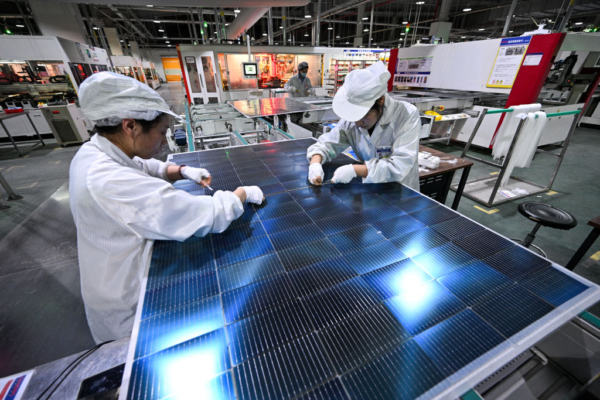
In a significant turn of events for Iran, the import of solar panels from China plummeted by over 80% in 2026. This dramatic decline poses a serious concern for the Iranian government, which is grappling with a worsening electricity shortage crisis.
This situation is exacerbated by recent announcements made by the United States military, indicating that they are preparing to impose restrictions on Iran’s land trade, thereby intensifying the pressure on the Iranian regime. Prior to this, the U.S. had already taken steps to control Iran’s import and export activities in the vital Strait of Hormuz.
A new report from the International Energy Agency (IEA) reveals that from January to September of this year, China’s exports of solar panels to Iran fell to less than one-fifth of the volume seen during the same period last year.
Data from the energy think tank Ember shows that during these nine months, China exported a mere 1.38 megawatts of solar panels to Iran, valued at approximately $15 million. This decline is particularly striking considering that Iran had imported large quantities of solar panels in 2024 and 2025, with import figures exceeding those of previous years by over tenfold.
As Iran grapples with severe shortages of natural gas, rampant air pollution, and persistent drought conditions, the current regime finds itself unable to significantly expand its capacity for thermal and hydroelectric power generation, despite having access to ample financial resources.
According to assessments from the Iranian Ministry of Energy and the Parliament Research Center, the country needs to add more than 5,000 megawatts of electrical generation capacity annually to avert ongoing electricity deficits.
For several years, Iran has faced serious power shortages due to its failure to meet generation expansion targets, resulting in significant challenges during the peak summer months when the electricity shortfall can exceed 20% of peak demand.
The ongoing conflicts with the United States and Israel have further strained the situation, with Iranian officials reporting that approximately 4,000 megawatts of generating capacity was destroyed during the conflicts.
In April, a significant warehouse housing solar project equipment in Iran was also attacked, leading to estimated losses in the renewable energy sector of around $1.5 billion, according to the Sustainable Energy and Energy Efficiency Organization of Iran (SATBA).
Despite these setbacks, the International Renewable Energy Agency (IRENA) projects that by 2025, Iran’s solar power installation capacity could increase by 128% from the previous year, reaching approximately 1,781 megawatts.
The stark drop in imports of solar panels in 2026 contrasts sharply with a rebound in China’s exports to several other markets in the Middle East. For instance, in the first eight months of the year, China’s export volume of solar panels to certain Arab nations initially fell by nearly half, but there has been a subsequent recovery in exports across the region.
A report released by the Chinese Chamber of Commerce in the UAE highlighted data from the Shanghai Metal Market, revealing that China’s photovoltaic component exports reached 23.92 gigawatts in September, marking a 44.2% increase compared to August.
This mixed landscape serves to underscore the complexities and challenges facing Iran as it seeks to navigate its energy needs amid international sanctions and a turbulent regional climate. The overarching question remains: how will Iran’s energy strategy evolve in the face of dwindling solar panel imports and increasing domestic power demands?