
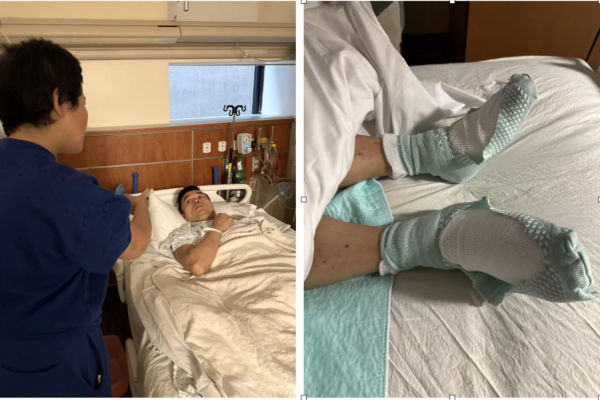
A tragic fire in the Brooklyn Chinese community on November 5 has claimed six precious lives, sending shockwaves through the Fujianese community. The day after the blaze, Huang Qi Wang, president of the Prosperous Brooklyn Association, accompanied a survivor, Ms. Lin, to visit her husband, Mr. Chen, who was receiving treatment at a hospital. During the visit, more details about the circumstances leading up to the tragedy began to emerge, revealing deeper issues surrounding the incident.
According to Huang Qi Wang, the fire occurred in a building located at 653 58th Street, which housed nine residents. Of these, six individuals lived on the upper floor, all of whom tragically lost their lives in the fire. The first floor originally had three residents, including Ms. Lin and her husband in the back unit, as well as a male tenant in the front unit. The basement was unoccupied. Remarkably, Ms. Lin and her husband were the only two survivors from the building, while the male tenant in the front unit remains missing.
The victims included a couple in their 40s, a mother and her 21-year-old daughter, and a grandmother in her 70s alongside her 30-year-old grandson. It was revealed that the elderly grandfather had been out of state at the time, allowing him to escape the tragedy, but unfortunately, his wife and grandson perished.
Firefighters managed to rescue four individuals from the scene; however, two of the upper-floor residents succumbed to their injuries en route to the hospital. The other two survivors from the first floor were transported for medical care, with Ms. Lin ultimately being discharged after being treated for smoke inhalation. In contrast, her husband remained hospitalized at Staten Island University Hospital’s burn unit due to severe burns on his feet and smoke inhalation, with an expected discharge not scheduled until the following week.
Huang described the situation during the rescue as critical, noting that firefighters did not use stretchers, but instead physically dragged the trapped residents out. This would explain why Ms. Lin, upon being rescued, was found limping in her sandals, as she had been barefoot and had stepped into the burning debris. Her husband suffered similar burn injuries on his feet.
Preliminary investigations pointed to a male tenant on the first floor, who had only moved in a month prior, as the likely catalyst for the fire. Reports suggest that this tenant had mental health issues, and concerns about his well-being have left his fate unclear.
Huang further explained that Ms. Lin and her husband were the co-landlords of the first floor, having rented the space and subsequently subletting the front unit to this male tenant. Mr. Chen worked as a delivery driver for Amazon, while Ms. Lin was currently unemployed. The male tenant responsible for the fire had not been recruited by the co-landlords themselves, but rather introduced by the primary landlord, leaving Ms. Lin and her husband unaware of his background and solely responsible for collecting rent.
Ms. Lin and her husband had previously expressed concerns regarding the male tenant’s alarming behavior of frequently tampering with electrical wires. On the afternoon of the fire, the tenant reportedly cut the wires, prompting a nearby resident familiar with renovation to attempt a repair. However, he was not a licensed electrician, which likely failed to mitigate the risk adequately. That evening, the same tenant allegedly tampered with the wiring again, leading to the eventual outbreak of flames.
On that day, when the male tenant first caused disturbances, the co-landlords had reached out to the main landlord, suggesting that police should be involved to evict the dangerous tenant. However, the landlord advised against calling the authorities, adopting an “avoid trouble” stance, according to Huang’s recounting.
The couple later discovered that the male tenant had a history of eviction in other locations, which led them to hope he would vacate the premises; he had promised to move out by the end of the month.
Huang Qi Wang echoed sentiments of urgency, warning that if the police were unable to locate the missing tenant, they might wrongly assign blame for the fire to the residents. This situation emphasizes the necessity to clarify the tenant’s role as a crucial figure who had compromised the electrical system, ultimately causing the fire outbreak.
This devastating inferno did not just claim lives and shatter numerous families but has also exposed longstanding safety concerns within the overseas Chinese community regarding rental properties. Issues arise when houses initially approved for two-family occupancy are divided into more living units, raising questions of unauthorized modifications and mismanagement by landlords and sub-landlords alike.
Upon reviewing building records, it was discovered that this particular address had previously attracted complaints regarding illegal renovations in 2025. Additionally, financial records indicate that the building was registered under ONE GOLDEN SUNSHINE CORP, which purchased the two-family home for $1.05 million in late October 2019. While the specific purchaser’s name was not present in the deed, multiple residents from Fujian indicated that the property was connected to a Chinese physician named Dr. Wang Wei, known for constructing new buildings in the vicinity.
Following the fire, Huang Qi Wang reached out to Dr. Wang, who reportedly cited receiving too many inquiries and needed to “take a break.” However, existing property records do not directly list Dr. Wang’s name, and the relationship between him and the registered property company remains to be thoroughly confirmed.