
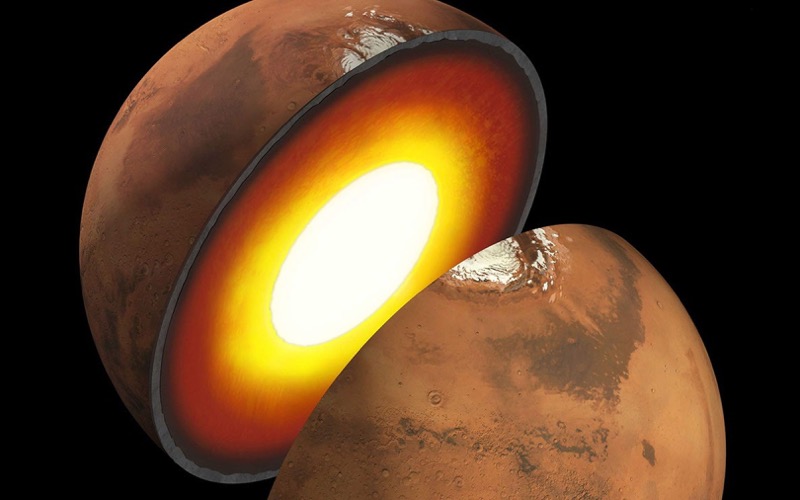
New study on the interior of Mars reveals that the red planet is composed of two drastically different hemispheres. Scientists have recently discovered a massive “heat anomaly” hidden deep within Mars’s subsurface, adding to the mystery of the extreme asymmetry between the planet’s northern and southern hemispheres.
Published in the journal “Nature,” a new study indicates that temperatures deep within the southern hemisphere of Mars are as much as 750 degrees Fahrenheit (400 degrees Celsius) higher than those in the northern hemisphere. This anomaly further enhances the enigmatic “dichotomy” between the flat northern plains and rugged southern highlands of Mars.
“Scientists typically assume that the overall structure of a planet’s interior is spherically symmetrical, but that may not necessarily be the case,” said Alexander Berne, former researcher at Caltech and current faculty member at the University of Arizona, who is the lead author of the study.
According to a report from Space, Berne and his team revisited historical data from NASA’s orbiting probes – the Mars Global Surveyor, Mars Odyssey, and Mars Reconnaissance Orbiter. Utilizing Berne’s developed “tidal tomography” technique, which factors in the dynamic gravitational effects of the sun on Mars, they calculated models of the planet’s interior structure and temperatures.
The data shows that temperatures in the mantle of Mars’s southern hemisphere are higher by 390 to 750 degrees Fahrenheit (200 to 400 degrees Celsius) compared to the northern hemisphere, possibly remaining partially molten. This could impact the habitability of Mars and the duration of volcanic activity.
The asymmetry on the surface of Mars has long been recognized: the northern hemisphere dominated by lowland plains (possibly once covered by extensive oceans), while the southern hemisphere has an average crust thickness 15.5 miles (25 kilometers) greater than that of the north, and is riddled with impact craters. “The North-South dichotomy is crucial for understanding Mars as it provides information that could affect Mars’ hydrological processes,” stated Amirhossein Bagheri, second author of the study from Caltech.
The hotter mantle in the southern hemisphere also explains other mysteries, such as the faster dissipation of seismic waves detected by NASA’s InSight lander in the south, and the origin of magnetic anomalies in iron-rich minerals in the south – if the mantle in the south rises to heat the crust beyond the Curie temperature, the material loses its original magnetism and gains new residual magnetism upon cooling.
The cause of the northern-southern boundary is currently uncertain. The prevailing view is that over 4 billion years ago, a massive impact excavated the northern lowlands, promoting the release of internal heat, leading to faster cooling in the north. Another explanation is that the thicker crust in the south acted like a lid, impeding heat loss.
Berne mentioned that the tidal tomography technology could also be applied to Mercury or Jupiter’s large satellites, offering a blueprint for designing future space exploration missions.