
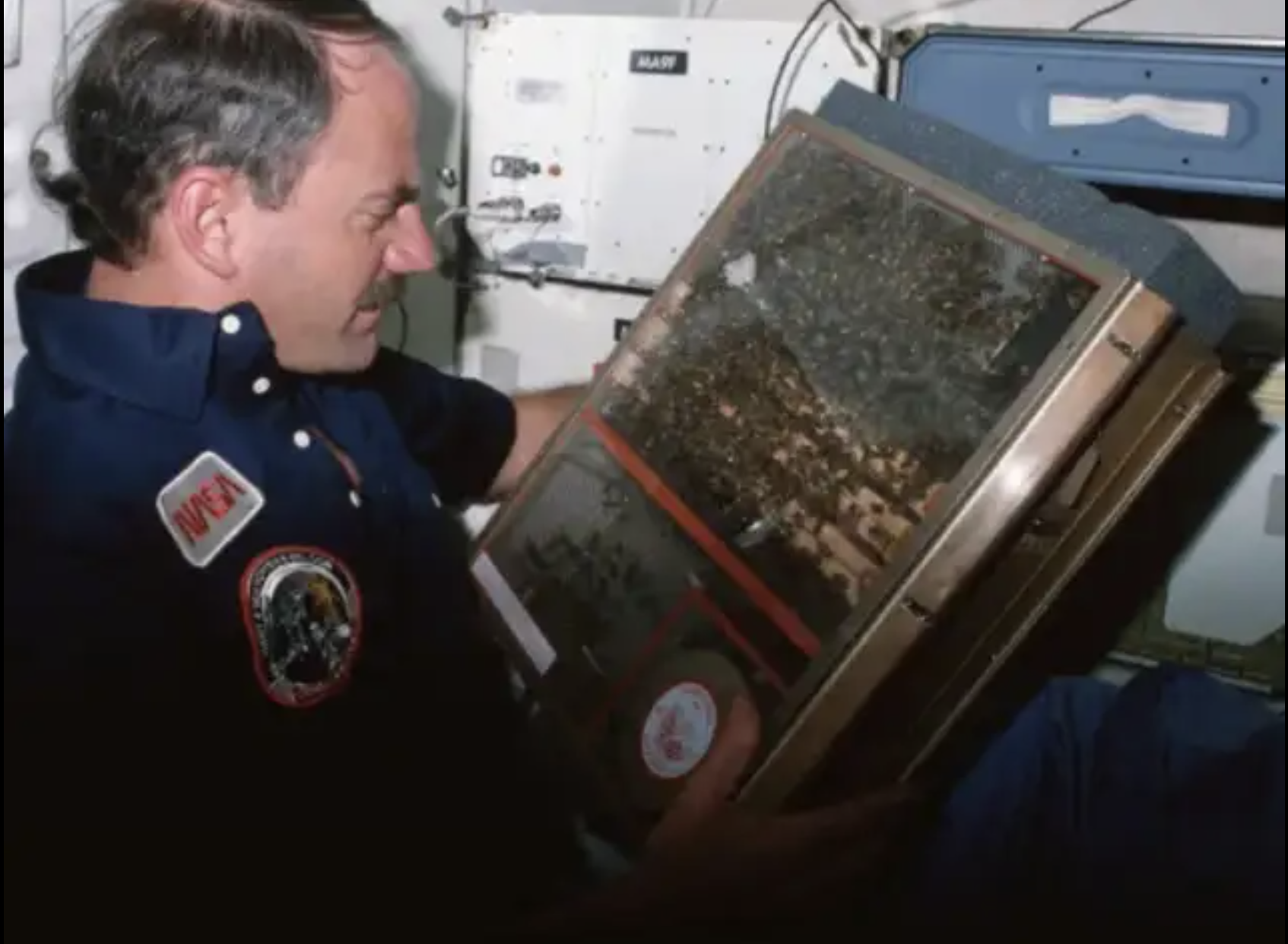
In 1984, NASA embarked on a groundbreaking experiment by sending approximately 3,300 honeybees into space aboard the space shuttle in order to study how they would build honeycombs in a zero-gravity environment.
According to the mission report released by NASA, the Challenger space shuttle was launched from the Kennedy Space Center on April 6, 1984, and returned to Earth on April 13. The primary objectives of this mission included deploying the Large Payload Handling Device and capturing and repairing the malfunctioning Solar Maximum Satellite.
On Earth, honeybees rely on gravity as a reference point when building their nests, with worker bees typically constructing hexagonal cells with the openings facing downwards. Scientists aimed to understand whether the bee colony could still build nests effectively in the absence of this gravity reference system. This challenge also delved into the bees’ communication methods, as worker bees perform a “waggle dance” on the vertical surface of the nest to communicate the angle of a food source relative to the sun based on gravity. Without gravity, this navigation and communication mechanism lost its reference point.
The NASA mission report documented changes in the behavior of the bee colony after entering orbit. Initially, the bees exhibited disorientation due to the loss of gravity cues they usually rely on for straight-line flight and walking. However, the report noted that as the mission progressed, the bees were able to fly, walk, and even float inside the enclosure without significant difficulty.
Despite a rough start, the bee colony continued to work throughout the entire mission. According to the mission report, by the end of the flight, the colony had built approximately 31 square inches of honeycomb, which closely resembled the structures built by ground-based bee colonies. The queen bee laid 35 eggs during the mission, demonstrating that the basic functioning within the bee colony remained normal in a zero-gravity environment.
The mission report also mentioned that the mortality rate of the bees during the flight was lower than expected, though specific numbers were not provided.
The bee colony was housed in a custom container called the Bee Enclosure Module, manufactured for this flight by Honeywell’s Space and Strategic Avionics Division. The Smithsonian National Air and Space Museum, where the enclosure is now preserved, described the dimensions of the module to be approximately 18×4.75×19 inches, designed for researchers to observe the behavior of the bee colony throughout the flight. Honeywell later donated this device to the museum, and a similar design was used for a fruit fly experiment in the STS-51-D mission in 1985.
Originally designated as STS-13, the mission was renamed STS-41-C shortly before launch by NASA, though this change was not reflected in subsequent academic literature. In the following year, entomologist J.D. Vandenberg published a research paper in the peer-reviewed journal “Apidologie” titled “Survival, Behavior and Comb Construction by Honey Bees, Apis mellifera, in Zero Gravity Aboard NASA Shuttle Mission STS-13,” highlighting the bees’ ability to adapt their behavior in weightlessness and construct clearly defined hexagonal cells.
With space agencies planning longer missions to the moon and Mars, the cultivation of crops and the maintenance of pollinating insects in space have evolved from mere scientific curiosity into practical challenges. In 2025, the academic journal “Frontiers in Physiology” published a review article titled “Insects in outer space: assessing the effects of microgravity on edible and model insect species for spaceflight food system,” singling out honeybees as one of the species worth continuous research due to their demonstrated resilience and feasibility in long-duration space missions.
The 1984 NASA mission that sent honeybees into space did not provide all the answers regarding bees and space, but it revealed a significant insight – even when the rules of gravity disappear, the instinct of a bee colony to work together to build comb and operate persistently remains unwavering.