
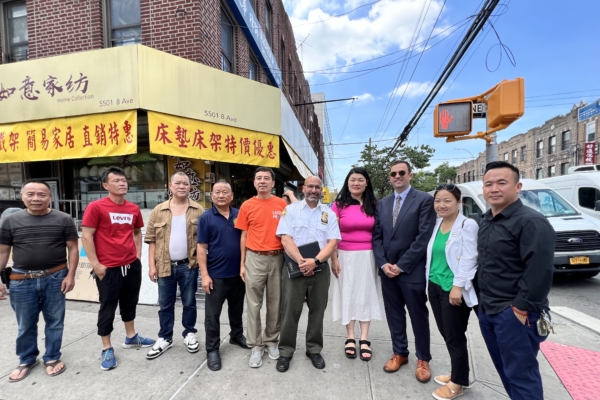
The long-standing issues of sanitation and street vendors in the Eighth Avenue Chinatown have been difficult to resolve. On Friday (21st), Council Member Jennifer Zhuang invited Department of Sanitation Commissioner Gregory Anderson, enforcement officer Frank Lettera, and community members to visit Eighth Avenue and discuss solutions to core problems such as illegal dumping, insufficient public trash bins, mixing of household garbage in street bins, and illegal street vending.
Zhuang stated that one of the most common community complaints her office receives is that the streets and sidewalks are “too dirty.” Despite volunteers cleaning up on Saturdays, the results are limited, so government resources and enforcement need to be increased. The second category of complaints comes from businesses, mainly focusing on issues of excessive illegal street vending and encroachment on the space of legal businesses.
In response to the long-standing issue of insufficient trash bins in the community, Commissioner Anderson promised that the Department of Sanitation would fill the community’s shortage of 120 to 140 public trash bins within the next month. He emphasized that adding more bins is only part of the solution and that “we need the community to take responsibility for keeping the area clean.”
He stated that the Department of Sanitation would intensify enforcement against illegal dumping on 61st and 62nd Streets between Eighth and Fourteenth Avenues, conducting nighttime inspections of black garbage bags to trace violators’ information and encouraging businesses to provide leads.
Police Chief Lettera mentioned that they would first check which existing cameras are still operational and which ones actually generate data, then evaluate whether to adjust or add cameras. He also revealed that since July 1st, over 10,000 pounds of food waste have been cleared from Eighth Avenue, indicating a significant amount of waste in the area.
Accompanying the visit, local representative Li Ning He believes that the addition of trash bins could be an opportunity for the community to start anew. He pointed out that in the past, residents complained about a lack of trash cans, and the Department of Sanitation was concerned that adding new bins would quickly be filled with illegally dumped trash again. Therefore, after the government reinvests in trash facilities, the community should also collectively maintain them to prevent the new bins from once again becoming spots for illegal dumping.
Community leader Qi Wang Huang pointed out that the garbage problem on Eighth Avenue cannot simply be attributed to residents’ “poor quality,” but stems from a lack of proper waste disposal channels in residential buildings. Many buildings along Eighth Avenue have businesses on the ground floor and two, four, or even more households upstairs. While businesses have commercial waste collection services, residents have “nowhere to throw,” so they end up disposing of household garbage in public bins in the streets, leading to overflowing bins and rubbish piles nearby.
Huang suggested that simply adding public trash bins alone cannot solve the problem and should start from the residential source. He proposed emulating practices in some areas of Seventh Avenue, where each building places around three household trash bins in a designated area downstairs and encloses them, making it convenient for residents to dispose of waste and for cleaners to collect it, clearly distinguishing between residential and commercial waste.
“It’s not that they like to litter, it’s that there is nowhere to put it,” he said. Only by providing clear residential waste collection channels and regular collection schedules can streets be kept clean in the long run.
For some businesses, illegal street vending is even more severe than the garbage problem. Mr. Chen, a representative of businesses on Eighth Avenue, pointed out that the current regulations require vendors to be at least 20 feet (about 6 meters) away from building entrances, but some parts of Eighth Avenue are only about 18 feet wide, meaning that most stalls do not have legal vending spaces.
Mr. Chen advocated for enhanced enforcement according to existing regulations and demarcation of an 8-foot passage.
Huang proposed a compromise solution: vendors can only set up on one side of the sidewalk, not on both sides simultaneously. This would release space on the other side of the sidewalk and, combined with enforcement against unlicensed or illegally occupying vendors, could quickly alleviate congestion.
Looking ahead, Huang and Zhuang both recommended concentrating vendors in fixed locations to create a market or flea market-like model. Zhuang stated that though vendors may initially worry about losing foot traffic, once a scale is established and consumers develop habits, it could both maintain clean streets and protect vendors’ livelihoods. “For the community to progress, changes are definitely needed.”