
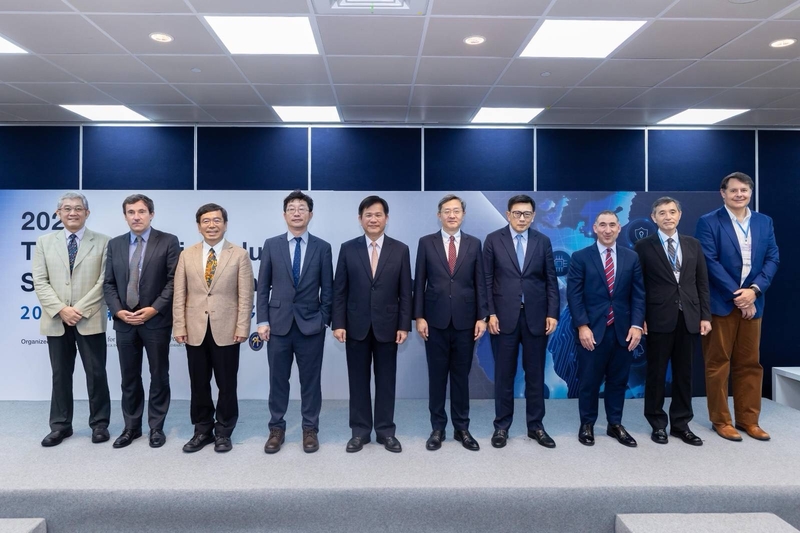
Taiwan’s Minister of Foreign Affairs, Lin Chia-lung, delivered a speech on the opening day of the “2026 Trusted Semiconductor Supply Chain Partner Forum” on September 4th, emphasizing Taiwan’s position as a global leader in semiconductor technology. He highlighted Taiwan’s role as a cornerstone of the AI revolution and expressed the nation’s goal of collaborating with more democratic partners to construct a secure and resilient high-tech supply chain.
The forum, jointly organized by the Ministry of Foreign Affairs of the Republic of China (Taiwan), the Chung-Hua Institution for Economic Research (CIER), and the Semiconductor Equipment and Materials International (SEMI), was held at the venue of the “SEMICON Taiwan 2026” international semiconductor exhibition on the 4th of September. The event aimed to analyze the risks, challenges, governance strategies, and cooperation opportunities faced by the semiconductor industry amidst global strategic realignment.
According to a press release by the Ministry of Foreign Affairs, the “2026 Trusted Semiconductor Supply Chain Partner Forum” invited experts and scholars from the United States, Japan, Europe, and Taiwan to discuss how Taiwan can become a key partner in a trustworthy supply chain amidst the geopolitics of the AI era.
Keynote speakers at the forum included co-author of “The Crystal Triangle: Global Semiconductor Security in the Silicon Age,” Glenn Tiffert; author of “Economic Security: The Missing Link in EU-Japan Cooperation,” Mathieu Duchâtel; co-author of “Innovation Economics: Global Competition for Advantage,” Dr. Stephen Ezell; and Honorary Professor at Kyushu University, Japan, Shigeno Asano. With top experts gathered, the event attracted over 200 representatives from industry, government, and academia.
Minister Lin Chia-lung’s address highlighted Taiwan’s commitment to mutually beneficial cooperation as a trusted and reliable partner amid the tumultuous geopolitics of today. He emphasized Taiwan’s achievement in building the world’s most advanced semiconductor ecosystem over the past 30 years, which now serves as a cornerstone for the global artificial intelligence (AI) revolution.
Lin stated that Taiwan produces over 90% of the world’s most advanced semiconductors and plays a leading role in the production of AI servers and printed circuit boards globally. Taiwan’s semiconductor industry supports many of the world’s most innovative companies, making it a key driving force for technological advancement in the era of artificial intelligence.
The Minister expressed Taiwan’s goal of collaborating with more democratic partners to construct a secure and resilient high-tech supply chain by leveraging complementary advantages in advanced design, equipment, and manufacturing. Initiatives such as the “Economic Prosperity Partnership Dialogue” (EPPD) between Taiwan and the U.S. and the U.S.-led “Pax Silica” initiative are creating new opportunities for Taiwanese companies to further deepen their global presence.
The forum focused on two main themes: “New Economic Security Landscape: Geopolitics and AI Governance” and “Taiwan as a Trusted Power Player: International Cooperation and Democratic Partnerships.”
Participants noted that supply chain reorganization involves striking a balance between efficiency and security, necessitating deepened dialogue with trusted partners. Both Taiwan and the EU are concerned that mature process chips may become a new bottleneck in the future. The EU has adopted a risk-averse strategy, but disparities exist among its members and reliance on China persists. The U.S. has extended its focus from hardware to software, talent, and cutting-edge models.
Participants also stressed the critical importance of Taiwan-Japan-U.S. cooperation for semiconductor resilience. Taiwan excels in advanced packaging and silicon photonics trends, while Japan provides critical materials and equipment. However, the global supply of helium and other raw materials is vulnerable to geopolitical impacts. Close Taiwan-U.S. ties are mutual, yet there is a decline in STEM talent exchange between the two countries, requiring policy responses. Initiatives like “Pax Silica” can be translated into concrete actions to facilitate the flow of talent, complementing advantages in critical materials and innovation, deepening trusted network cooperation, and jointly constructing a secure, resilient, and open democratic high-tech supply chain ecosystem.