
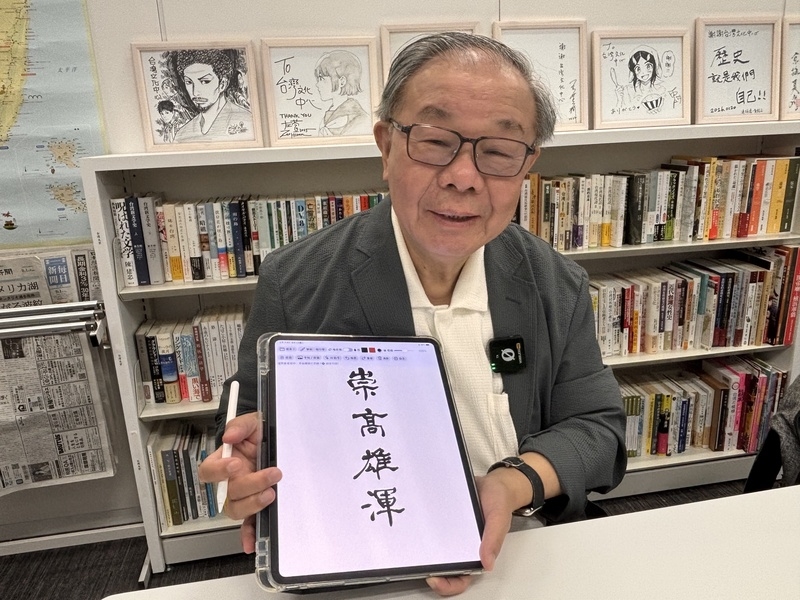
From Taiwan TV program “Word of the Day” to writing calligraphy for Japanese political figures, and then combining artificial intelligence to develop a digital calligraphy tool called “ePen,” Taiwanese calligrapher Zhang Binghuang has spent a century promoting Taiwan-Japan exchanges.
According to the Central News Agency, Zhang Binghuang once wrote “pines and cedars in the snow” for former Japanese Prime Minister Shizuka Shio, and wrote “wisdom, benevolence, courage” and “sublime Osaka” for Prime Minister Sanae Takamichi. In 2026, due to his long-standing promotion of Taiwan-Japan calligraphy cultural exchanges, he was awarded the Order of the Rising Sun by the Japanese government.
Zhang Binghuang’s connection with Japan dates back to about 60 years ago. During high school, his works were sent to Japan for exhibition through Taiwan-Japan student calligraphy exchanges, unexpectedly winning awards and marking his first visit to Japan to receive awards. This journey was like a seed that opened up a century-long exchange of calligraphy between Taiwan and Japan.
After graduating from university and completing military service, Zhang Binghuang originally worked in trade. When traveling back and forth to Japan, he always brought several satisfactory works to give to local friends. A Japanese trade partner saw his calligraphy and directly told him, “These are good enough for an exhibition.”
At the age of just 28 or 29, with the help of his friends, Zhang Binghuang successively held solo exhibitions at department store galleries in Osaka, Tokyo, and Yokohama. Japanese department store calligraphy exhibitions not only showcased works but also sold them, resulting in almost all of his works being sold out. Zhang Binghuang laughed and said that he later discovered, “I actually earned more from writing than from trading.”
After returning from an exhibition in Osaka and returning to Taiwan, Zhang Binghuang coincidentally encountered the Ministry of Education’s initiative to revitalize traditional culture, aiming to produce a calligraphy TV program. Graduating from Shih Hsin University with a major in film and having a background in calligraphy and video, he was selected to host the program “Chinese Calligraphy” broadcast on three TV stations. At that time, whenever you tuned into the “old three stations,” you could see him introducing calligraphy.
Subsequently, to promote standard Chinese characters, he was responsible for writing and teaching on CTV’s “Word of the Day.” The program was produced twice, totaling about 25 years. The hand slowly writing each word with a calligraphy brush on the TV screen became a shared memory for many Taiwanese people.
“Calligraphy” is one of the three treasures of Japan. The Japanese love for calligraphy not only exists in the cultural field but also extends into politics and the business world. Zhang Binghuang observed that many Japanese political figures have their own motto or spiritual guidelines, and they would specially invite calligraphers to write them down and hang them in their offices to see every day.
When Japanese Prime Minister Sanae Takamichi visited Taiwan, before taking office, she asked Zhang Binghuang to write “wisdom, benevolence, courage.” After assuming office, she asked him to write “sublime Osaka.”
“Sublime Osaka” is Takamichi’s political motto. “Sublime” means noble and dignified, while “Osaka” conveys grandeur and strength. These four characters reflect Takamichi’s political stance and national view of striving to build a “strong and prosperous Japan.” During the last year’s Liberal Democratic Party leadership election, she also wrote “sublime Osaka.”
Keiji Furuya, chairman of the Japan-Taiwan Friendship Parliamentarian Alliance, asked Zhang Binghuang to write “a thousand miles at a glance” and hung the work directly in front of his seat. When Zhang Binghuang visited, Furuya specifically pointed to the artwork and told him, “Look, I sit here every day, and I can see it just by looking up.”
Zhang Binghuang believes that when Japanese political figures think about turning their ideas into calligraphy works, they are willing to find Taiwanese calligraphers to do it instead of only considering Japanese calligraphers. This in itself is a form of cultural diplomacy. “When they want to express their political ideas in writing, they think of inviting Taiwanese calligraphers instead of just Japanese calligraphers, and I think that’s a good thing.”
When asked to choose four characters to symbolize the current Taiwan-Japan relationship, Zhang Binghuang wrote down “graceful and harmonious.”
“Graceful and harmonious” comes from Wang Xizhi’s “Preface to the Orchid Pavilion,” describing a scene of a gentle breeze blowing and all things unfolding, symbolizing the continuous progress of friendship in a harmonious and smooth atmosphere, which is a very appropriate interpretation of the current Taiwan-Japan relationship.
Approximately 26 years ago, Zhang Binghuang was teaching at Tamkang University when computers were rapidly becoming popular. People began using keyboards to write articles and reports and were no longer willing to write by hand. For someone promoting calligraphy education, this trend brought significant pressure. “When typing on keyboards became more prevalent than handwriting, it became challenging to teach calligraphy because people lost interest in learning it.”
At that time, he was involved in a digital national language teaching program. Although the program was not implemented, it was the first time he truly saw the power of computers. “I had no understanding of computers at that time, but I thought, if we don’t make good use of computers, calligraphy education will continue to decline.”
The problem was that at that time, there were no iPads like today, not even mature touch pens. Zhang Binghuang and his team started from scratch and took several years to develop a digital pen and writing tablet, gradually evolving into the current “ePen.”
Zhang Binghuang, who previously promoted calligraphy on TV with a calligraphy brush, now uses an ePen. By simply picking up a portable tablet and Apple Pencil, and opening a specialized app developed, he can start “writing” on the spot. However, Zhang Binghuang self-mockingly admits that he is still a “computer idiot while operating,” saying, “I still haven’t mastered using the Apple Pencil yet.”
After years of development, the smart ePen recently made significant breakthroughs, including replicating the ink’s shades and difficult-to-present effects such as “flying white” and “dry brush” in a digital environment can now be vividly reproduced, allowing the ePen to convey the flavor of ink.
Furthermore, the latest version integrates artificial intelligence, transforming it into an on-demand calligraphy teacher. The system can search calligraphy collections from institutions such as the National Palace Museum, the Metropolitan Museum of Art, and the Tokyo National Museum. Users can select a segment they wish to learn and adjust its size, then directly convert it into a digital model.
On-site, Zhang Binghuang demonstrated using the AI-enhanced ePen with a passage from a Japanese national treasure, the “White Anthology.” He extracted a text passage from the museum’s collection, created a drawing template, and practiced directly on the tablet. After the completion, removing the template, he allows AI to analyze the characters’ form, structure, and strokes. Within a short period, AI can pinpoint the work’s strengths, weaknesses, and areas for improvement, guiding him by saying, “This stroke position is incorrect,” “This stroke is not bold enough,” or “This stroke was written too quickly.”
Zhang Binghuang said, “People can write even at midnight without a teacher beside them, and the iPad can directly point out your mistakes.”
In recent years, generative AI has become increasingly powerful, and in the future, merely giving instructions could potentially generate calligraphy in the style of Wang Xizhi. However, Zhang Binghuang does not believe that imitating Wang Xizhi with AI is the direction digital calligraphy should pursue. “If AI mimics Wang Xizhi’s writing, what’s the point? It’s written by a machine or AI, not by you.”
He emphasizes that developing the ePen is not meant to replace human writing with a system but to make learning easier and more efficient. Technology can help with research, creating models, and analyzing issues, but the final stroke should still be completed by the person themselves. “What you write is your own. If the system writes for you, it’s no longer your work.”
In 2026, Zhang Binghuang was awarded the Order of the Rising Sun by the Japanese government for his long-standing promotion of Taiwan-Japan cultural exchanges. However, upon receiving the notification for the first time, he was completely incredulous. Recalling the moment, a Japanese Ministry of Foreign Affairs official with imperfect Chinese called him and inquired if he would like to accept the Order of the Rising Sun on behalf of the Japanese government. He thought to himself, “How could this be possible?”
The official explained the Order of the Rising Sun and related procedures over the phone in detail. Zhang Binghuang listened and confirmed, and eventually concluded, “A scam wouldn’t be able to explain things so clearly,” so he agreed to accept it in Japanese. The Japan-Taiwan Exchange Association subsequently contacted him, and he further learned that the Order of the Rising Sun is divided into different levels, with the Order of the Rising Sun (Gold and Silver Rays) being awarded to individuals who have made contributions to Japan in the fields of academia, arts, and culture.
Subsequently, the Japanese side inquired whether he would like to receive the decoration in Taiwan or Japan. Considering ongoing commitments and the undefined timing of the ceremony in Japan, he ultimately decided to accept the honor in Taiwan and completed the ceremony in mid-June.
During an interview with the Central News Agency, Zhang Binghuang presented a photo showing his name written on official documents, stamped with the “Great Seal of Japan.” “Many Japanese people have told me that they have never seen the Great Seal of Japan.” Zhang Binghuang said that even he was surprised when he saw the document.
A calligrapher from Taiwan with no political position, solely through calligraphy creations and long-term cultural exchanges, was bestowed with a national-level decoration from Japan, which made him cherish this honor even more.
For Zhang Binghuang, the most crucial significance of the Order of the Rising Sun was not to add another line to his resume but to show more people the value of calligraphy. “Calligraphy is not trivial; it’s not just a minor art. To receive such a prestigious decoration from Japan means that this culture is valued, not only domestically but also internationally.”
He mentioned that Taiwanese society sometimes does not respect calligraphers as much as Japan does, and those who write might even overlook their own profession. However, this recognition through the Order of the Rising Sun illustrates that even within various cultural spheres, calligraphy can receive the highest level of acknowledgment. “People who write should not underestimate themselves.”
Before the Order of the Rising Sun, Zhang Binghuang had received an award related to technology and humanities the year before. A person renowned for calligraphy, who received a national-level decoration for cultural exchanges and a technology award for involvement in digital tool development, may seem like crossing boundaries. However, he believes that the logic is entirely coherent.
“I’m not a technology expert. I’m just someone who writes, but I was able to receive a technology award because of using computers and participating in development. So, what are humanities scholars worrying about? Why can’t they connect with technology?”
Zhang Binghuang mentioned that when he had won awards in the past, he rarely promoted it externally because he considered it a personal matter. However, for these two honors, he is willing to share repeatedly—not to show off but to convey the message to everyone: it’s unnecessary to doubt themselves because they lack technology knowledge.
From writing with a traditional brush to using AI, from the familiar hand on “Word of the Day” to featuring calligraphy in the Japanese Prime Minister’s residence, Zhang Binghuang’s journey of 60 years is not only a creative process as a calligrapher but also a story of Taiwan-Japan cultural exchanges and traditional art transitioning into modern times.