
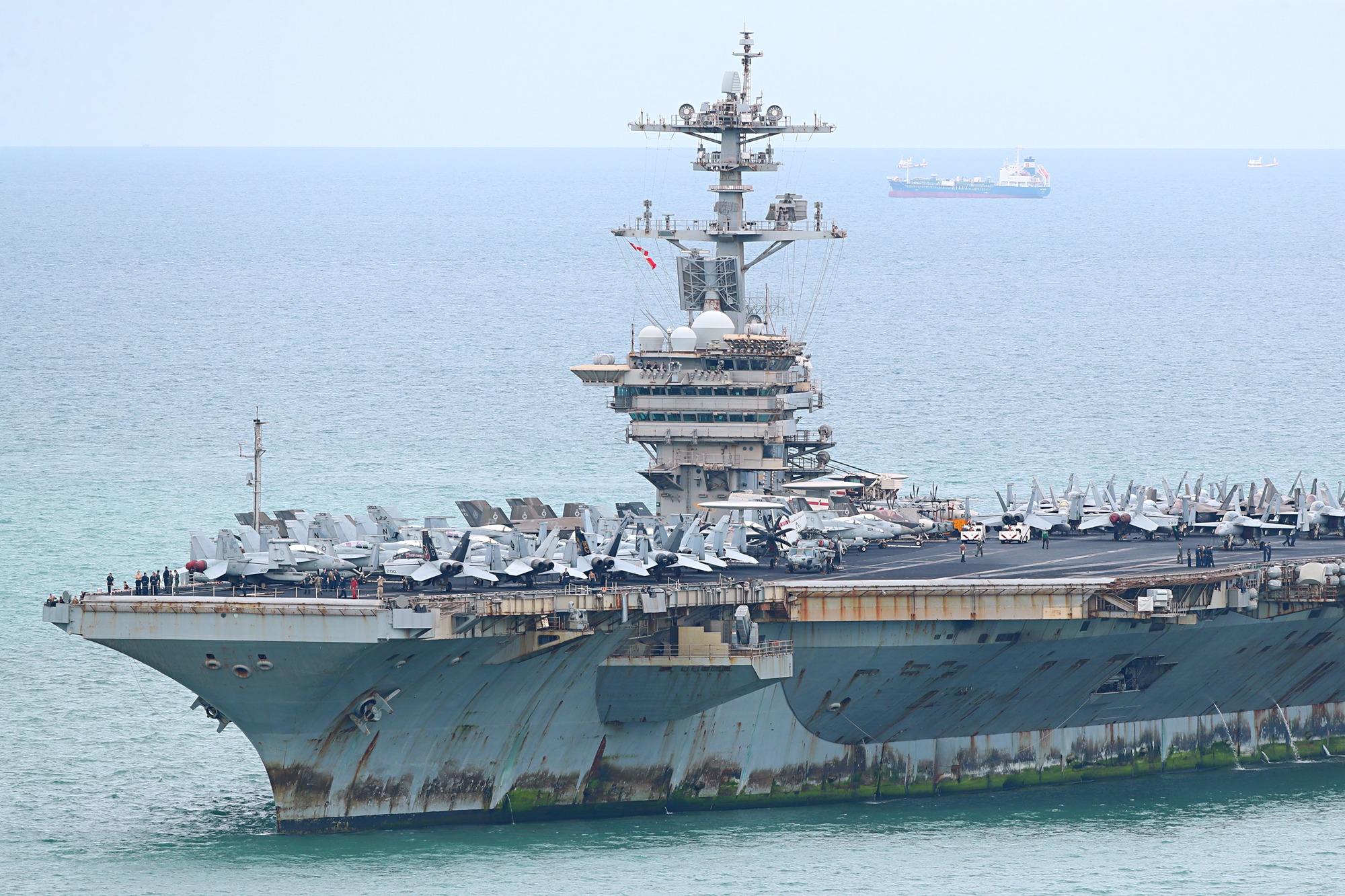
The US Navy aircraft carrier USS Abraham Lincoln has completed a 286-day deployment and arrived at Laem Chabang Port in Thailand on September 2nd. During this deployment, the Lincoln aircraft carrier spent 208 days at sea, with 200 days in the combat zone, participating not only in Operation Epic Fury but also in one of the largest maritime blockades in decades.
On September 2nd, a portion of the USS Abraham Lincoln carrier strike group arrived in Thailand for a scheduled port visit. This marked the first complete port stop for the Lincoln carrier since its deployment began in November 2025, allowing thousands of sailors and Navy Marines to go ashore and rest.
According to a statement released by the US Navy, personnel from the Lincoln carrier strike group, including staff from Carrier Strike Group 3 (CSG-3), Carrier Air Wing 9 (CVW-9), and Destroyer Squadron 21 (DESRON 21), along with 9 aviation squadrons under CVW-9, entered Laem Chabang Port. In addition, the guided-missile destroyer USS Frank E. Petersen Jr. (DDG 121) docked near Laem Chabang Port and the missile cruiser USS Robert Smalls (CG 62) arrived at Map Ta Phut in Thailand for their respective port visits.
Rear Admiral Robert E. Loughran, Commander of Carrier Strike Group 3, stated in the release: “Our arrival at Laem Chabang provides a well-deserved rest and recovery opportunity for our sailors and Navy Marines.”
He further emphasized the historical significance of the missions carried out by the strike group during their nearly seven-month deployment under the US Central Command, where they cooperated with various US Navy and Marine units in supporting Operation Epic Fury and participating in one of the largest maritime blockades in decades.
The deployment of the Lincoln aircraft carrier lasting 286 days is an exceptionally rare and extended deployment for a US aircraft carrier in recent years.
Media outlets, including the US military newspaper Stars and Stripes, have recently reported some negative aspects regarding the prolonged deployment of personnel aboard the Lincoln carrier. An article by Stars and Stripes on August 11 highlighted concerns related to mental health, food, and water supplies.
Acting Navy Secretary Hung Cao issued a statement on August 14 addressing the actual circumstances aboard the Lincoln carrier. Cao stated, “The extension of Lincoln’s deployment was due to the operational needs. Deployments themselves are challenging, and combat operations make the situation more difficult. War is hell, disrupting normal routines and work.”
Cao emphasized the importance of leaders balancing mission requirements while caring for their subordinates, acknowledging the demanding nature of deployments and the uncertainty that comes with warfare.
He pointed out that despite the challenges faced, including adjustments in meal plans when fresh supplies were unavailable, communications restrictions in times of high combat threats, the personnel on board remained resilient and determined. Cao underlined the importance of acknowledging the sailors and Navy Marines as symbols of American strength and resilience.
After Stars and Stripes published the report on the deteriorating conditions aboard the Lincoln carrier on August 11, the Pentagon requested the dismissal of the newspaper’s publisher Max D. Lederer Jr., Chief Editor Erik Slavin, and Middle East reporter Lara Korte the following day due to disobedience and their interviews with CBS News.
David O’Connor, a Pentagon official, mentioned that preparations to dismiss Slavin and Korte began as early as July 22 to counter associations made between the dismissals and the Lincoln carrier reporting.
On the other hand, Slavin and Korte stated that the grounds for dismissal, citing disobedience, were related to a CBS News interview where they discussed the newspaper’s editorial independence on July 5. In the interview, they emphasized the importance of journalistic freedom without government intervention.