
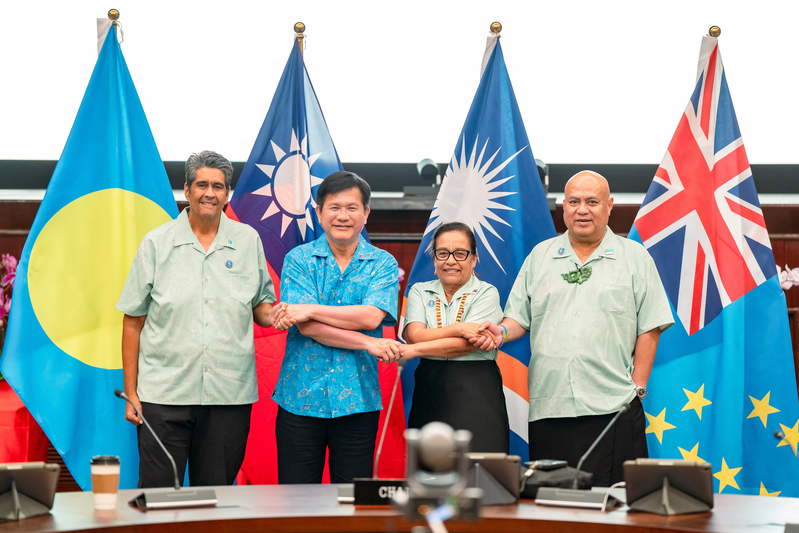
Taiwan’s Foreign Minister Lin Chia-lung visited the Republic of Palau, attending the “Taiwan/Republic of China Dialogue with Pacific Island Countries (PIF)” forum. Following the forum, joint statements were signed with Palau, the Marshall Islands, and Tuvalu, reaffirming their commitment to peace, stability, and prosperity in the Pacific region.
The Ministry of Foreign Affairs of the Republic of China announced that Minister Lin Chia-lung led a delegation to Palau and participated in the 55th Pacific Islands Forum and related events from August 27 to September 3. During the visit, he engaged in extensive discussions with representatives from Pacific island nations and like-minded countries to deepen Taiwan’s cooperation in the region. Minister Lin returned on the evening of September 3, completing a successful trip.
Representing the Republic of China at the PIF opening ceremony, Minister Lin Chia-lung also co-hosted the “Taiwan Night” event. He attended the “Pacific Prosperity Exhibit” at the invitation of Palau President Surangel S. Whipps, Jr., along with government officials from Palau and representatives from like-minded countries such as the United States, Japan, and Australia.
The “Pacific Prosperity Exhibit” showcased the collaborative efforts between Taiwan, Pacific island allies, and like-minded countries in areas including low-carbon energy, social empowerment, smart agriculture, intelligent healthcare, digital resilience, and infrastructure, demonstrating their joint commitment to meeting regional development needs, enhancing Pacific resilience, and promoting sustainable development.
Minister Lin also participated in the 30th “Taiwan/Republic of China Dialogue with Pacific Island Countries Forum” hosted by President Surangel S. Whipps, exchanging views with leaders from partner nations on topics such as talent cultivation, regional connectivity, and exchange.
He proposed an integrated approach named “Education, Training, Employment, and Assessment” (ETEA) to enhance vocational education and talent cultivation in friendly nations based on Taiwan’s expertise in the industry. This initiative aims to assist partner countries in nurturing talents aligned with social and industrial demands, strengthening youth employment capabilities for long-term national development.
Furthermore, Minister Lin discussed with partner leaders the deepening of sustainable, reciprocal, and autonomous economic cooperation, exploring viable ways for partner funds to participate in the Taiwanese capital market. The goal is to share opportunities and achievements created by Taiwan’s economic development with partner countries, expanding cooperation in finance, industry, and economic development.
Afterward, Minister Lin, alongside leaders from the Pacific Three, signed a joint declaration reaffirming the decision made by PIF leaders in 1992 regarding their relationship with Taiwan/Republic of China. The declaration recognized Taiwan’s long-standing practical contributions in fields such as agriculture, fisheries, healthcare, education, technical assistance, talent training, and community development in the Pacific region, showcasing the accumulated foundation of mutual trust, friendship, and cooperation between Taiwan and Pacific allies.
During the visit to Palau, Minister Lin witnessed various collaborative projects between Taiwan and Palau, including visits to the Palau National Hospital, attendance at the inauguration ceremony of the Golf Eco-Park, the launching of the Taiwan-Palau Hydrogen Initiative, and the inauguration of the solar energy demonstration area and electric bus at the Palau One Stop Shop green energy demonstration zone. These initiatives cover areas such as healthcare, green energy, energy transition, and sustainable development.
Additionally, Minister Lin engaged in exchanges with Palau government officials and traditional leaders to understand the operation of local electricity energy in Peleliu State, gathering insights for future planning and deeper bilateral cooperation.
During discussions with the Palau government and various sectors, Minister Lin emphasized that Taiwan-Palau cooperation should extend beyond intergovernmental collaboration to involve civil society and industry. Through the “Development Partner Project,” more opportunities for direct people-to-people exchanges, business cooperation, and shared development results between Taiwan and Palau can be created.
The Ministry of Foreign Affairs stated that tourism and investment serve as crucial links connecting the peoples and economic development of both sides. In the future, Taiwan will not only encourage more people to travel to Palau but also actively promote corporate and private funds to invest in Palau, driving the development of industries such as tourism, services, and infrastructure. By integrating Taiwan’s economic vitality with Palau’s natural, cultural, and developmental advantages, a collaborative model involving government, business, and people participation and mutual benefits can gradually take shape.
Minister Lin shared Taiwan’s experience in utilizing emerging technologies such as drones to assist in public services and social development, suggesting that through tech diplomacy, Taiwan’s advantageous technologies and applications could be introduced to partner countries. This includes enhancing agricultural practices, environmental monitoring, disaster response, infrastructure, and services in remote areas, improving public governance efficiency, and helping to create more convenient, secure, and sustainable living and development environments locally.
Minister Lin welcomed the announcement by the U.S. government during the PIF to collaborate with Taiwan in promoting projects such as the relocation of the Palau National Hospital and the water sampling and training programs in Palau, displaying the collective determination of like-minded countries to respond to the development needs in the Pacific region and enhance regional resilience.
Before returning to Taiwan, Minister Lin attended a briefing on the Palau National Hospital relocation project organized by Palau and exchanged views on future directions for cooperation. He also held discussions with representatives from like-minded countries to explore ways to assist Pacific partner nations in enhancing resilience, promoting economic development, and fostering sustainable growth through mutual support, complementarity of strengths, and resource integration.
Minister Lin remarked, “This year’s PIF summit held in our ally Palau carries significant meaning.” This trip not only deepened the friendship between Taiwan and Palau but also expanded exchanges and cooperation between Taiwan, Pacific allies, the PIF, and like-minded countries.
He mentioned that Taiwan has long participated in the PIF as a “Development Partner,” jointly addressing challenges such as climate change, energy security, economic development, and regional security with Pacific nations. Taiwan supports the common vision outlined in the “2050 Strategy for the Blue Pacific Continent.”
The Ministry of Foreign Affairs mentioned that in recent years, the Republic of China has integrated government interagency cooperation, industry, and private resources through the “Total Diplomacy” approach to promote the “Development Partner Project.” The future will see a transformation of existing intergovernmental collaborations into more opportunities for people and businesses to participate and share in substantial ways, ranging from talent cultivation, tourism exchanges, investment cooperation to the application of emerging technologies, further combining Taiwan’s development momentum with partner nations’ needs.
The Ministry of Foreign Affairs emphasized that Taiwan will continue to be a trustworthy and committed “Development Partner” in the Pacific region, willing to contribute long-term through talents, capital, technology, and regional connections to jointly build a resilient, prosperous, and sustainable Blue Pacific future with Pacific partners.