
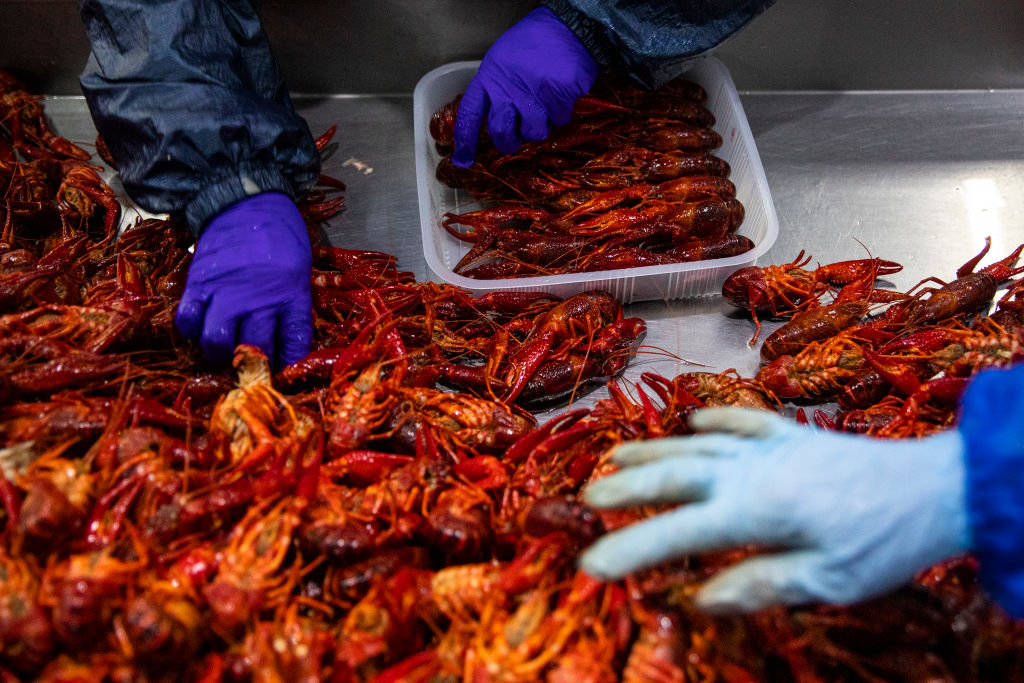
In the period from April to July this year, the price of crayfish in China has significantly dropped. In a large-scale agricultural wholesale market in Beijing, the wholesale price of crayfish was initially cut in half compared to the same period last year. By early July, the selling price at the breeding end in Qianjiang, Hubei, had approached the cost line. At the same time, with the continuous expansion of breeding scale and weakening consumer purchasing willingness, small and medium crayfish farmers are under pressure.
According to a report by the Chinese media “New Weekly” on July 24, the “Crayfish Category Development Report 2026” released by the Red Meal Industry Research Institute and Feifei Crayfish Farm estimates that in 2025, China’s crayfish breeding area was about 31 million mu (about 2.07 million hectares), with a production of around 3.75 million tons. On average, this would mean each person would need to eat over 5 pounds of crayfish to consume the entire production.
The scale of crayfish farming in China has been continuously increasing. The “China Crayfish Industry Development Report (2025)” shows that the production in 2024 was 3.4476 million tons, a year-on-year increase of 9.07%, with the number of provinces engaging in crayfish farming reaching 27.
The production in Hubei, Anhui, Hunan, Jiangsu, and Jiangxi accounts for about 90% of the total output in China, while Guangxi, Hainan, Sichuan, Heilongjiang, Xinjiang, and other regions have also joined in. The warm winter and spring climate this year led to early supply in some main producing areas starting from March, further extending the supply period.
Professor Cheung Chin-hung of the Anthropology Department of the Chinese University of Hong Kong, author of “The Temptation of Crayfish,” pointed out that consumer purchasing willingness has weakened. Traditional production areas are expanding their breeding areas, and new production areas are continuously joining in. The market is facing challenges in absorbing the large amount of crayfish being marketed.
“It’s not that people no longer want to eat shrimp, it’s that they can’t eat them all anymore,” he said.
“Inadequate production capacity and price fluctuations are impacting small-scale farmers with less than 10 mu in operation,” reported “New Weekly.”
According to a report from “Hai Bao News” on July 6, the selling price of crayfish in Qianjiang, Hubei, once dropped to as low as 8.5 yuan per jin, while the local breeding cost is around 8 yuan per jin. At that time, small crayfish were only selling for 5 to 6 yuan per jin, while large crayfish were priced at 18 to 20 yuan.
According to the “China New Economic Longitude” citing data from the agricultural trading platform “Yi Mutian,” since March of this year, crayfish prices have dropped by about 30% to 40% compared to the same period last year, with prices for large-sized products nearly halved. In May, market supply heat increased by 28% compared to the previous year, while procurement heat remained relatively stable.
On May 8 at the Beijing Xinfadi Agricultural Wholesale Market, the wholesale prices of small and large crayfish were 15 yuan and 21.5 yuan per jin respectively, representing a year-on-year decrease of 3.2% and 8.5%. On April 1, at the beginning of the season, the wholesale prices for these two types of products were 17.5 yuan and 22.5 yuan per jin, showing a decrease of 35.2% and 52.6% respectively compared to the previous year.
Despite the significant drop in crayfish wholesale prices, consumer willingness has not rebounded. “New Weekly” reported that crayfish used to be popular due to late-night snacks and dinner scenes, but this year, young consumers are less willing to organize gatherings specifically for crayfish meals, finding the peeling process cumbersome and messy, leading to a decrease in crayfish consumption choices when ordering.
Data released by the China National Bureau of Statistics on July 15 showed that in the first half of 2026, China’s catering income grew by 2.8% year-on-year, but the growth rate decreased to 1.2% in June, 1.6 percentage points lower than the overall growth rate in the first half of the year, indicating weak consumption growth in the catering sector.
As of April this year, China had approximately 61,000 specialized crayfish stores, with brands having less than 5 stores accounting for 98.45% of them. These small and medium operators also need to bear costs such as rent, labor, processing, and losses, and the decline in wholesale prices has not yet fully reflected in restaurant retail prices.
According to previous reports cited by “New Weekly,” some low-price activities use small crayfish weighing 3 to 4 qian each, with each shrimp weighing less than 20 grams and shells accounting for more than half, resulting in a small edible portion. In response to these issues, some netizens commented, “Restaurants still charge the same, 100 yuan for three jin,” while others said, “Even with a big bowl, there’s not much meat.”