
On Thursday, November 5, California Governor Gavin Newsom announced a significant decision regarding the state’s capital punishment system. He declared that all 548 death row inmates in California would have their death sentences commuted to life imprisonment without the possibility of parole. This announcement has sparked a wide range of reactions across the political and public spectrum.
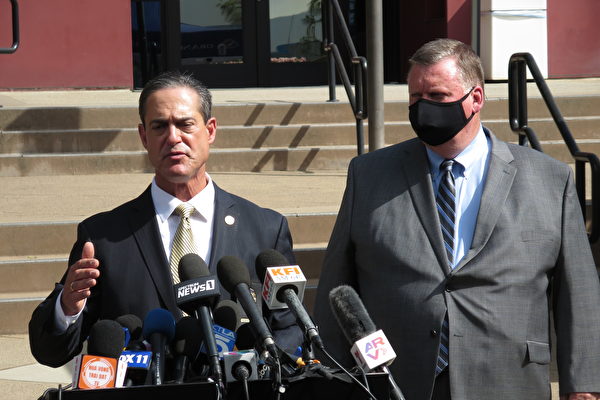
Todd Spitzer, the District Attorney of Orange County, issued a statement on the same day, expressing his strong disapproval of the Governor’s decision. He likened it to showing mercy to “wolves” while being brutally harsh towards “sheep,” emphasizing a profound moral concern regarding the implications of such a policy.
In his statement, Spitzer posited, “How can crimes go unpunished?” He firmly stated that in cases involving particularly heinous offenses, death may be the only appropriate punishment. As an elected District Attorney, he has consistently sought and will continue to pursue the death penalty in situations where justice demands it.
Spitzer noted that the death penalty has garnered support from California voters multiple times. As a prosecutor, he believes he represents the interests of the people of California and the public good, while suggesting that Governor Newsom does not reflect these values. He asserted, “The death penalty is not a decision made by the District Attorney, a judge, or the Governor, but rather a verdict rendered by a 12-member jury who, after hearing all the evidence, determined that death was a just outcome.”
Spitzer expressed his belief that it was not surprising for Newsom to unilaterally overturn a judicial decision, interpreting it as another step in his plan to empty California’s prisons. This decision sends out a troubling message: “No one has to bear responsibility for their actions.” For numerous families of victims, this represents a crushing blow, as it brings their perpetrators closer to freedom.
Starting from October 1, new regulations were implemented by the California Parole Board, allowing thousands of inmates sentenced to life without parole the opportunity to apply for parole. Spitzer criticized this as a total destruction of the sense of safety and closure that victims’ families had previously felt. They were promised that those who committed serious crimes would serve their lives behind bars.
He lamented, “In today’s society, the cries of criminals seem to overshadow the wails of victims… this is akin to twisting the knife further into those who have already endured unimaginable pain.” Spitzer insisted that Governor Newsom should feel shame for his actions.
In a letter addressed to all Californians, Newsom articulated that the execution of the death penalty within an imperfect legal system prevents the commitment to core values, with justice and human dignity being paramount among them. Having served as an elected official for over 30 years, Newsom has consistently opposed capital punishment. Upon taking office as Governor in March 2019, he immediately ordered a moratorium on the execution of death row inmates.
With California housing the largest death row population in the Western Hemisphere, many residents believe that individuals who commit heinous crimes should face the ultimate punishment. However, Newsom has maintained that “from a moral standpoint, the state has no right to take away their lives.” He concluded that commuting the sentences of all individuals on death row to life imprisonment without parole is the most severe punishment he believes he can ethically enforce.