
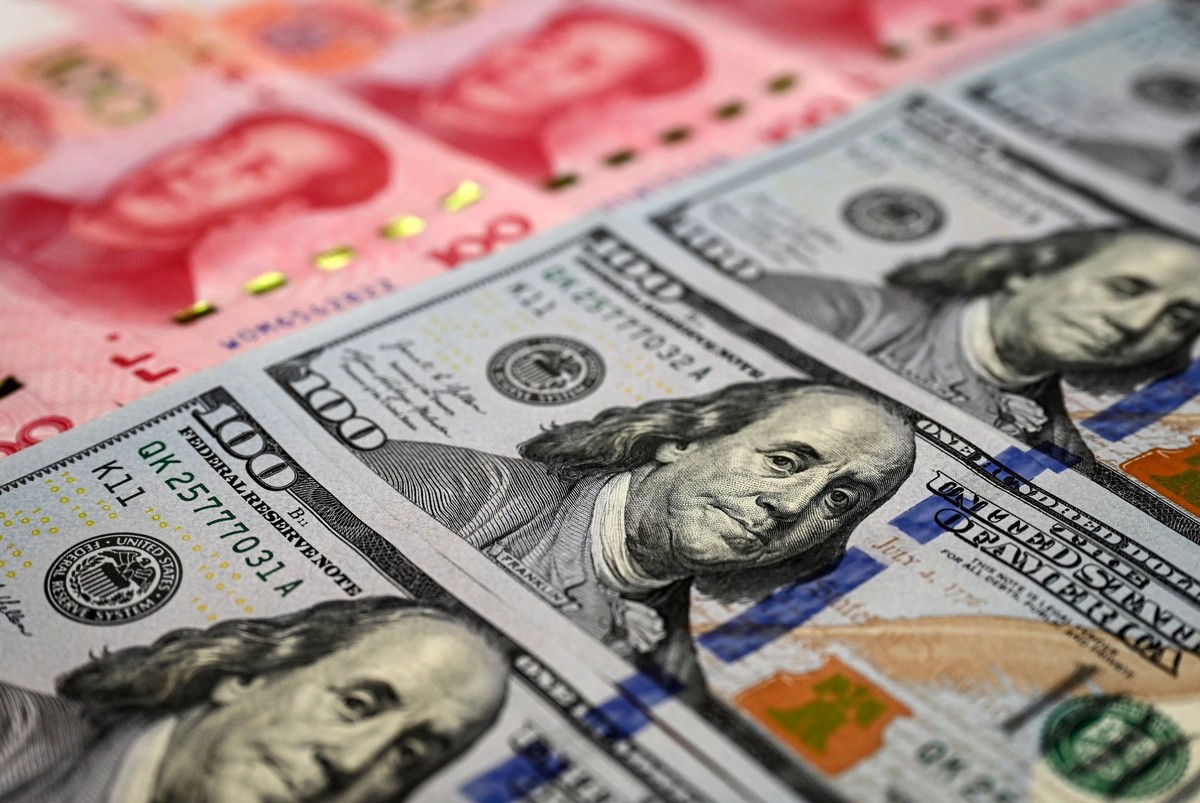
China’s exports have consistently maintained a trade surplus, combined with the weakening of the US dollar, resulting in the Renminbi (RMB) to US dollar exchange rate reaching a three-and-a-half-year high.
On September 4th, the onshore Renminbi closed at 6.7108 against the US dollar, reaching a level not seen in over 3.5 years.
In late August, the USD to RMB briefly touched 6.7190, breaking below the psychological barrier of 6.72, then rebounding to around 6.7210. Market analysts view 6.7200 as a key support level.
That same day, the People’s Bank of China set the central parity rate at 6.7787 RMB to 1 USD, also reaching a more than 3.5-year high. The deviation from market expectations widened to around 700 basis points, marking the largest deviation in nearly six months.
Goldman Sachs’ report indicated that the RMB onshore has appreciated by nearly 4% this year, with China’s strong exports being one of the reasons driving the exchange rate higher. It is predicted that in the coming years, the RMB may appreciate by 3% to 5% annually.
Over the past 20 months, the RMB has appreciated by nearly 9% against the USD, reaching its strongest level in three and a half years.
According to reports from mainland media on September 3, Yang Fan, chief analyst of macroeconomics and policies at CITIC Securities, mentioned that recent developments in the US have put downward pressure on the USD, constraining its rebound potential and providing favorable external conditions for the RMB to appreciate.
Guan Tao, chief economist at China Fortune Securities, noted that the 2026 first-half report on the RMB exchange rate issued by the National Institute of Finance and Development under the Chinese Academy of Social Sciences indicates that China’s persistent trade surplus continues to support RMB appreciation.
The report further suggests that the RMB is expected to continue its bi-directional volatility against the USD, with limited room for further appreciation, yet buoyed by the trade surplus and current account surplus.
Yuan Haixia, director of the China Chengxin International Research Institute, mentioned that the sustained trade surplus continues to provide added foreign exchange income, as the willingness of enterprises to convert currency receipts into immediate revenue has increased, which, in turn, supports the RMB’s strength.
Market participants anticipate that the People’s Bank of China will limit the RMB’s appreciation by year-end to support export competitiveness.
Recently, some market observers have noted signs indicating that the PBOC has begun to slow down the pace of RMB appreciation, with decreased trading activity, reduced USD sales by export companies, and adjustments in the daily central parity rate.
On September 1st, the PBOC set the central parity rate at 6.7809, significantly weaker than the market expectation of around 6.7170, with the official rate falling over 630 basis points below forecasts. This trend continued with further reductions in the central parity rate on September 2nd and 3rd.
Multiple major global banks surveyed by Reuters forecast a median year-end exchange rate of around 6.68 USD to RMB, with HSBC predicting it will remain at 6.72 by year-end, and Goldman Sachs setting a 12-month target of 6.40.
The central parity rate for the RMB is considered a “barometer” of the foreign exchange market, determined by the PBOC daily before the market opens, serving as the benchmark price for interbank foreign exchange transactions, with fluctuations limited to within 2%.
Since November 2025, the PBOC has consistently set the central parity rate weaker than market expectations. State-owned banks have also intervened multiple times to purchase foreign exchange to control the pace of RMB appreciation.
Peter Berezin, Chief Global Strategist at BCA Research, believes that China will not allow significant appreciation of the RMB against the USD or any other currency. Leading indicators such as lending and consumer activities continue to decline, contradicting the logic of a significant currency surge.
Zhu Chaoping, Global Market Strategist at J.P. Morgan Asset Management (Shanghai), similarly stated that the low-interest-rate environment continues to drive capital outflows, suggesting that even though there is room for RMB appreciation for the rest of the year, the magnitude will not increase significantly.