
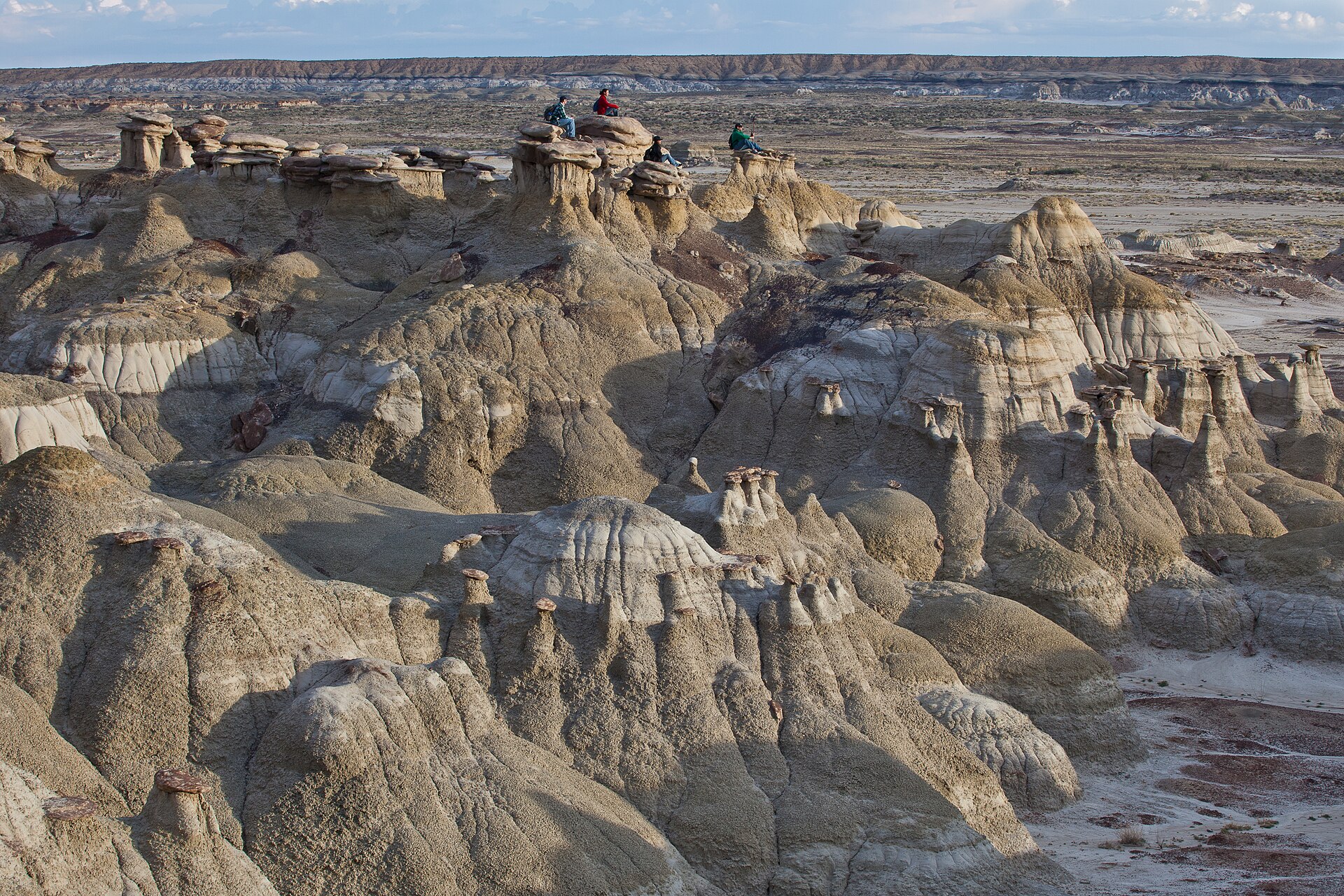
In the northwestern region of New Mexico, a breathtaking landscape of undulating plateau desert has been a source of wonder for many. Recently, following days of relentless rain, two iconic sandstone pillars—known as “Alien Throne” and “King of Wings”—have tragically collapsed. These extraordinary formations have evoked feelings of sorrow and nostalgia among the public.
Reports have emerged highlighting the severe impact of multiple rounds of intense storms across New Mexico, as well as parts of Colorado, Utah, and Arizona. Rising river levels led to flooding that inundated previously arid riverbeds, devastating homes, further saturating soils, eroding landscapes, and resulting in substantial economic losses.
Meteorologists estimate that from late October to early November, nearly 200 trillion gallons (approximately 757 trillion liters) of rainfall occurred in these states due to an influx of tropical moisture.
The “King of Wings” collapsed in early October, and news of its fall quickly spread across social media platforms. Visitors documented the transformation of this grand slab of stone that once majestically towered above the mudstone landscape but now lies shattered on the ground.
Kialo Winters, a local tour guide and founder of Navajo Tours USA, stumbled upon the destruction of the “Alien Throne,” known in Navajo as Tsé Bináká Níyol, while leading a group through the Ah-Shi-Sle-Pah Wilderness on October 30. The sight of the monument reduced to rubble was heartbreaking for Winters.
He recounted his experience to the Associated Press, saying, “It felt surreal, and I had to stop. My mind was in chaos.”
The precise timing of the “Alien Throne’s” collapse remains uncertain, as Winters had faced challenging road conditions that kept him from the area for several weeks. He had not seen any posts online regarding its status until he witnessed the scene for himself.
Alan Studt from Parma, Ohio, reflected on his first visit to these sites in 2019 and a subsequent 50-day road trip in April 2025, during which he returned to see the formations again. Looking back at photos he had taken earlier, he noted new wind erosion holes on the “Alien Throne” and cracks at the base of the “King of Wings.” He concluded that these signs of weathering indicate that these formations could not stand forever.
The collapse has resonated widely on social media, prompting discussions around the fragility of physical structures and natural wonders, intermingled with a sense of mourning for the lost landscapes. Some expressed gratitude for having witnessed these remarkable formations and captured them on film, while others lamented their missed opportunities to see them.
For Winters and other Native Americans in the region, these rock formations hold significance beyond mere geological formations. For thousands of years, they have served as natural landmarks guiding ancestors along trading routes and connecting generations through shared stories.
Winters expressed that despite the physical disappearance of these pillars, their cultural ties to identity and history remain strong. He hopes that through photographs, illustrations, and the shared memories of those who traversed the desert, this legacy will continue.
He also urged visitors to respect the site by allowing it to “rest,” refraining from climbing on any remaining stones, and strictly advising against taking home any fragments.
The two distinct sandstone pillars are situated in the Bisti/De-Na-Zin Wilderness of northwestern New Mexico. This area, once an ancient river and delta sediment zone millions of years ago, has evolved over time into a unique stratification of shale, mudstone, sandstone, and coal layers, commonly referred to as “badlands.”
Under the effects of erosion, this plateau desert has formed countless unique formations known as hoodoos. The “Alien Throne” was particularly renowned for its sci-fi-inspired complex layered structure, resembling a giant crown, often inspiring astronomical photography and serving as a backdrop for science fiction films. Meanwhile, the “King of Wings” was distinguished by its long, slender, and seemingly gravity-defying sandstone wing that jutted skyward.
The structural integrity of these hoodoos is inherently fragile. The tops of these formations are generally composed of harder sandstone, while the supportive “neck” below consists of relatively softer mudstone or shale. Over the years, while wind and rain have sculpted these pillars, they have also weakened the lower supporting structures.
The recent heavy rains, a rarity in this region known for its low annual rainfall, rapidly saturated the underlying soft mudstone, stripping it of its load-bearing capacity. Once the weight of the heavy sandstone top exceeded the limit of the mudstone’s support, the resulting pressure led to the catastrophic collapse of the entire structure in a matter of moments.