
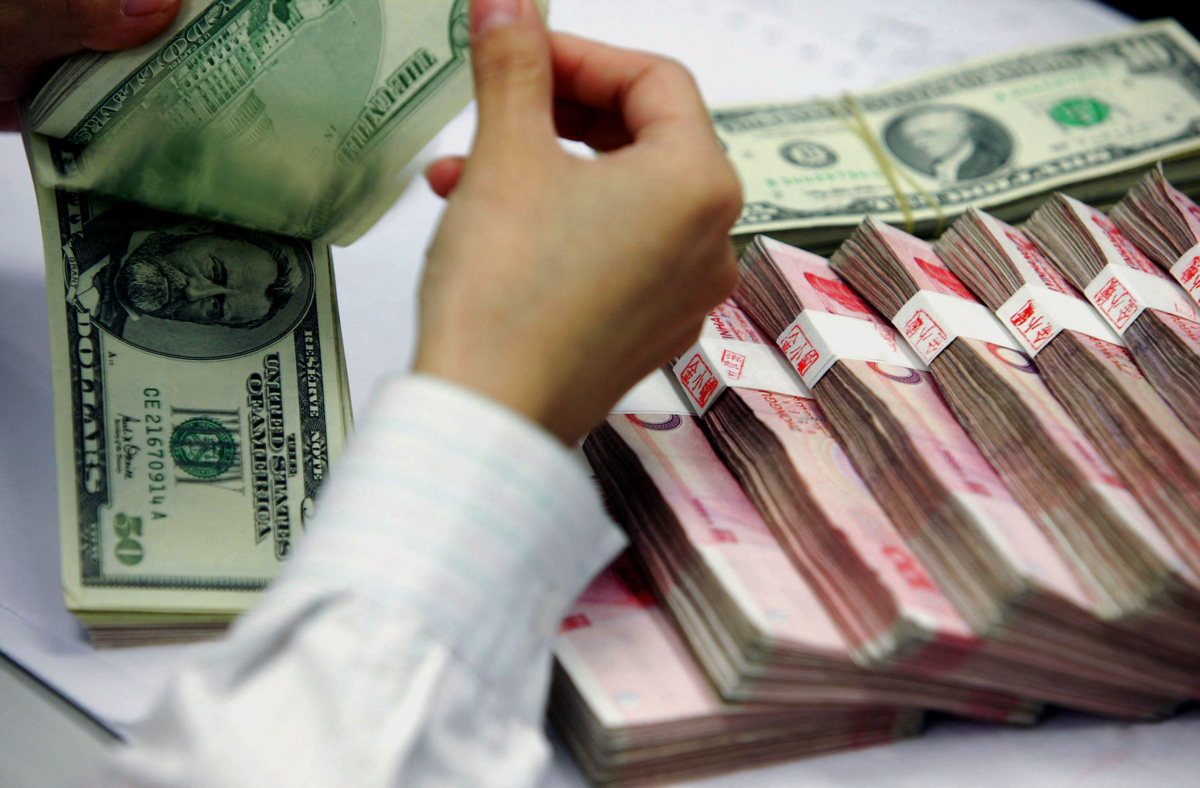
Since the beginning of this year, the Chinese yuan has been on a steady upward trajectory in its value, with the CFETS index, which tracks the overall performance of the yuan, rising by 5.79%. According to projections by Goldman Sachs, the yuan is expected to appreciate further, potentially reaching 6.40 yuan against the U.S. dollar within the next twelve months. However, this rise in the yuan’s value is having a constricting effect on the profit margins of Chinese exporting companies, with some business leaders lamenting that the appreciation is eroding their already slim profits.
As Reuters reported on November 6, the yuan has appreciated nearly 5% against the U.S. dollar this year and approximately 9% against the euro. Goldman Sachs forecasts that the currency will strengthen from its current level of around 6.70 yuan per dollar to 6.40. The CFETS index has also gone up by 5.79% this year, indicating that the appreciation of the yuan is not limited to its exchange rate with the dollar alone.
In the first nine months of this year, China’s goods trade surplus reached an impressive $938.1 billion, surpassing $726.2 billion during the same period last year. The increase in export revenues has led to a heightened demand for exchanging dollars into yuan, further pushing up the value of the former. This has resulted in a cyclical trend characterized by “expectations of appreciation, companies consolidating their foreign exchange, and a subsequent further rise in the yuan.”
For exporters, however, the appreciation of the yuan means that the same income in dollars translates to lesser yuan upon conversion. Chen Lifeng, a garment exporter from Ningbo, Zhejiang province, noted that the rise in the yuan makes products significantly more expensive in European markets, nearly devouring the profits of his company.
“This has already impacted our ability to secure orders; there is hardly any profit left. If the yuan continues to appreciate, we will not be able to sustain our operations,” said Chen. His company, Tengsheng Garments, primarily exports to Europe.
Similarly, Chen Xiujun, head of a plastics manufacturing firm in Fuzhou, Fujian Province, expressed concerns about domestic “overcapacity and fierce competition,” which have forced companies to seek customers overseas. However, the appreciation of the yuan adds new pressures. He stated, “There is nowhere left to hide.”
Hu Yuanfang, a co-owner of a metal furniture company in Hangzhou, mentioned that if the yuan continues to increase in value, she might have to raise product prices, which could adversely affect sales. She is considering switching to cheaper materials and packaging options to mitigate losses.
The struggles of these companies are reflected in their profitability figures. An analysis by Reuters of 5,209 listed Chinese companies and 9,733 overseas firms showed that the median net profit margin for Chinese companies in the first half of the year was only 4.9%, whereas their overseas counterparts achieved 8.9%. Another study from Natixis cited that profit margins in key Chinese industries, such as electric vehicles, batteries, solar and wind energy equipment, and semiconductors, hover around a mere 2%.
Standard Chartered Bank estimates that for every 1% increase in the yuan’s real effective exchange rate, the average profit margin for exporting companies would drop by approximately 0.3 percentage points.
Confronted with upward pressure on the yuan, the People’s Bank of China announced on November 3 that it would raise the foreign exchange reserve requirement ratio for financial institutions from 4% to 6%, effective November 15. This decision is expected to lock away an additional $24 billion in the financial system, tightening dollar liquidity in the market to slow the pace of yuan appreciation.
This move indicates that the Chinese authorities do not wish for the yuan to appreciate too quickly. According to Ding Muqiao, an analyst at China Merchants Bank, if necessary, there is room for further policy adjustments.
The issue of the yuan’s exchange rate has also sparked trade disputes between China, the U.S., and Europe. European leaders and the International Monetary Fund (IMF) believe that the yuan remains undervalued, giving Chinese exporters an unfair pricing advantage. In July, the IMF estimated that the yuan’s real effective exchange rate is undervalued by 17.3% to 25.3%. German Chancellor Merkel suggested that this undervaluation could be as high as 25% to 30%.
However, some analysts argue that even with the yuan’s appreciation, systemic economic imbalances in China may not be resolved. Former IMF officials like Gita Gopinath believe that the exchange rate reflects the structural imbalances within China’s economy rather than being the underlying cause. If domestic demand does not improve, simply raising the yuan’s value could potentially exacerbate deflationary pressures.
The People’s Bank of China, on the other hand, asserts that China’s trade surplus arises primarily from its industrial competitiveness rather than the exchange rate of the yuan. This perspective has not quelled concerns regarding the underlying weaknesses in domestic demand, overcapacity, and reliance on exports.
A representative from a bathroom fixture factory in Wenzhou, Zhejiang Province, voiced his frustrations to Reuters, stating that the rising yuan, coupled with stringent enforcement of tax, social security, and labor regulations, is gradually eroding the company’s remaining profit margins. “Our profit margins have been squeezed to the limit,” he concluded.