
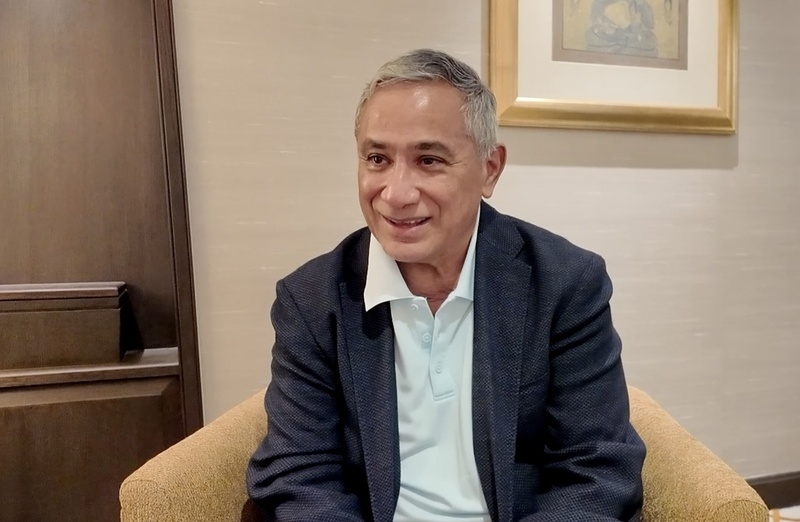
Belizean Prime Minister John Briceño recently sat down for an exclusive interview with the Central News Agency to discuss the Taiwan issue, expressing a clear stance and criticizing China’s unjust sanctions against Belize’s Foreign Minister. He emphasized that Belize’s unwavering support for Taiwan will not waver. When it comes to national governance, he pointed out the challenges the government faces in providing basic public services to residents in a country with a small population and scattered communities.
Briceño, dressed in casual sports attire, was seen chatting with friends in the hotel lobby during his participation in the annual meetings of the International Monetary Fund (IMF) and World Bank in Bangkok. Despite his prominent role as a national leader, it is hard to distinguish him as one without his aides by his side.
The 66-year-old Belizean Prime Minister Briceño is known for his down-to-earth style. In the past, he has mentioned to the Belizean media that he sometimes washes dishes and does housework at home, describing these daily activities as helping him stay grounded.
During the interview with the Central News Agency on the evening of the 14th, Briceño spoke extensively about the close relationship between Belize and Taiwan, always wearing a warm smile on his face. However, when asked about China’s recent sanctions against Belize’s Foreign Minister Francis Fonseca, Briceño’s expression turned serious as he emphasized Belize’s status as an independent country with the right to determine its relations with other countries. He expressed deep concern and disappointment over China’s actions.
Briceño believes that China, as a major country, taking such actions is unreasonable, unnecessary, and “wrong and illegal.” When questioned if the sanctions would affect Belize’s commitment to maintain relations with Taiwan, he emphatically stated that it would not and added that China’s actions only strengthen Belize’s support for Taiwan.
When discussing the reasons for supporting Taiwan, Briceño mentioned Belize’s own experience of facing territorial claims from neighboring Guatemala in the past and ultimately gaining the right to decide its future and become an independent country. Therefore, he believes that “Taiwan should also have the opportunity to decide its own future.”
“We firmly believe in the right to self-determination,” Briceño emphasized, stating that Taiwan possesses many qualities sought after by many countries in fields such as economy, technology, AI, healthcare, education, and climate change research. Belize will continue to advocate for Taiwan’s recognition by the United Nations and other international organizations.
However, Briceño hopes that the relationship between Belize and Taiwan goes beyond diplomatic ties and encourages Taiwanese people to invest in Belize for mutual development. He emphasized the importance of Taiwanese people coming to Belize to seek investment opportunities and actively contribute to local development.
Through practical investments, Briceño believes that Belizeans can better understand that Taiwan is not just a government-level partner but also actively involved in local development.
Regarding shrimp farming technology, Briceño sees many opportunities for cooperation between the two countries. As for technology and AI industries, he suggests starting with technology exchanges that meet Belize’s needs, rather than immediately pursuing the most advanced technology.
He added that with a young population, Belizean youth who receive specialized and university education can quickly learn new technologies, facilitating cooperation between the two countries.
Currently, there are six Taiwanese exchange students working in different departments and fields in Belize. Briceño believes that such exchanges can deepen relations between the two countries, allowing collaboration to extend from the government level to the private sector.
While firmly standing on Taiwan-related issues, when discussing the international financial system, Briceño focuses on how small countries can achieve more equitable development opportunities.
During his visit to Bangkok, Briceño not only attended the IMF and World Bank annual meetings as Minister of Finance but also served as the Chairman of the World Bank Small States Forum to advocate for the development needs of small economies.
Using the example of a project to assist small farmers in improving agricultural climate resilience, Briceño pointed out that Belize must follow various procedures required by the World Bank, but the decision-making process is time-consuming, and by the time all requirements are completed, the project is near completion.
Briceño believes that international financial institutions should adjust procedures that do not suit the actual conditions of small countries and have a better understanding of the limitations in administrative capacity and resources of small countries.
Climate change is also a concern for Briceño. He noted that the proliferation of Sargassum algae has affected a vast region from Florida in the United States to Caribbean island countries. Tourism is a vital economic lifeline for the Caribbean region, and countries must work together to find regional solutions.
In recent years, rising energy and transportation costs have put pressure on small and highly open economies. Briceño stated that increasing energy prices would raise electricity prices, transportation costs, and overall prices, making it essential for small countries to find ways to alleviate the impact of external shocks on people’s lives.
Briceño hopes that the IMF and World Bank will more fully consider the economic conditions of small countries, making international policies and aid mechanisms more aligned with the actual needs of each country.
Governing a small country with a population of around 420,000 may seem like managing a city to outsiders, but Briceño pointed out that one of Belize’s main challenges is the limited population size and the necessity to care for dispersed communities.
With a population of around 420,000 and a land area about two-thirds the size of Taiwan, Briceño highlighted that Taiwan has a population of around 23 million, enabling the government to share the costs of public infrastructure among a larger population. In contrast, Belize has 196 small communities, each requiring electricity, water supply, clinics, hospitals, roads, internet, and phone services, which are very costly.
Briceño said, “Belize not only has a small population but also limited tax revenue, yet it must find ways to ensure that residents in scattered communities can access basic public services.”
He stated that the government must continually strike a balance with limited resources, and the challenges of governing a small country are not just due to the limited economic scale but also ensuring that every community enjoys basic amenities while maintaining financial sustainability.
Starting his second term as Prime Minister in 2025, Briceño’s challenges, from insisting on autonomous choices of diplomatic partners to ensuring that all national residents can access basic public services, reflect the practical difficulties faced by small countries in international politics and national governance.