
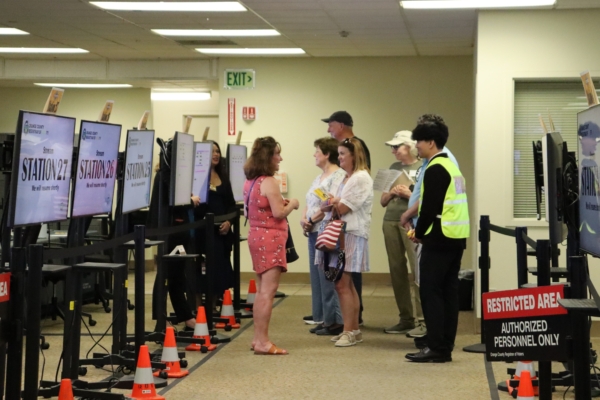
On October 6th, the Orange County Registrar of Voters held an “Open House” event to introduce residents to the voting process and the handling of ballots. Many residents interested in the election attended the event to inquire about their concerns with the staff.
Bob Page, the Orange County Registrar of Voters, emphasized the importance of holding an “Open House” event before elections, providing residents with three hours to understand the ballot processing procedures. Staff at 17 workstations explained their responsibilities for about 5 minutes per group and were ready to answer voters’ questions at any time.
October 5th was the deadline for mailing in ballots in California. In recent years, the state government has encouraged young people under 18 to register early (including party preferences) to vote once they turn 18. A high school student who hasn’t reached voting age yet said they attended the event to gain some valuable insights.
Voter education is an ongoing effort, according to Page. The election center has expanded its work area this year to speed up ballot processing. Thanks to state funding, they will use automated software to verify signatures on envelopes for the first time.
Page explained, “Similar to many other industries, we are using automated software for signature verification by comparing signatures on envelopes with samples in the voter database. We have set strict standards for high-confidence matches, which are more stringent than manual standards and expected to reduce the number of reviewers by about one-third.”
“If the software determines a high-level match, the ballot is accepted; if not, the ballot goes for manual verification,” Page said. The Orange County Registrar of Voters has 54 full-time staff, with an additional approximately 1,900 temporary staff to be hired for the November elections. The highest number hired previously was 2,200 people.
Regarding the impact of a recent court ruling on California, Page mentioned that while the Supreme Court has allowed access to databases for identity verification, states are not obligated to use them. “State law does not authorize us to use the database,” he clarified.
Furthermore, he explained that the ruling prohibits systematic removal of voters within 90 days of an election. Despite the open database access, it’s impossible to input all voter data for comparison at once; only individual voter queries are feasible.
Page added, “Federal law requires voters to declare their citizenship, and California law mandates a declaration of citizenship when registering to vote.” He emphasized that without the authority to independently verify citizenship, changes in the law, such as Proposition 39 for voter ID in November, could impact state election regulations.
According to the Orange County Registrar of Voters, more people are opting to use mail-in ballots, which can be sent back via mail, deposited in convenient ballot boxes, or scanned in-person at the election center. In the November 2022 midterm elections, 84% of Orange County voters used mail-in ballots; this proportion increased to 85% in the 2024 primaries but slightly declined to 77% in the 2024 presidential election. By the June 2026 primaries, 87% of voters used mail-in ballots.
The increasing trend of using mail-in ballots, irrespective of party affiliation, suggests convenience and the growing number of options and candidates on the ballot, requiring more time for research.
The initial results from election night also reflected this trend: in the November 2022 elections, 77% of voters used mail-in ballots, rising to 91% in the 2024 primaries, 89% in the 2024 presidential election, and 94% in the June 2026 primaries.
To ensure fairness and transparency in elections, especially given that a majority of Orange County voters utilize mail-in ballots, attention to critical aspects related to mail-in voting is crucial.