
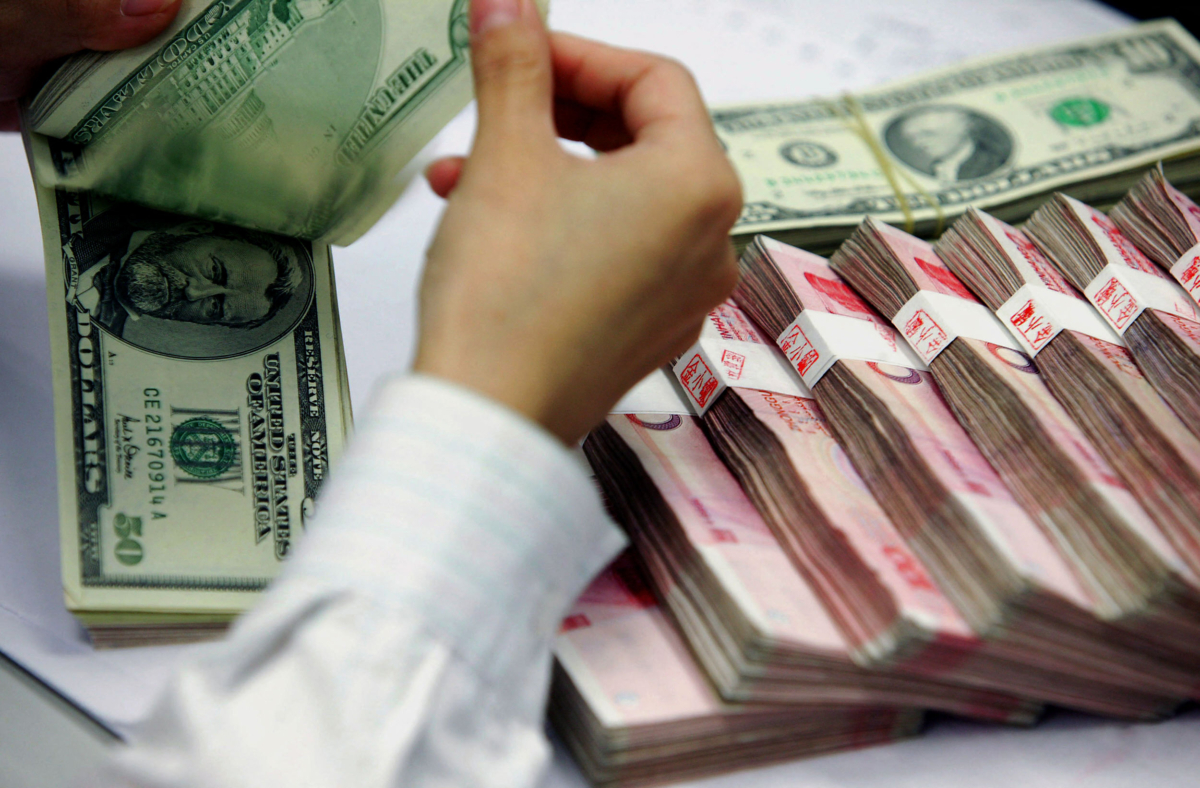
Despite a slight increase in the renminbi (RMB) exchange rate this year, various institutions and international organizations still assess that the currency remains significantly undervalued. The Chinese Communist Party (CCP) is facing pressure from the U.S. and Europe to appreciate the renminbi, while at the same time contending with the domestic implications of such a move, which could further jeopardize Chinese exporters, hinder economic growth, and exacerbate unemployment issues.
According to a report from Reuters on November 6, Chen Lifeng, who manages a company exporting clothing to Europe, expressed concerns that the recent strengthening of the renminbi has made product pricing prohibitively high, nearly erasing all profit margins.
Since the beginning of this year, the RMB has appreciated nearly 5% against the U.S. dollar and about 9% against the euro. “This has affected our ability to take orders. We hardly have any profit left,” said Chen, the head of Ningbo Tengsheng Garments in eastern Zhejiang Province. “If the exchange rate continues to rise, we will not be able to sustain our operations.”
His worries highlight the difficult situation faced by the CCP. Even though European leaders and officials from the International Monetary Fund (IMF) believe that the renminbi is still undervalued—which gives Chinese exporters an unfair advantage—the Chinese policymakers fear that a rapid rise in the currency could further squeeze the already thin profit margins of exporters and threaten jobs. Furthermore, against a backdrop of weak domestic demand, it could weaken one of the few remaining reliable drivers of economic growth.
Most analysts interviewed by Reuters expect that Beijing will adopt gradual measures to slow the appreciation of the renminbi. However, there is little belief that there will be a fundamental shift in monetary policy, which means the risk of increased friction between China and its trading partners demanding a stronger renminbi is rising.
On Tuesday, the People’s Bank of China announced it would raise the foreign exchange reserve requirement ratio for financial institutions, signaling the central bank’s discomfort with the rapid strengthening of the renminbi.
The shrinking profit margins for exporters may also explain why Beijing is likely to resist Europe’s calls for what they refer to as “currency diplomacy.” This concept, proposed by Europe, is reminiscent of the Plaza Accord reached in 1985 between the U.S., Japan, Germany, and France, which led to a significant decline in the value of the dollar.
Chinese scholars have long viewed the Plaza Accord as a result of U.S. pressure, attributing it as a cause for Japan’s decades-long economic stagnation. However, the other signatory nations of the agreement did not experience comparable fates.
Goldman Sachs projects that over the next 12 months, the RMB will strengthen from its current level of approximately 6.70 to 6.40 against the U.S. dollar.
The impacts of RMB appreciation are particularly severe for low value-added export companies, such as those in the textiles and home appliance sectors. These industries are labor-intensive and are more adversely affected compared to AI-related manufacturing industries.
Zhu Ning, a chair professor of finance at Shanghai Advanced Institute of Finance, stated, “These exporting businesses may have to downsize and lay off workers, further harming domestic consumption.”
Nonetheless, even high value-added sectors are facing very slim profit margins due to weak domestic demand, forcing manufacturers to compete overseas at the expense of their profits.
A Reuters analysis of 5,209 publicly listed Chinese companies, each with a market capitalization of at least $100 million, revealed that their median net profit margin in the first half of this year stood at 4.9%. In contrast, a global sample of 9,733 similar competitive firms had a median net profit margin of 8.9%.
A study by France’s Natixis revealed that in strategic sectors identified by Beijing for future growth, such as electric vehicles, batteries, solar and wind power equipment, and semiconductors, profit margins were only 2%. Analysts pointed out that this data is partly attributable to a low-interest-rate environment and largely achieved through cost-cutting rather than revenue growth.
Their report concluded, “The financial soundness of industries that are hoped to support China’s future growth model largely relies on the central bank, similar to those older industries they are meant to replace.”
Standard Bank estimates that for every 1% appreciation of the renminbi’s real effective exchange rate (REER), which adjusts for inflation against the currencies of trade partners, the average profit margin for exporting companies declines by approximately 30 basis points.
Chen Xiujun, chairman of Fuzhou Hongsheng Plastics Industry Co., explained that “overcapacity and cutthroat competition” domestically have forced companies to seek customers overseas, but they are then confronted with the impact of renminbi appreciation in international markets.
“There’s nowhere to hide,” Chen stated.
The IMF indicated in July that the renminbi’s REER is undervalued by 17.3% to 25.3%; German Chancellor Friedrich Merz estimates the undervaluation to be between 25% and 30%. Despite recent strengthening, data from the Bank for International Settlements (BIS) shows that as of September, the renminbi’s REER is still about 14% below its peak in March 2022.
This decline in exchange rate levels comes at a time referred to by Western policymakers as “China Shock 2.0,” where the increasing sophistication of Chinese exports is viewed as a threat to domestic industries and jobs.
Hu Yuanfang, who co-manages Hangzhou Zhenyu Metal Products Co. with her husband, mentioned that if the RMB appreciates further, she might be forced to increase product prices, something she would prefer to avoid due to its potential impact on sales.
“Customers can probably only accept a price increase of about 2%. In that case, we need to negotiate on how to make up the remaining gap,” Hu explained. She added that potential responses could involve absorbing some losses or switching to cheaper raw materials or packaging.
A boss of a bathroom manufacturing plant in Wenzhou voiced that manufacturers are facing multiple financial pressures.
“The appreciation of the renminbi, coupled with increasingly stringent compliance demands regarding taxation, social security, and labor regulations, is continually eroding our meager profits,” the owner, surnamed Qiu, noted, preferring anonymity due to legal sensitivities.
“Our profit margins have already been compressed to the extreme,” he lamented.