
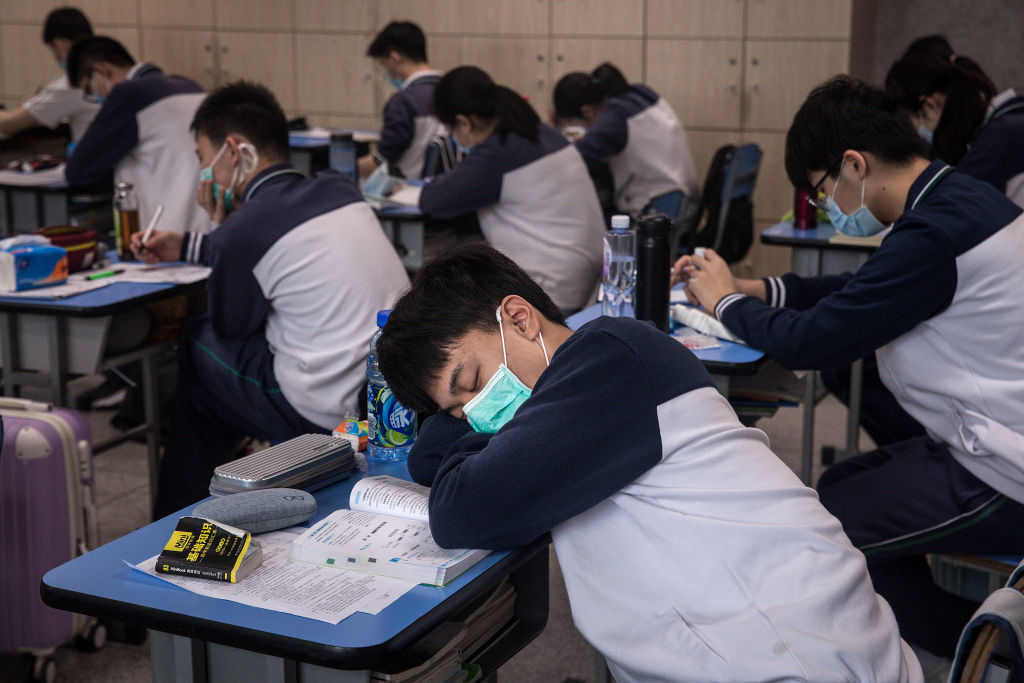
In recent months, several secondary schools across mainland China have begun to delay school start times or even cancel morning classes altogether. This decision aimed to allow students to sleep a bit longer and alleviate their academic burdens has sparked considerable discussion among parents. The critical question raised is whether these changes genuinely address the issues of sleep deprivation and heavy academic workloads.
There are concerns among some parents that simply adjusting school start times without reducing academic assignments may result in what seems like a reduction in workload but could ultimately be just a superficial fix. This apprehension is backed by previous reports from Jiangsu province, where parents of high school students noted that their children were spending upwards of 15 to 16 hours at school each day.
According to a report by Yangtze Evening News on November 3, a number of schools in Nanjing, including Jinzhong Group People’s Middle School, the Thirteenth Middle School, and the Ninth Middle School, have shifted their start times to 7:20 a.m., with classes beginning at 7:30 a.m. at the People’s Middle School.
One parent of a first-year high school student from Jiangning in Nanjing mentioned that their child previously woke up at 6:40 a.m. and finished evening study sessions at 9:30 p.m. The new schedule allows their child to arrive at school at 7:15 a.m. and finish at 9:20 p.m., which, according to the parent, does not significantly change the overall workload or sleeping patterns.
Another parent, whose child is in their third year of high school at Zhonghua Middle School in Nanjing, echoed this sentiment. They noted that while the adjustment allowed for an extra 20 minutes of sleep in the morning, it did not lead to earlier bedtimes in the evening.
Additionally, various schools in regions such as Sichuan and Zhejiang have already made similar modifications to their schedules. For instance, during the spring semester, Chengdu’s Lili Middle School abolished early morning classes for its junior high students and set the school start time no earlier than 7:50 a.m., with classes beginning at 8:00 a.m.
Reports from Ningbo Evening News indicate that an intermediate middle school in the Qianwan New District of Ningbo has also eliminated morning classes that were scheduled between 7:30 a.m. and 7:50 a.m., allowing students to arrive at school by 8:00 a.m. However, the requirement for students to memorize content remains, now moving to an afternoon slot from 3:30 p.m. to 3:50 p.m.
A parent of an eighth-grade student took to social media to express concerns about these adjustments, quoting other parents who feared a return to earlier start times in the near future. The parent noted that some teachers continue to demand adherence to the original schedule despite official notifications, lamenting the challenges of implementing changes effectively.
This parent shared that their child wakes up at 6:30 a.m. and typically works on homework until midnight, often sleeping up to 12 hours on weekends to catch up on rest. Their child once expressed frustration, stating, “Dad, I’m too tired; I can’t finish my homework!” The parent reflected on the disconcerting notion that sleep should not be something that children need to make up for on weekends.
They also recounted that once their child reached eighth grade, previous extracurricular activities like badminton and kicky bag classes stopped, and their child had even taken sick leave recently due to tonsillitis, all while still needing to complete homework and keep pace with the curriculum.
The parent hopes that their child’s school will also revise its schedule to provide students with more sleep and physical activity time, stating, “It’s not that kids are lazy or unmotivated; it’s the education system that is struggling.”
Moreover, some netizens reflected on the situation, remarking that working adults often do not have such lengthy hours at their jobs. Another commenter pointed out that reducing school hours does not necessarily equate to lower early start times and emphasized that actual changes need to address the educational system itself.
A commentary published by Chinanews on November 5 emphasized that unless the volume of homework is reduced and the anxiety concerning college admissions dissipates, merely delaying school start times might only push sleeping hours later without genuinely increasing them.
The article argued that if the prevailing belief remains that “the longer students spend in school, the better they learn,” even with adjusted start times, any extra free time granted to students could be consumed by after-school tutoring and additional homework assignments.
Professor Yao Jijun from the Education Science College at Nanjing Normal University stated that delaying school start times should be accompanied by strict control over the total amount of homework assigned. They stressed the importance of ensuring that the end of evening study aligns with bedtime, thereby preventing any additional sleep time from being reclaimed by school assignments.