
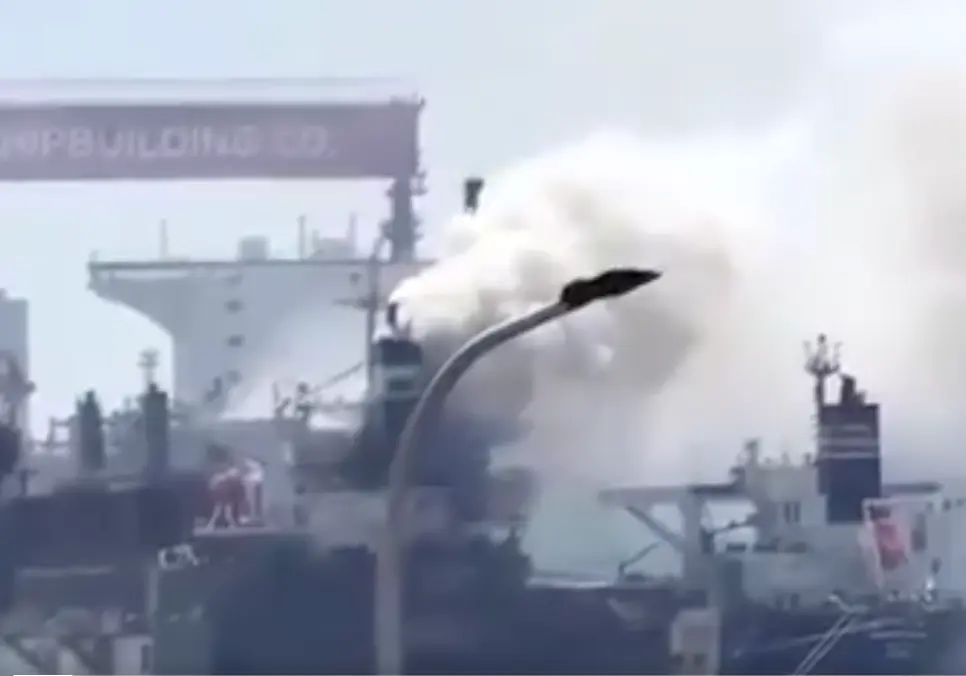
On September 10th, a foreign cargo ship caught fire during maintenance at the Beihai Shipyard in Qingdao City, Shandong Province, resulting in a major accident. Industry insiders revealed to reporters from Dajiyuan that the shipyard had serious internal conditions and safety hazards.
According to the official report of the Communist Party of China, the accident occurred around 11:15 a.m. on September 10th, and the fire was extinguished around 2:30 p.m. A total of 42 people were on board the ship, with 12 safely evacuated, 5 injured, and 25 killed.
The involved cargo ship, named “OCEAN MELODY,” is a bulk carrier with a 20-year-old vessel age, flying the flag of Liberia, and with a cargo capacity of 55,742 tons. The nationality and identities of the deceased have not been officially disclosed.
An industry insider from a shipbuilding company in Anhui, Li Ming (pseudonym), informed Dajiyuan that he knew people within the Beihai Shipyard, and based on the information he received, 5 of the deceased were of foreign nationality, 1 was a third-party individual hired by the shipowner, and the remaining 19 were labor workers.
Li Ming mentioned that 12 people who were close to the exit managed to escape, while 5 were severely injured. He stated, “Those near the exit managed to run out. The ‘OCEAN MELODY,’ a ship under the flag of Liberia, was undergoing maintenance at the dock and carried flammable gases and oil.”
He described the bottom compartment as a closed space with only a circular hole as the escape route, making it difficult to flee in case of an accident, speculating that many people might have been suffocated by the smoke.
Li Ming revealed, “In heavy industry like this, deaths occur every year. Two months ago, two people died at the shipyard next to ours. They died from inhaling argon gas leaking into the compartment during argon arc welding.”
Following the incident, shipyards across mainland China have mostly halted operations for safety checks and training. Li Ming stated, “After an accident occurs, we become aware, then hold a safety meeting. If 5 or more die at once, it becomes a major accident; this is considered a major disaster.”
Li Ming estimated that the victims’ families might receive compensation ranging from around 1.5 to 1.6 million yuan, with the highest known compensation currently standing at 2.2 million yuan, potentially higher for third-party individuals.
Official media has sparsely and limitedly released information about the incident, with many details yet to be disclosed. As of now, the cause of the fire and progress of subsequent handling remain to be further clarified.
One fire monitor at the shipyard, Mr. Wang, informed Dajiyuan that he is currently on standby at home as the shipyard has restricted access, and the situation inside the shipyard is unknown to him, leaving the timing of his return to work uncertain.
Mr. Wang considered himself fortunate as he was initially supposed to monitor the engine room on the day of the incident, but was assigned to oversee welding on the outer propeller guard, which delayed him for a couple of hours. He mentioned, “Thankfully, I didn’t go inside. We watched the welder weld and ensured that the sparks from gas cutting didn’t ignite anything below. Each hot work spot requires a fire monitor.”
He expressed uncertainty regarding the presence of fire monitors in the bottom compartment during the incident and the number of monitors onboard. Once a fire broke out, the space inside the compartment became filled with smoke, hindering visibility and making escape difficult.
During the fire, Wu Tianhao (pseudonym), who worked at a neighboring shipyard, revealed that around 10 a.m. on the same day, a crane collapsed in the scrapyard at the Beihai Shipyard, with the fire breaking out later in the day. He emphasized that the two incidents weren’t related, but they highlighted serious safety management issues at the Beihai Shipyard.
Wu Tianhao commented, “We saw smoke at the time, assuming it was a ship preparing to leave the dock, so we didn’t pay much attention until we learned about the fire in the afternoon.”
He also pointed out that in case of a fire inside a ship, most people would likely suffocate. While those near the exit might have a chance to escape, the limited space and dense smoke inside the compartment would hinder visibility and escape routes.
He mentioned that safety management in various shipyards across China poses hidden risks, reflecting on the need for improved safety measures.
A crane operator from the area, who preferred to remain anonymous, disclosed to Dajiyuan that he worked at the Beihai Shipyard 15 years ago. He mentioned, “I worked in the old shipyard area of the Beihai Shipyard before it moved to the new yard. The work environment at the shipyard was very unsafe, so I quit and changed jobs. Only those in the know understand the recent incidents at Beihai Shipyard.”
It is understood that accidents at shipyards across mainland China are alarmingly frequent but often hidden from public knowledge.
A netizen from Zhejiang posted online stating that significant accidents occur frequently but are suppressed from public awareness.
Another netizen from Guangdong revealed that in 2024, there was a fire at a local shipyard where many people died, but only top management knew the actual death toll. The majority of employees were kept in the dark, and information about the incident only surfaced two years later, with over ten casualties, with no public information available online.