
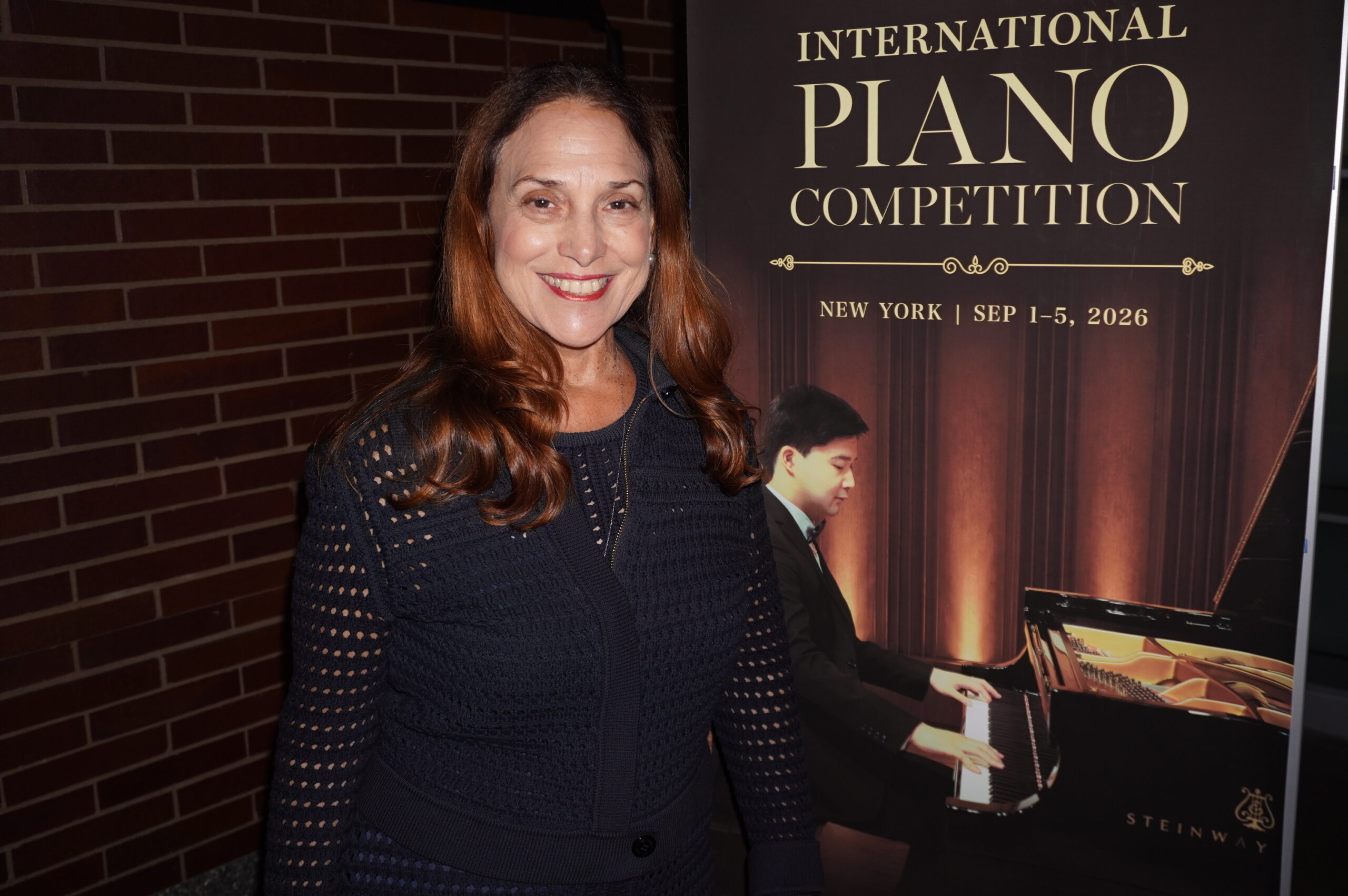
After watching the events of the 8th NTD International Piano Competition from September 3rd to 5th, Irene Diamond, a longtime piano teacher in New York, was deeply impressed by the young performers on stage. To her, this competition is not just a test of playing skills but also a starting point for young musicians to accumulate life and music experiences.
“They are very young, their lives are still long, and this is just the beginning,” Diamond said.
She believes that being able to prepare such challenging and lengthy competition pieces at this age is a rare training in itself. “They already have a good starting point, with such beautiful pieces. They can slowly digest and refine it, making it better over time and continuing to grow.”
Diamond, who has received professional training in piano performance and teaching methods, has been teaching piano for a lifetime. When she watched the competitors perform in this competition, she paid particular attention to the difficulty of the selected pieces and their ability to handle large-scale works.
She mentioned a young competitor’s performance of Schumann’s “Kreisleriana,” a piece that typically lasts about 40 minutes and is a highly challenging repertoire. “It’s really like a doctoral level piece of music,” she said.
She believes that such pieces are not just for competition purposes; “This piece will accompany them for life. As they mature, they will bring out more from the music.”
Regarding the overall technical level of the competitors, she said that all participants demonstrated excellent abilities. She also specifically mentioned a competitor from Poland, noting that her technique and performance ability were “very precise” and that she showed deep internal understanding in the interpretation of the designated competition piece “God’s Call.”
“God’s Call” is the designated piece for this competition. Diamond believes that this work has distinct musical qualities and provides ample space for competitors to showcase their piano playing skills.
“I think this piece is a very important aspect for this competition because it allows pianists to showcase their skills,” she noted, highlighting how the composer incorporated many piano performance techniques into the piece, allowing performers to fully demonstrate their “showmanship.”
What truly impressed her was the different interpretations of the same piece by different competitors.
She described the Polish competitor’s interpretation of the piece as “particularly internalized.” “When you truly internalize a piece, the first question you should ask is: What does the composer want to convey? It’s not just ‘I’m playing this piece,’ but rather – what makes this piece beautiful? What is the composer’s intention?”
Diamond later learned that the Polish competitor, in preparation for this piece, recorded her performance repeatedly, constantly trying until the last moment to find her satisfactory sound. This helped her understand why what she heard from the audience was an expression that had been “internalized.”
“She just kept trying, kept trying until she was satisfied, even until the very last moment when she stepped onto the stage,” Diamond said. “Because it’s like everything finally coming together, including spirituality and emotions.”
She believes that this is also an important part of a musician’s growth – technical skills cannot be separated from internal expression. As performers age, gain experience, and deepen their understanding of the piece, they can gradually touch upon the deeper content of the work beyond just the notes.
This year’s competition focuses on the three important musical periods of Baroque, Classical, and Romantic. For Diamond, this is particularly crucial because different musical periods have their own language, style, and historical background.
She said that the Baroque, Classical, and Romantic periods are roughly located in the 17th, 18th, and 19th centuries, respectively. “You can imagine it as art. When you walk into an art museum, you can see significant differences between art pieces from different eras.”
Similarly, different musical periods have different ways of expression.
Therefore, when listening to the competitors perform this year, she also paid particular attention to how they handled the relationship between “their feelings” and “the composer’s intention.”
“One thing we strive to do is to perform classical music according to the composer’s intention,” she said. Of course, since modern people did not live in the era of composition, understanding the composer’s ideas can only be achieved through research and music heritage, leading to natural variations in interpretations among performers.
At the same time, she observed that “some of the competitors I heard today, I feel they lean more towards playing based on their feelings rather than necessarily the way the composer intended.”
In her view, this ability requires long-term learning and good teachers. “You can’t learn these things overnight.”
She believes that young musicians need to find a balance between personal expression, the work itself, and the historical and cultural context in which the work exists, which is the long-term learning that goes beyond the competition.
Diamond also particularly acknowledges the training value of competitions for young pianists. “I am very willing to recommend my students to participate in such competitions,” she said.
One of the reasons is that competitions require students to prepare a complete set of performance pieces. “Usually they don’t do this. If it’s not for the competition, they might not need to prepare such a complete program. So, this requires a lot of goal-setting to get yourself ready for a whole set of pieces.”
However, in her opinion, the real value of the competition should not just be about “winning.”
Diamond introduced that she uses the Suzuki approach in teaching, starting to teach piano to very young children. A core principle of this teaching philosophy is “Nurtured by Love.”
Therefore, she specially reminds parents and young learners: “Before starting competitions, performances, or other activities, you must first let them have the joy of music.”
She said that children need to first know they are loved, truly enjoy music, and then the external motivations brought by competitions and performances come next. “It cannot be pushed by parents or teachers; it must come from within.”
She even poses a very practical question: “Otherwise, if they don’t win, what will they do?”
In her view, young musicians may initially receive attention because of their talent, but the real challenge is how to sustain it in the long run. “Beyond talent, you need ‘heart.’” She believes that connecting talent with inner love can sustain a young person through the more difficult stages of growth in the future.
Diamond believes that while it is expected to see who will win in this year’s competition, the more important aspect is whether these young performers can take away the experiences accumulated during the competition. “You can see that they must demand a lot from themselves and have great determination to get to where they are today.”
“To prepare a complete competition repertoire of about 45 minutes, along with the different pieces to be played at various stages, is a tough training for young pianists,” she believes. The performances shown by these competitors on stage today are not just accidental “miracles,” but the results of long-term practice, discipline, and determination.
And when the competition ends and the awards are announced, the real journey has just begun. “They can slowly digest this music, make it better over time, and continue to grow,” Diamond said.
For this teacher who has taught piano for a lifetime and has been accompanied by piano almost her entire life, perhaps this is the most important perspective when looking at a piano competition: the competition can test today’s performance, but the real growth of musicians happens offstage and in the long life ahead.