
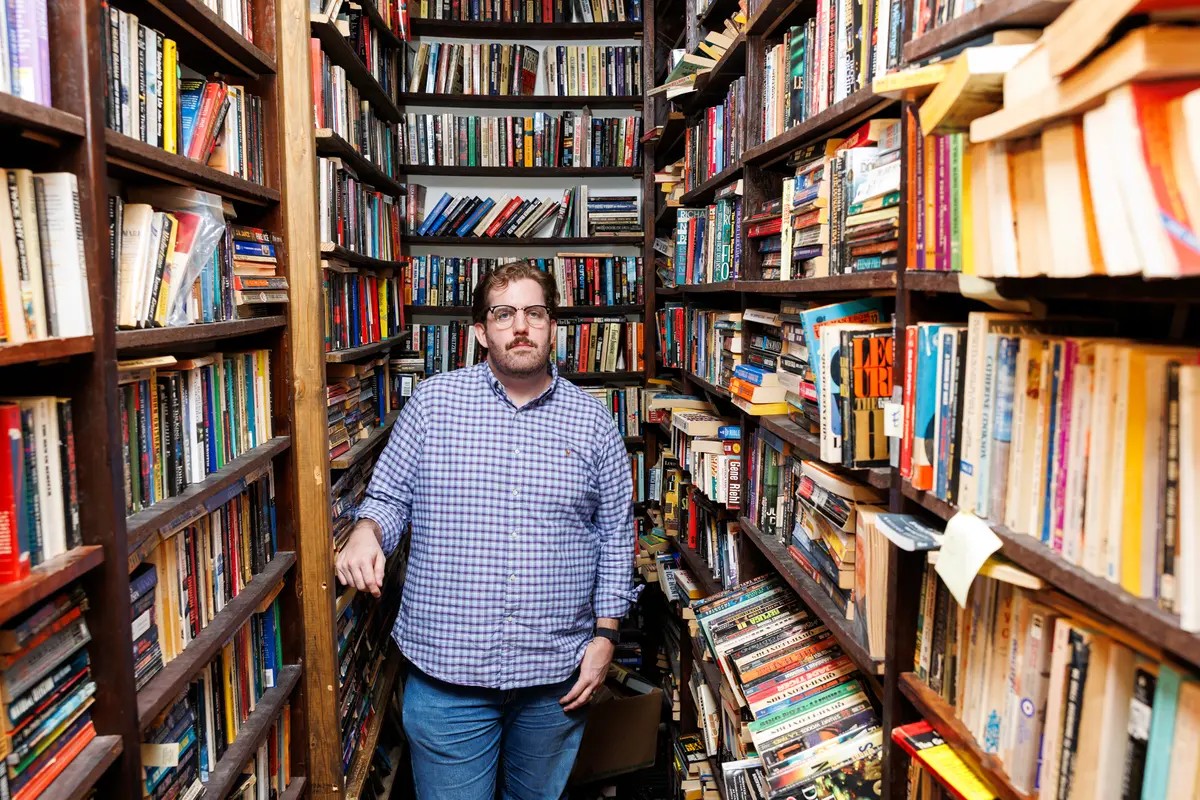
In Houston, Texas, Charlie Becker, the owner of the family bookstore Becker’s Books, has been providing literary works to the local community for over 30 years.
Becker recalled that since his father opened this second-hand rare books store in 1993, their family has “experienced many changes.”
At the age of 12, Becker accompanied his father on the first bulk purchase for the bookstore. A local company planned to dispose of their stock of books, but they contacted Becker’s father first.
“As that company was close to bankruptcy, they said my father had to go and pick up those books. I went with him to the warehouse,” he said.
Throughout Becker’s upbringing, he heard many stories from his father about how he saved books that were about to be sent to the landfill. Over the years, he witnessed the profound changes in the book trade industry with the rise of the internet, digital catalogs, and the emergence of large online book retailers like Amazon.
For generations, booksellers have been dedicated to preserving humanity’s written heritage. However, recent reports indicate that millions of paper books are being scanned by computers for training artificial intelligence models, and then all these books are shredded and destroyed. This practice poses unprecedented challenges.
Even worse, book collectors and sellers say that there isn’t a simple way to prevent this situation from happening.
This so-called “AI book shredding” practice has gained attention recently after a 2025 court document revealed that the AI technology giant Anthropic, based in San Francisco, California, purchased millions of paper books, cut the spines, scanned each page into a digital dataset, and then shredded and discarded the original books.
It was disclosed that this project was part of Anthropic’s central library expansion plan called “Project Panama.” The Anthropic company’s central library aims to collect “all the books in the world” and “permanently” preserve them.
The same court document indicated that Tom Turvey, the former head of Google Books scanning project partnerships, was hired to collect data for this “Panama Project”. Turvey’s team contacted “major book distributors and retailers through email to discuss purchasing bulk print books for Anthropic’s ‘research library’.”
Court documents from the unsealed “Bartz v. Anthropic” lawsuit in January this year revealed that retailers like Better World Books and World of Books were listed as suppliers of thousands of books to Anthropic.
Anthropic has not responded to requests for comment.
“In the AI industry, books are a common way to train large language models,” a spokesperson from Anthropic told tech website “Tom’s Guide”. “Our data collection projects never involve purchasing and destroying rare antiquarian books.”
While a federal judge ruled that destructive scanning of legally purchased books constitutes transformative fair use — changing the original work for a new purpose — this practice continues to spark increasing public outrage.
Concerns among book distributors are escalating. Many booksellers express that systematically destroying books not only signifies the disappearance of text but also the loss of cultural heritage.
“I’ve heard worrying messages. It’s completely understandable for warnings to be raised,” Susan Benne, Executive Director of the Antiquarian Booksellers’ Association of America (ABAA), based in New York, told “Epoch Times”.
Since 1949, the ABAA has been a reliable source of rare and printed books. Benne stated that destroying printed books, even if they are not rare or antiquated, touches a deep emotional chord with most people.
“Think about certain books you read as a child or in college, that emotional attachment, I think for many of us, seeing this destruction is difficult to accept,” Benne said. She likened AI book shredding to floods, museum fires, or other similar catastrophic events, destroying the treasure troves of human knowledge and culture.
“It touches on the same nerves.”
Becker agrees with this sentiment. He believes that the destructive practice of book shredding, especially for training artificial intelligence, triggers a certain “visceral” instinct in people. “I think that when certain books are seen as commodities, or as disposable, we lose something culturally,” he said.
However, Becker clarifies that not all books being input for AI training are rare or out-of-print books.
“Many are dissatisfied because they think those books are as priceless as rare treasures. But everyone needs to remember that often, this data may just be something like an old General Electric refrigerator manual,” he said.
Benne concurs with this. “Out of print doesn’t imply rare. From what we understand, many of them are just very common books.”
But she added, “That’s not to say there’s no cause for concern.”
One of the biggest challenges in stopping the practice of “AI book shredding” lies in the lack of transparency about who is bulk purchasing books.
In July, a report from 404 Media highlighted that the book database ISBNdb claimed in promoting its paper book acquisition service that it would keep buyers’ information confidential.
The homepage of the ISBNdb website once displayed “Acquiring Print Books for Your AI Large Language Model Data Needs” before making changes. The site now states that ISBNdb was “exploring market demands” but has now “decided not to proceed in this direction.”
When asked about this, a representative from ISBNdb reiterated the statement on the company’s website. The representative told “Epoch Times”: “ISBNdb has never purchased, scanned, or destroyed any books for AI training or any other purposes. We have never bought or sold printed books for AI training: no orders, no purchases, no books.”
However, this is just one aspect of the issue. Benne mentioned that when sellers collaborate with major buyers, it may involve non-disclosure agreements. “Asking the other party ‘what are you going to do with this book?’ is not common practice currently.”
It is due to the lack of relevant information that Becker believes it is necessary to understand which books are being scanned for AI and then subsequently shredded.
“Truthfully, no one knows; that’s part of the problem,” he said. “Those who care about our literary heritage should be involved in some part of this process, but the reality is not so.”
As early as April, Becker noticed a sudden surge in book sales, reaching two to three times the usual weekly sales figures.
In the warehouse of the family bookstore, he said while working, “You gradually understand what people are buying.”
With around 300,000 books stored in the warehouse, when sales started to pick up, he began scrutinizing the orders.
“At that time, I went online, and saw many people were saying the same thing,” he said.
“This is just crazy. I counted and then carefully looked at the orders and found that out of the latest 100 book orders we received, 95 were from the same buyer. All orders came from the same buyer, which was very strange.”
Andrea Klein, the operator of The Bookseller Inc. company in Ohio, also noticed some peculiar orders in recent weeks.
For Klein, the magnitude of the increase in book sales was enough to catch her attention. She found that the buyers were not the end-users of the books. “It was evident they were purchasing for someone else,” Klein told “Epoch Times.”
“I thought they were buying for someone in Europe to save on shipping costs by combining orders. But after hearing various AI news, I think that might be the reason.”
The Bookseller Inc. company was founded in a basement in Cuyahoga Falls, Ohio, in 1948 and has been passed down through generations. Today, Klein operates this second-hand and rare book store online. As a smaller retailer, she is very sensitive to anything unusual.
“Usually, I would sell one or two books, customers from everywhere. However, what caught my attention were the recent two buyers who ‘probably related’,” she said.
“They would order five or six good books. They wouldn’t just buy $10 or $20 books but order books worth around $100. This happened around three or four times, even five times.”
Benne mentioned that she also heard about some strange orders circulating in the paper book industry. “As far as we know, a few months ago, there were some peculiar orders surfacing, and discussions were started privately,” she said.
These orders typically involve older or niche books, often published before 2022. These books are valuable for training large language models as they definitely do not contain AI-generated text.
On the other hand, Benne emphasized efforts in the book industry to utilize artificial intelligence more equitably. Companies and non-profit organizations like Project Gutenberg are digitizing book data for preservation.
She believes that digital cataloging and protection differ significantly from mere “acquisition, modification of information, and then unethical use.”
Becker also shares the same view. “I’m not entirely against artificial intelligence,” he said. “I think this is much more complex than simply being in favor of or against.”
After the discovery of the practice of AI book shredding, Becker’s determination to serve literature with artificial intelligence was strengthened. He and co-founder Adam Nelson-Archer are creating an AI-driven cataloging platform for second-hand and rare book sellers. “This is to guard civilization,” he said.
The act of scanning and then destroying books has sparked strong protests, prompting some tech giants to take similar protective measures. Last month, for instance, the world’s richest person, Elon Musk, posted on his X account, stating, “I have asked the SpaceX AI team to preserve all the precious books in libraries and to scan them in traditional ways instead of simply cutting the spines for scanning.”
The exposure of AI book shredding comes at a time when public trust in AI technology in the United States is sharply declining. A recent survey by Bentley University in Massachusetts and Gallup in Washington, D.C., revealed that an increasing number of American adults believe that the disadvantages of artificial intelligence outweigh the benefits, and as many as 73% of Americans do not trust companies to responsibly use AI.