
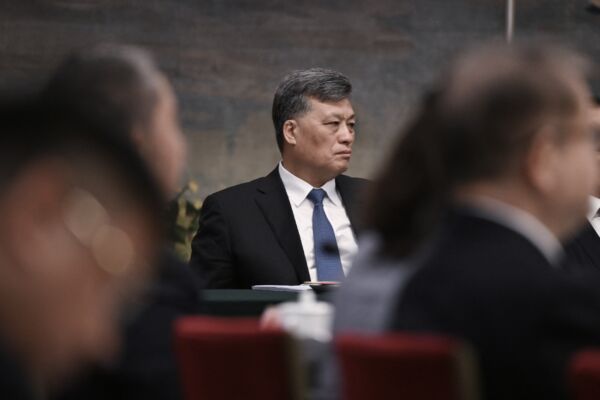
On November 5, the highest prosecutorial authority of the Chinese Communist Party announced that a public prosecution has been initiated against Ma Xingrui, a former member of the Central Political Bureau, on charges of bribery. However, exclusive reports suggest that the true reason for his downfall extends beyond mere corruption, pointing to his involvement in discussions about a potential political coup, a topic deemed taboo by Xi Jinping.
According to insider sources close to the upper echelons of the CCP, the reasons for Ma Xingrui’s recent fall from grace are not related to financial improprieties as perceived by the public, but rather stem from private conversations he had with certain military officials and local dignitaries about Xi Jinping’s succession. This breach of political decorum is believed to have violated the intricate power dynamics within the CCP.
Further insights reveal Ma Xingrui’s long-standing connections with affluent party families and his particularly close relationships with Xi Jinping’s family and Peng Liyuan’s family. Ma’s downfall is now being linked to a shifting power landscape within the CCP, characterized by factional realignment.
Questions arise regarding why exactly Ma has suddenly become a target for Xi Jinping’s purges. Could it be attributed to corruption within military industrial sectors, influence peddling among party elites, or the more sensitive issue of power struggles at higher levels? The insider emphasized that “the decision to apprehend him primarily pertained to political issues. He was not taken down for channeling benefits to the leadership.”
The insider, who chose to go by the pseudonym Tang Ming, pointed out that a crucial factor leading to Ma’s disgrace was an unmonitored meeting involving military and local leaders, which included figures such as Li Ganjie and Zhong Shaojun. The gathering took place during a time when Xi Jinping was reportedly facing health issues, raising concerns among attendees about Xi’s potential incapacitation and discussions regarding succession became inevitable.
According to Tang Ming, the sensitive nature of these discussions attracted the attention of officials like Chen Xi, who monitored the meeting and subsequently reported it to Xi Jinping and the central office, leading to Ma’s immediate arrest. “Is this a political issue? If it were purely economic interests, he wouldn’t have been affected,” Tang asserted.
Even a discussion framed purely around succession could be seen as crossing a line, particularly with the identities of the officials involved. “If I were to fall ill, who are you to debate my successors while I am still alive?” he said, underscoring the gravity of the situation.
Tang Ming highlighted the sensitive political status of those participating in the meeting. For instance, Zhang Youxia was serving as the first vice-chairman of the Central Military Commission, while Zhong Shaojun had worked closely alongside Xi Jinping. Meanwhile, both Li Ganjie and Ma Xingrui held vital resources in local and organizational personnel systems.
The clandestine nature of their discussions mirrored scenarios from ancient Chinese imperial history, where courtiers would debate succession in secret while the emperor was still alive. This scenario brings forth grave implications that could be tantamount to plotting rebellion against the established order.
In discussing the seriousness of the health concerns surrounding Xi at the time, Tang acknowledged the perception among senior officials that Xi was likely to extend his rule indefinitely. However, the emergence of health worries gave rise to speculation among officials about the need for power transition strategies in the event of any unexpected occurrences. “At that moment, everyone felt he would serve indefinitely, thus provoking discussions on who could assume leadership.”
He emphasized that under the current bureaucratic structure of the CCP, any dialogue regarding health, succession, or private dealings among military and political elites could very well lead to accusations of questioning political loyalty. “This was precisely the line Ma Xingrui crossed.”
Moreover, Tang posited that Ma’s disgrace may also reflect deeper political maneuvers, possibly tied to broader power contests as the upcoming 21st National Congress approaches. “Ma Xingrui had been seen as a potential candidate for the Politburo Standing Committee at the 21st Congress. Had he not faced this crisis, he might have ascended to that level.”
Tang laid out a theory of how different power factions interact within the CCP, noting that while officials like Ma Xingrui, Cai Qi, and Li Xi are all under Xi Jinping’s leadership, their political relationships and networks diverge significantly. “Though they are all Xi’s subordinates, Cai Qi’s faction and the aerospace faction, for instance, are not the same.”
As Xi enters his third term, figures such as Cai Qi and Chen Xi, representing an alternative network of loyalists, have begun to consolidate greater political influence, creating pressures to dismantle the old guard.
The balance of power between different factions is often not outright confrontational; rather, it frequently revolves around utilizing disciplinary issues and economic difficulties to advance personnel changes. “If there truly is a problem, then exploiting it to remove someone becomes normal. It is a matter of internal struggles.”
Expectations build as the CCP has announced that the 21st National Congress will take place in the second half of 2027, suggesting a tight convergence between the current political purges and the upcoming arrangements for the Politburo and the Standing Committee.
Throughout the interview, the sources repeatedly underscored that there exists a tacit acceptance of the economic benefits enjoyed by wealthy party families. However, should officials tread into the sensitive territory of political loyalty, military control, or supreme power transition, they risk being purged swiftly.
Comparing various influential families within the CCP, Tang inferred that while there are those who engage in substantial economic activities, the real determinant of whether an official faces investigation often pertains to whether their actions encroach upon the tolerance thresholds set by the highest leadership.
In analyzing whether Ma Xingrui accepted substantial bribes, the narrative differs. According to Tang, Ma’s missteps were less about directly handling significant funds. “Most of the money was actually collected by his wife. He may have known about the arrangements but did not handle most of the money personally,” he disclosed.
It is also suggested that Ma’s partners received intermediary fees amounting to billions, yet his wife’s earnings did not reach those heights. Compared to other officials involved in schemes amounting to thousands of billions, Ma does not stand out as the most egregiously corrupt individual among China’s elite.
Nevertheless, the Central Commission for Discipline Inspection (CCDI) announced on July 14 that Ma Xingrui allowed relatives to exploit his influence for substantial economic benefits and stated that he or those allied with him had illegally accepted significant financial rewards.
Ma’s indictment claims he leveraged his roles across various high-level positions within the government and industry to procure advantages for others and to illicitly accept vast amounts of wealth.
Notably, the indictment did not specify the time frame concerning the alleged offenses or detail his tenure as the Party Secretary of Xinjiang. In contrast to the prevalent view of a 25-year timeline of corruption linked to his ascension in 1999, sources do not concur.
“This is information made publicly available by the CCP. Hardly anyone believes the CCP, yet they attempt to corroborate their accounts with the regime’s own declarations,” Tang articulated, arguing that while Ma held a prominent position in the aerospace sector, the timeline of his alleged misdeeds is exaggerated.
He acknowledged that while long-standing corruption issues plague the aerospace and military sectors, the issues surrounding Ma mainly concern his time in Guangdong and Xinjiang. Ma was appointed to various significant roles within local government after transitioning from his position in the aerospace sector in 2013.
During Ma’s time in Xinjiang, the CCP focused on enhancing investments in infrastructure and major industries across the western region, thus granting considerable project resources to local party leaders. “Ma was pivotal in overseeing projects amounting to thousands of billions, providing ample opportunities for him to facilitate economic benefits.”
Public data indicates that in 2024, Xinjiang was set to implement 430 key projects, with a total investment estimated at 3.3 trillion yuan. Following adjustments, the number of key projects escalated to 466, amounting to total investments of 3.7 trillion yuan.
In March 2025, Ma personally attended an investment promotion event in Beijing with 18 central enterprises. The data at the time revealed that over 40 central enterprises were already engaged in 336 projects in Xinjiang, with investments exceeding 280 billion yuan.
These figures reflect the significant scope of major projects in Xinjiang yet do not directly substantiate any illegal exchanges of benefits. Tang believes that local high-ranking officials wield substantial practical influence in the approval, coordination, and contracting of major projects.
“In the current landscape, the largest opportunities for facilitating benefits to these leader families lie within Guangdong and Xinjiang, with Xinjiang’s projects surpassing those in Guangdong.”
For the insider, what is most notable about Ma Xingrui’s case is this very political reality: within a highly centralized power structure, corruption issues can become a long-term leverage for officials. However, the timing of any inquiry and who is scrutinized may hinge on the shifting political imperatives of higher authorities.