
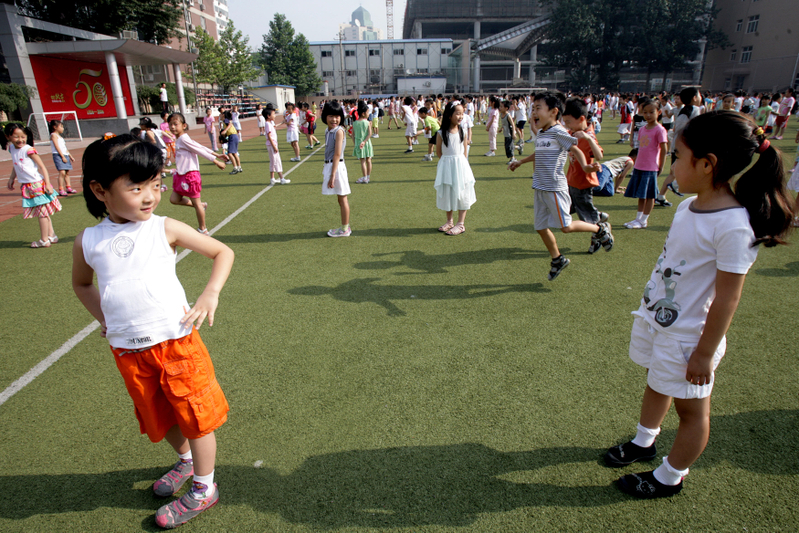
On September 1st, the primary and secondary schools in mainland China welcomed the start of the autumn new school year. Recently, a statistical table regarding the number of new primary school students in various provinces has been circulating on the internet. The data in the table shows that the number of primary school enrollments in Shandong and Henan in 2026 has decreased by over 50% compared to 2023, with several provinces in northeast and central China experiencing a decrease of over 30%. Scholars interviewed noted that the impact of the declining birth rate on primary school enrollment is becoming evident.
According to estimated data released by financial institutions such as Gehoo, in Shandong, the number of primary school enrollments decreased from 1.802 million in 2023 to 0.898 million in 2026, a 50.2% reduction. Similarly, in Henan, the number dropped from 1.745 million to 0.77 million, a 55.9% decrease.
Furthermore, the table shows that the number of new primary school students in Heilongjiang decreased from 453,000 to 239,000, a 47.2% decline; in Jilin, it went down from 401,000 to 213,000, a decrease of 46.9%; Liaoning dropped from 331,000 to 186,000, a 43.8% decrease; Anhui decreased from 1.071 million to 617,000, a 42.4% decline; and Hebei went from 1.246 million to 748,000, a 40% decrease. The reductions in Hunan, Hubei, and Jiangxi were 37%, 34.9%, and 34.2%, respectively.
The Epoch Times reporter has yet to find the complete 2026 enrollment data from the education departments of various provinces.
The data for Shandong’s 2023 primary school enrollments in the table is consistent with the “Statistical Bulletin on the Development of Education in Shandong Province in 2023” published by the Shandong Provincial Department of Education. The 2026 numbers for various provinces can be estimated based on the birth rate of eligible children.
According to the “China Statistical Yearbook 2021,” the national birth rate in 2020 dropped to 8.52 per thousand, breaking below 10 per thousand for the first time and hitting a new low since 1978. First Financial reported that in Shandong, the number of births in 2020 was 870,000, falling below 1 million for the first time since 2001; Henan saw 920,000 births, breaking the 1 million mark for the first time in 43 years, a 36% decline from 2016.
As a result, the number of primary schools in China has been declining for six consecutive years since 2020, with a cumulative decrease of about 34,000 schools over five years. According to data from the “Statistical Bulletin on the Development of Education in China in 2025,” the country saw a reduction of approximately 8,000 regular primary schools in 2025, with nearly 22 schools closing per day.
A scholar, Mr. Lu, who focuses on population and education issues, told The Epoch Times that Shandong and Henan are representative, with the former having a larger birth population and the latter being a populous province. He believes that the decrease in primary school enrollments in both regions indicates that the rate of declining birth rates exceeds some people’s predictions.
Mr. Lu also expressed, “Changes in primary school enrollment can be observed in advance. This year’s first-grade students were mainly born between 2019 and 2020, and the changes in the birth rate will be reflected in primary school enrollments in a few years. Shandong used to have a higher birth rate, but now many young people can’t even afford to support themselves. A friend’s child answered his father, ‘Let’s wait for the next life if you want me to get married and have children.’ It sounds heartbreaking.”
The statistical bulletin also reveals that the national enrollment in primary schools was 14.6174 million in 2025, a decrease of 1.5489 million people or about 9.6% from the 16.1663 million in 2024. Compared to 2013 at 18.7788 million, there was a reduction of 4.1614 million people in two years, approximately 22.2%. The number of primary school teaching points decreased from 52,200 in 2024 to 42,300 in 2025, a decrease of about 9,900 in a year. The number of primary school students also decreased from 105.84 million in 2024 to 101.78 million in 2025, a drop of approximately 4.061 million people.
This year, the Education Department of Shandong Province and seven other departments issued the “Implementation Plan for Scientific Allocation of Basic Education Resources to Adapt to Changes in School-Aged Population in Shandong Province.” The plan states that starting from 2026, non-net inflow areas will no longer establish primary school teaching classes with more than 45 students, and class sizes will decrease annually; rural areas and towns with more outflows of population will generally not establish new primary and secondary schools and kindergartens.
The plan also proposes that compulsory education schools and kindergartens with zero students and no eligible children in the service area for the next three years should be merged based on the law; small-scale schools and kindergartens with continuously declining student populations may have a transitional period.
Mr. Tian, a parent from Hunan (pseudonym), told The Epoch Times, “Even the first-grade classes at schools here are not full. Many schools cannot open classes, with only ten students per class. How can classes run like this? Now, students have to transfer to other schools for combined classes, which makes the commute longer.”
Regarding the employment situation of local young people, Mr. Tian mentioned, “The tourism industry here is not as good as before; many shops have closed. Most of the young people have gone to the provincial capital or other provinces for work, and it is challenging to find jobs locally.”
Ms. He, a retired teacher, expressed concern after seeing the circulating online statistics regarding the number of new primary school enrollments in different provinces. She remarked, “In the past, the ‘large class size’ issue was my biggest headache. It was difficult for a teacher to attend to the psychological and learning differences of every child when a class had fifty to sixty students. Now that the number of students has decreased, with fewer students, the authorities can’t collect as much ‘cabbage’.”
Ms. He stated that the declining birth rate is a global trend, but in China, it needs to be understood from another perspective. She said, “A few days ago, I saw a primary school student crying while doing homework. He said, ‘I’m studying hard, but when I grow up, I’ll still be a servant for the wealthy?’ The words of a primary school student reflect those of adults. Shouldn’t the authorities reflect on this? They fear that after harvesting the ‘cabbage,’ who will support the civil servants?”