
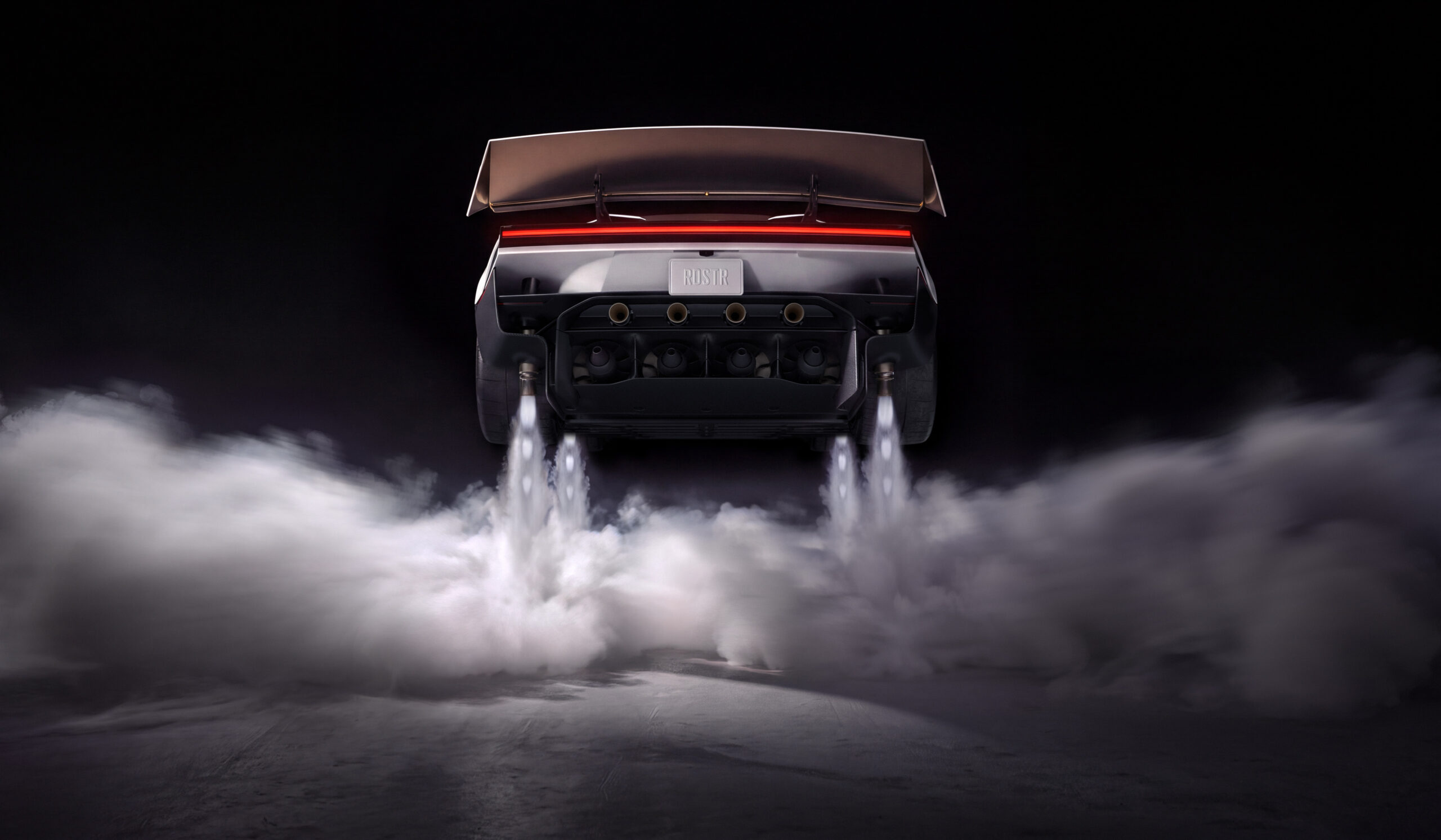
Tesla showcased its new generation Roadster electric supercar in Texas, USA on Thursday (October 15). The car was seen driving upside down and briefly flying over other vehicles. Tesla also announced that the vehicle achieved a test result of accelerating from a standstill to 60 miles per hour (approximately 97 kilometers) in 0.81 seconds. CEO Elon Musk mentioned that the plan is to start production in 2028.
The Roadster prototype was first unveiled in 2017, but its production timeline has been repeatedly delayed. This presentation allowed the public to see how Tesla’s propulsion system developed in collaboration with the space exploration technology company SpaceX enables the electric sports car to briefly leave the ground while driving on roads.
However, from a technical demonstration to actual production, Tesla still faces many challenges, especially with the version that has flying capabilities, in terms of meeting regulatory requirements and obtaining road approval.
The event took place at a SpaceX facility near Waco, Texas (Test Video). The Roadster first drove up a special multi-story ramp, using a bottom fan suction system to adhere closely to the road surface, enabling the vehicle to continue driving even when upside down. Upon reaching the top of the ramp, the car soared into the air, adjusting its posture through cold-gas thrusters, and then landed gently.
Following that, the Roadster flew over a line of Tesla vehicles, including Model 3, Model Y, Cybertruck, Semi electric truck, and Cybercab autonomous taxi, flipping in the air before landing. Musk, witnessing the successful demonstration, casually remarked, “Well, it worked.”
Musk said, “So, it can basically fly like a rocket.”
He also admitted that this may not be a car optimized for safety, but if the fun factor is rated on a scale of 10, it would exceed 11.
The Roadster’s fan suction system can generate a suction force equivalent to about twice the car’s weight at its maximum; high-pressure air tanks store compressed air, which is expelled through nozzles to provide the necessary thrust for flying and flipping. Tesla stated that the vehicle can replenish the compressed air in the tanks on its own, without the need for special chemical propellants.
Tesla’s Vice President of Engineering, Lars Moravy, mentioned that the Roadster’s design inspiration comes from the aerospace field, including the US SR-71 “Blackbird” reconnaissance aircraft. The new car features steer-by-wire technology and a yoke-style steering wheel, along with a retractable tail wing to increase downforce.
Tesla revealed three configurations for the Roadster. The Performance version, with a dual-seat design, equipped with a multi-mode suction system, can accelerate from a standstill to 60 miles per hour in less than 1.6 seconds; the Thrust version, also a dual-seat design, adds a rear cold-gas thruster, with an official claimed acceleration time of less than 0.9 seconds.
The top-tier Rocket version, with a single-seat design, has multiple sets of thrusters around the body, allowing acceleration both forward and upward, as well as rotation in the air. Tesla claimed that the time from a standstill to 60 miles per hour is less than 0.59 seconds for the Rocket version.
Tesla stated that all three versions have a range of over 300 miles (approximately 483 kilometers), with the Rocket edition capable of reaching a top speed of 230 miles per hour (about 370 kilometers per hour).
Musk further suggested that future production vehicles may challenge half the speed of sound, approximately 0.5 Mach, but this has not been achieved yet.
The official price for the Roadster has not been announced yet, but reservations are now open. According to Reuters, the deposit for the Performance version is $50,000, while the Thrust version goes up to $250,000; as for the Rocket version with flying capabilities, it currently accepts reservations only from invited buyers.
For the Performance version, buyers must pay $5,000 upfront, and then transfer the remaining $45,000 within 10 days to complete the reservation.
Additionally, the brief flying capability of the Rocket version involves regulations from the Federal Aviation Administration (FAA) and the National Highway Traffic Safety Administration (NHTSA). It is currently unclear whether such vehicles will be allowed to drive on public roads in the future.
When Tesla showcased the new generation Roadster prototype in 2017, it claimed to start deliveries in 2020, with a starting price of $200,000. Some consumers paid high deposits that year, but the car was delayed multiple times due to the company prioritizing the development of other models. Now, Musk has pushed the production goal to 2028.
Gene Munster, co-founder of asset management company Deepwater Asset Management, stated on the social platform X that this unveiling event mainly showcases Tesla’s engineering and technological prowess. He believes that aside from outshining traditional car manufacturers, this demonstration has no other commercial value.