
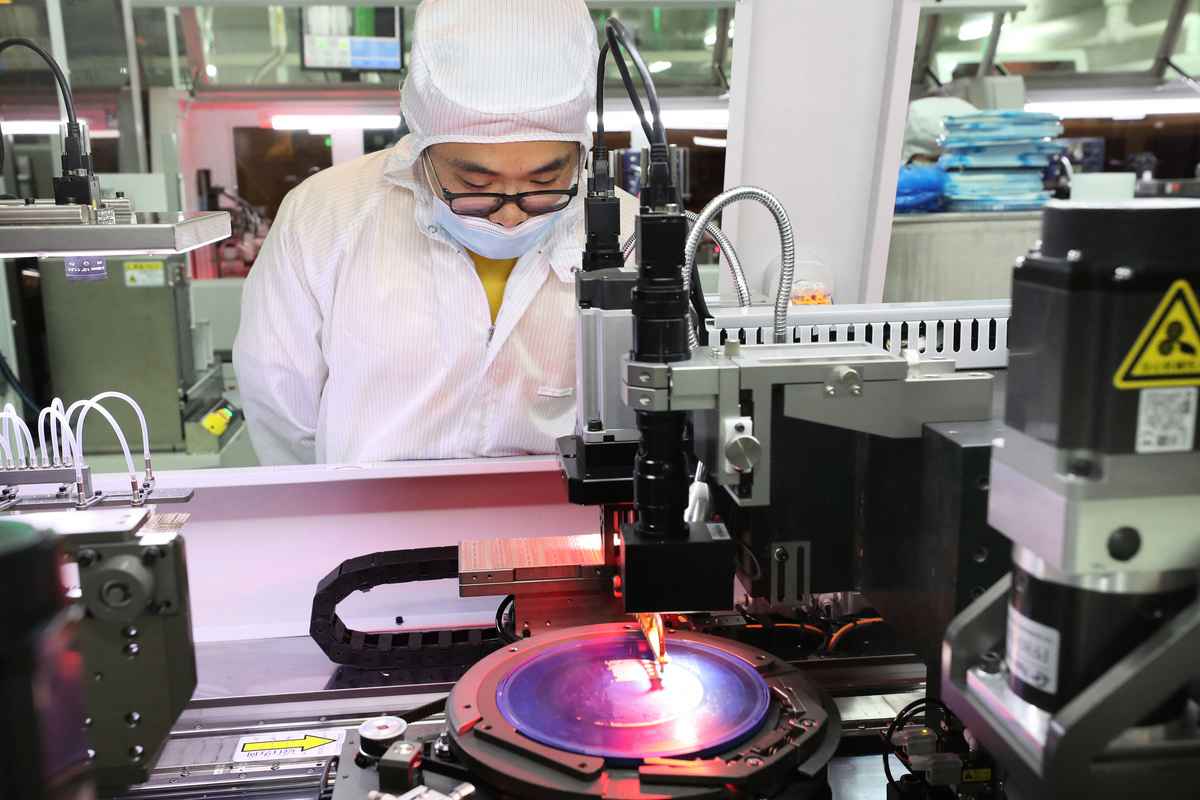
A report from a US think tank warns that although Western countries have successfully prevented the export of advanced lithography machines to Beijing, China has found ways to bypass the ban by importing old equipment and improving processes, enabling the mass production of 5-nanometer chips. Experts are calling for new legislation to close these loopholes.
According to an analysis report released by the American Enterprise Institute on Wednesday (July 29th) as reported by National Interest magazine, Chinese chip manufacturers have successfully achieved mass production of chips close to the most advanced processes by utilizing the technique of “multi-patterning” on legally acquired old deep ultraviolet immersion equipment, despite the Netherlands banning the export of ASML’s most advanced Extreme Ultraviolet (EUV) lithography systems to China since 2019.
The report’s authors, Ryan Fedasiuk and Julia Torres, pointed out that as early as 2022, Semiconductor Manufacturing International Corporation (SMIC) had successfully mass-produced 7-nanometer chips using upgraded old equipment. It was further confirmed by the end of last year that they had the capability to mass produce 5-nanometer chips.
However, the production cost using this method is four to five percent higher compared to Taiwan Semiconductor Manufacturing Company’s (TSMC) equivalent processes. Additionally, with more steps involved, the probability of errors increases, resulting in lower overall chip yield rates.
Moreover, the cost is high due to the increased time, materials, and capacity consumption required for the repeated exposures, making manufacturing costs much higher than directly using EUV lithography machines. The production line is occupied by numerous laborious steps, hindering effective amplification of chip production.
The report indicates that in just 2024 alone, Chinese companies purchased nearly 90 deep ultraviolet immersion lithography machines not restricted by the ban. Coupled with the $47.5 billion national chip fund support from Beijing, it is estimated that these equipment, operating at full capacity, can produce millions of advanced chips annually, becoming crucial for Huawei’s expansion in AI chip production.
The Extreme Ultraviolet (EUV) lithography machine, worth $250 million and the size of a bus, is essential equipment for printing the world’s most advanced semiconductor chips. Each machine comprises over 100,000 parts and demands extremely high-quality mirrors.
If the surface smoothness of this mirror were magnified to cover the entire land area of Germany (approximately 357,000 square kilometers), the largest defect on the mirror would still be less than a millimeter.
The report suggests that to address these vulnerabilities, US lawmakers should promptly pass the “MATCH Act”.
On April 2, 2026, Republican Congressman Baumgartner from Washington state led a bipartisan joint proposal with 12 other legislators for the “Multilateral Alignment of Technology Controls on Hardware Act” (MATCH Act). The bill aims to comprehensively prohibit the sale of outdated lithography equipment to China, ban the provision of maintenance for installed machines, and designate Huawei and SMIC as restricted ultimate end users.
Specifically, the prohibition of maintenance on deep ultraviolet immersion lithography equipment would cut off the lifeline for Beijing, as these machines are large and complex, requiring specialized maintenance and replacement of parts to maintain high operational output, work that must be carried out by ASML’s own technical personnel flying to China.
The report’s authors recommend that provisions regarding the application of extraterritorial jurisdiction on allies (such as the Netherlands, Japan) should be kept as a last resort to avoid causing excessive impact on companies like ASML and Tokyo Electron, while preserving diplomatic flexibility exemptions.
Analysts believe that if the sales and maintenance of old equipment continue unregulated, China could significantly increase its capacity for advanced chip self-sufficiency in the coming years, bringing variables to the competitive landscape of the global Artificial Intelligence (AI) hardware market.