
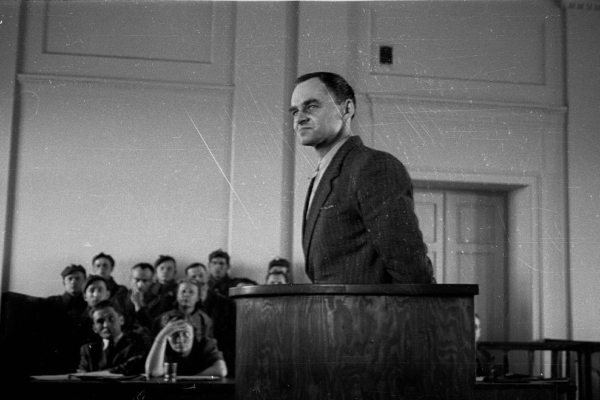
Seventy-eight years ago on this day, Polish resistance fighter Witold Pilecki passed away at the age of 47. During the darkest days of World War II, Pilecki, a cavalry officer, joined the underground resistance and undertook a daring mission: to deliberately get arrested by the German forces and infiltrate the Nazi concentration camp Auschwitz.
Pilecki was arrested on September 19, 1940, during a street roundup in Warsaw and was later sent to the camp, where he was assigned prisoner number 4859. For nearly three years inside the camp, he carried out resistance activities, attempting to sabotage the operations within the camp and transmitting the atrocities to the outside world through the Polish resistance network.
Renowned journalist Jack Fairweather uncovered this forgotten story in his new book, “The Volunteer: The True Story of the Resistance Hero Who Infiltrated Auschwitz.” He revealed that within the camp, not only were there victims but also individuals like Pilecki actively organizing resistance and trying to dismantle the camp system.
Fairweather told Time magazine, “I remember being profoundly shocked by this. It turned out that within Auschwitz, there were individuals assassinating SS officers, stealing radios for broadcasting, sabotaging facilities, and copying documents to smuggle out of the camp.”
He said, “I used to think of the camps as the ultimate symbol of suffering and victimhood. But Pilecki saw them in a whole new light – as sites that could be destroyed from within.” During his time there, Pilecki smuggled out information about Nazi executions and interrogations, eventually managing to escape the camp and writing the first report on Auschwitz.
Before the war, Pilecki led a simple life as a farmer in eastern Poland, raising children with his wife. As the war broke out, Poland fell into turmoil, divided between Nazi and Soviet occupation, leading to the underground resistance movement. Pilecki aimed to infiltrate Auschwitz but struggled to obtain approval from superiors, as many believed that Auschwitz was just a prisoner-of-war camp.
By September 19, 1940, Pilecki finally gained permission through a Warsaw roundup of Polish citizens to enter the camp. Inside, he found that the reality was starkly different from what the resistance had imagined. The first clue to the true nature of Auschwitz came through the prisoners’ food rations deliberately designed to only sustain life for six weeks.
In his Auschwitz report, Pilecki wrote, “Here, we were ordered to surrender all belongings, which were put into bags with assigned numbers. Next, our hair and body hair were shaved, and we were doused with cold water. My jaw was struck by a heavy stick, two teeth were knocked out, and blood flowed. From that moment on, we became mere numbers – my number was 4859.”
“For a camp where prisoner numbers would later exceed over ten thousand, this was a relatively early and small number.”
Assigned to perform grueling labor tasks such as transporting rocks with a wheelbarrow, Pilecki continued to gather intelligence within the camp and passed on information to the Polish underground resistance network through escaped prisoners and Polish inmates sent to town for laundry.
Alex Storozynski, the Chairman of The Kosciuszko Foundation, said, “The underground army did not wholly believe these horrifying contents.” Pilecki also attempted to organize an attack and launch a massive escape from the camp but never received approval from the Polish high command. Over the next two and a half years, he gradually passed his reports up through the Polish command system, ultimately reaching London.
After surviving nearly three years in the camp, Pilecki concluded in his report, “Staying here may be too dangerous and difficult for me.” Planning his escape through a loosely guarded back door of a bakery, he managed to work there under arrangement and, with several fellow prisoners, fled under the cover of night.
Fairweather remarked that many people who knew Pilecki are still alive, and he was able to interview some of them. “In just over a week, he traversed over 100 miles through Nazi-occupied territory. But most importantly, I met some families that had sheltered him during his escape, and they even remembered the sparse conversations they had.”
In Fairweather’s view, “Pilecki was a patriot and devout Catholic whose faith sustained him in the camp.” He gradually realized that “his mission itself had a revolutionary power. The Nazis tried to undermine people by racial divisions, dehumanizing them and stripping them of their common bonds. At Auschwitz, prisoners were starved, beaten, and abused. When Pilecki began recruiting comrades within the camp, sharing the secrets of the mission with others, he proved that even in the direst circumstances, a bond or belief beyond the individual could be formed, and that power could endure.”
“I think anyone who read his reports spirited out to the Polish resistance network – first in Warsaw, then in London and Washington – has struggled to comprehend such unimaginable atrocities.”
Pilecki’s story also made Fairweather realize that “empathy is a choice – you can choose to understand others’ pain or choose to turn a blind eye, just like he chose to volunteer for Auschwitz. The Nazis relied on the world turning a blind eye to their crimes.”
Holocaust survivor Primo Levi recalled that Nazi guards had said to him upon his arrival at the camp that even if someone survived and spoke the truth, the world wouldn’t believe it. However, Pilecki advised them to never stop trying to understand the suffering of others, no matter how harrowing the issue or dire your own circumstances.
After WWII, Poland was occupied by Soviet forces, establishing a communist government. Pilecki continued to resist the post-war “second occupation” but was eventually arrested, tried, and executed, with his wartime records being destroyed or sealed. It wasn’t until the mid-1990s that his family learned the details of his mission in Auschwitz. His story has since been gradually rediscovered and brought back into the spotlight of history.
The European Union has designated May 25, the date of Pilecki’s passing, as the “International Day of Heroes of the Fight Against Totalitarianism” to honor heroes who resisted Nazi and totalitarian regimes.
This article draws references from reports by Time magazine and National Public Radio (NPR).