
Recently, a Chinese tourist was targeted in Manila, Philippines, after being approached by individuals believed to be members of a so-called “honeytrap” gang. The incident resulted in the theft of the tourist’s wallet, leading to the arrest of five suspects involved. Reports indicate that the group had originally planned to sedate the tourist by lacing soda with a sleeping agent, incapacitating him before stealing his belongings.
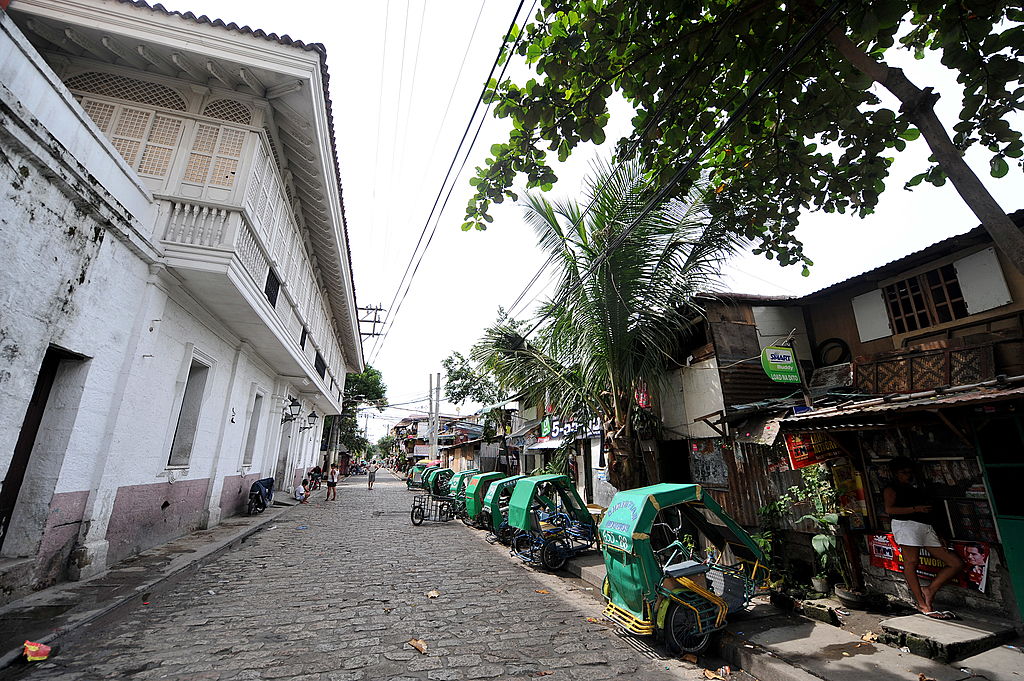
According to a report by ABS-CBN News on November 3, the incident took place on November 1 in the vicinity of the Spanish Walled City in Manila. The victim, a 28-year-old man working as an engineer in Japan, was visiting the Philippines for the first time.
Surveillance footage captured a scene in which a man and four women arrived in a white taxi. One of the women approached the unsuspecting tourist as he exited the San Agustin Church, striking up a conversation. Soon after, the group formed a bond with him, even offering to share an umbrella.
In an interview, the tourist mentioned that one of the women spoke Japanese and claimed to have previously worked in Japan, which fostered his sense of trust towards her.
Further insights from the Philippine media outlet “People’s Taliba” on November 4 reveal that the suspects initially invited the tourist to view ancient cannons within the Walled City. They later lured him to Chinatown under the pretext of celebrating a birthday for one of the women.
As he was about to get into their vehicle, a 67-year-old female suspect stole his wallet, a move that was intercepted by patrolling police officers. Law enforcement stated that they recovered the wallet from her handbag, which contained 400 Philippine pesos.
One of the female suspects, in an interview with ABS-CBN, revealed their plan to feign taking the tourist on a tour before offering him a drink spiked with sedatives to facilitate the theft of his personal belongings.
Another male suspect confessed that they had been using such tactics for years, typically targeting foreign tourists in Manila’s popular areas.
The five suspects have labeled themselves as members of the “Ativan Gang,” a term synonymous with the “honeytrap” gang in Chinese media. Notably, two members had previously been issued arrest warrants for theft-related offenses. Currently, all five are in custody and facing theft charges.
The victim has since returned to Japan and has issued a warning to fellow travelers, advising them to be cautious and not to trust strangers simply because they claim to speak a familiar language.
Similarly, a Chinese travel blogger, Ms. Li, reported an analogous experience. As detailed in a report by “Hongxing News” on June 25, she arrived in Manila on June 18, where two local women approached her and invited her to accompany them. After consuming a drink that they provided, she lost consciousness.
Upon regaining awareness, Ms. Li discovered that her cash was missing, and her bank cards had been used to withdraw approximately 20,000 yuan in multiple transactions. Post-incident, she reviewed surveillance footage and found that the two women had been following her prior to their encounter, indicating that it was not a mere coincidence.
The U.S. Department of State recently updated its travel safety advisory for the Philippines, mentioning that solo travelers who accepted offers from strangers for companionship have been drugged and robbed. The advisory urges travelers to refrain from accepting food, drinks, or transportation from unfamiliar individuals.
This series of incidents highlights the need for vigilance among tourists in areas known for such predatory behavior, stressing the importance of being cautious and aware of one’s surroundings while traveling.