
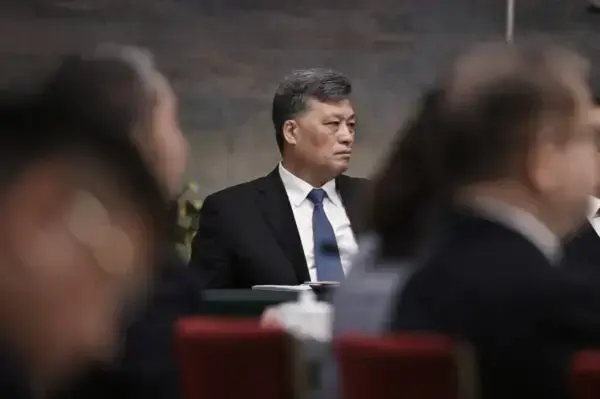
A former member of the Standing Committee of the Chinese Communist Party’s Political Bureau and former Xinjiang Autonomous Region Party Secretary, Ma Xingrui, has faced formal charges for alleged bribery. The authorities claim that his corrupt activities began during his tenure as Deputy General Manager of China Aerospace Science and Technology Corporation (CASC), extending over a staggering 25-year period. Analysts suggest that Ma’s promotion amidst corruption reflects a broader pattern of “being promoted with a medical condition,” with Chinese President Xi Jinping being held responsible.
According to an announcement from the Chinese Central Television on November 5, the Supreme People’s Procuratorate reported that Ma’s alleged bribery case has been transferred to the prosecutorial authorities for review and prosecution. The Supreme Procuratorate has formally decided to detain Ma on suspicion of bribery and has designated the Yichang City Procuratorate to handle the prosecution. The Yichang City Procuratorate has since initiated legal proceedings against him at the Yichang Intermediate People’s Court.
Prosecutors accuse Ma Xingrui of exploiting his various roles—ranging from party committee member and deputy general manager of CASC to vice secretary of the Guangdong Provincial Party Committee, secretary of the Shenzhen Municipal Committee, governor of Guangdong Province, and member of the CCP Political Bureau—to facilitate illicit benefits for others, thereby illegally receiving vast amounts of money and property. The authorities have deemed the amount involved as particularly massive, leading to criminal charges of bribery against him.
At 67 years old, Ma Xingrui hails from Dongcheng, Shandong Province, and grew up in a miner’s family in Shuangyashan City, Heilongjiang Province. He is recognized as a technical bureaucrat, having been promoted to Vice President of the Fifth Academy of China Aerospace Corporation in May 1996, as well as Chief Engineer and Chief Designer of the Shijian-5 satellite project in June of the same year. By September 1999, he became a member of the Party Committee and Deputy General Manager of CASC.
Over his career, Ma held several influential roles in various capacities, including chairman of Xinnuo Satellite Communications Co., Ltd. and deputy commander of the lunar exploration project. In 2013, Ma transitioned from military enterprises to positions within the Ministry of Industry and Information Technology, the National Space Administration, and the National Defense Technology Industry Administration. By late 2013, he was appointed to several leadership positions in Guangdong Province, culminating in his appointment as Secretary of the Xinjiang Party Committee in December 2021. He also served as a member of the 18th, 19th, and 20th Central Committees and as a member of the 20th Central Political Bureau.
Notably, the prosecutors assert that Ma’s corrupt activities have been ongoing since 1999, corresponding with his role in CASC, thus spanning a quarter-century.
Political expert Li Linyi has observed that Ma exemplifies a pattern of simultaneous corruption and advancement, often referred to as being “promoted with a medical condition,” for which Xi Jinping is held accountable.
Independent commentator Du Zheng has remarked that Xi has elevated many of his “ill-fated” allies, and with the recent wave of arrests, whether for corruption or political disloyalty, the scale of these actions has inevitably weakened Xi’s authority significantly.
After stepping down as Secretary of Xinjiang in July of last year due to “other assignments,” Ma’s new role was never announced publicly. Reports emerged on April 3 indicating that he was under investigation for serious misconduct while serving as a deputy leader of the Central Rural Work Leading Group. By June 26, his qualifications as a National People’s Congress representative were suspended.
In July of this year, Chinese authorities officially reported Ma’s expulsion from the Communist Party and public office. The notice described his severe violations of political discipline and accountability, particularly for failing to manage or supervise illegal activities among his associates. It cited allegations of engaging in corrupt practices involving both power and money.
The notice notably highlighted family-related issues, accusing Ma of allowing relatives to exploit his position for substantial personal gain, thereby creating a corrupt family network.
Given reports of Ma’s close ties to Peng Liyuan, the wife of Xi Jinping, the intricacies surrounding this case have drawn significant attention.
Senior political commentator Chen Pokong notes that Ma’s downfall poses a substantial blow to both Xi Jinping and Peng Liyuan. The prolonged investigation indicates Xi’s reluctance to remove Ma outright, suggesting efforts to obstruct his downfall from within. Ma was considered a close confidant of Xi, a prominent figure during the 20th National Congress, and there is a consensus among many influential figures within the political establishment advocating for legal action against him, which may have rendered Xi unable to protect him.
Independent commentator Cai Shenkun has pointed out that the real danger in the Ma Xingrui case lies beyond mere allegations of corruption. Ma’s wife, Rong Liguan, has purportedly engaged in highly unusual activities by providing various leaders’ spouses and children with insurance policies in Hong Kong and other areas, involving amounts ranging from hundreds of thousands to tens of millions. This extensive network of gifts has raised considerable concerns among observers.
Reports from Hong Kong’s “Sing Tao Daily” on September 27 cited revelations from Shenzhen sources about Ma’s wife’s significant appetite for wealth, with reports suggesting her mistress was also implicated in the bribery activities.
The unfolding details of this case highlight a complex interplay of power, corruption, and the political ramifications within the Chinese Communist Party.