
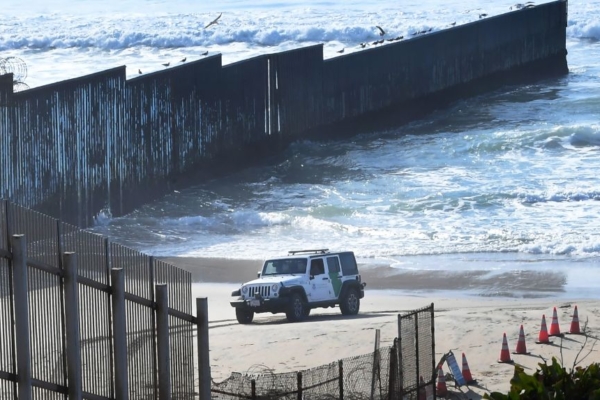
On November 1, the U.S. Coast Guard announced that it had intercepted 37 individuals suspected of illegal immigration off the coast of Southern California last month.
On October 9, the Coast Guard intercepted 13 suspected illegal entrants just offshore from San Diego. These individuals were aboard a 24-foot vessel and were subsequently handed over to the Imperial Beach Border Patrol for further processing. On the same day, the Coast Guard’s patrol ship, the Narwhal, stopped another vessel equipped with a small cabin near Santa Cruz Island, which carried 23 individuals also suspected of illegal entry. The crew subsequently transferred these individuals to Customs and Border Protection (CBP).
Further developments occurred on October 17 when a high-speed personal watercraft was detected off Point Loma. The operator of the jet ski failed to obey commands from authorities, prompting law enforcement to initiate a chase. Eventually, the watercraft was overturned by waves, resulting in the arrest of one passenger, while the operator managed to escape.
Coast Guard Southwest Region Enforcement Supervisor, Colonel Jason Hagen, stated, “Our crews stand ready to fulfill border security missions, enforce federal laws, and ensure the safety of our waterways.”
He added, “Dangerous and illegal immigration activities pose life-threatening risks, especially when smugglers use overloaded, poorly equipped vessels that are unfit for maritime navigation, heightening the danger substantially.”
The U.S. Immigration and Customs Enforcement (ICE) emphasized that the primary motivation for human traffickers is monetary gain, displaying little concern for the safety of those they transport, thus placing these individuals in extreme jeopardy.
In late September, a vessel reportedly involved in maritime human trafficking capsized near Puerto Rico, resulting in three fatalities. Three citizens from the Dominican Republic were charged in connection with this smuggling operation.
Hector Ramirez-Carbo, Acting U.S. Attorney for the District of Puerto Rico, remarked in a statement on October 8, “The defendants attempted to illegally transport 64 migrants into Puerto Rico, leading to the unfortunate deaths of three individuals, with 12 others still missing. This case underscores the severe dangers associated with human smuggling activities.”
In an unrelated case in April, two skippers pleaded guilty in a similar attempt to smuggle migrants at sea, which led to the death of four individuals, including two children. Reports mention that each foreign national allegedly paid around $13,500 for this perilous journey.
Before 2025, the Coast Guard faced criticism regarding its handling of maritime illegal immigration. A report issued by the U.S. Government Accountability Office (GAO) in January outlined that the Coast Guard needed to enhance its interception efforts.
This report assessed the Coast Guard’s operations from fiscal year 2015 to 2024 and revealed that the agency failed to meet performance targets for six out of those years.
In the 2015 fiscal year, the Coast Guard fell short of its goals, prompting authorities to adjust the targets. The agency met revised goals in 2016 and 2017; however, from 2018 to 2021, it failed to achieve targets for four consecutive years. Once again, the goals were lowered. In the subsequent two years, the Coast Guard met these revised targets but fell short again in 2024.
In response to the increasing number of maritime crossings that began in 2021, the Coast Guard found itself compelled to make trade-offs between different missions. The report noted, “Specifically, the Coast Guard allocated resources originally designated for other missions, such as counter-narcotics, toward immigration interception. This affected the agency’s ability to execute its other operations.”
In 2025, the Coast Guard intercepted or transported over 11,000 illegal migrants while patrolling more than 100,000 miles of U.S. border waters. The continued rise in maritime trafficking incidents remains a significant concern for U.S. authorities, underscoring the ongoing challenges they face in securing the nation’s maritime borders.