
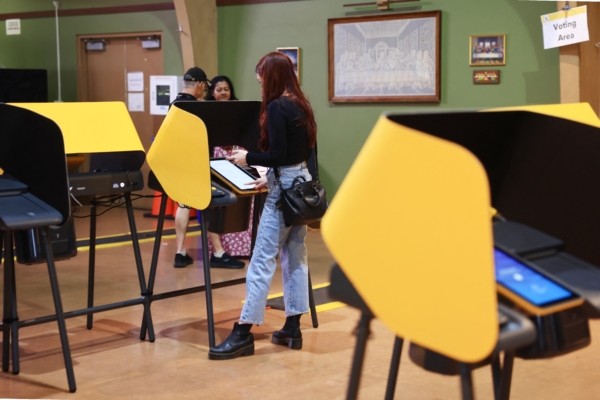
In this year’s midterm elections, candidates from the California Republican Party are facing a challenging battle not only against their Democratic counterparts but also due to the adverse effects of congressional district redistricting.
Ahead of the midterms, California holds 52 of the 435 seats in the House of Representatives. This year, there are two vacant seats, with the Democrats currently occupying 41 seats, the Republicans holding 8 seats, and 1 seat held by an independent. According to state law, Secretary of State Shirley Weber must confirm the election results from November 3 by December 11.
In California’s 22nd Congressional District, as of 8:08 AM on November 4, Democratic challenger Randy Villegas is leading incumbent Republican Congressman David Valadao with 66.4% of the votes. Following the redistricting process, this district now appears more favorable to Democrats, who spearheaded the redistricting efforts in this predominantly blue state.
Meanwhile, in the 40th Congressional District, Republican Ken Calvert, the current representative of the 41st District, is ahead of fellow party member Young Kim with a vote share of 54.5%. Following the reconfiguration of districts due to Proposition 50 last year, two Republican incumbents were forced to compete against each other. Despite Democratic hopes to split the Republican vote during the primary elections in June, both candidates managed to secure the top two spots and advance to the general election.
Proposition 50 was approved by California voters with a remarkable 65% majority, introducing a new congressional map that will remain in effect until 2030. The newly drawn 40th District encompasses parts of both Calvert’s and Kim’s current districts, stretching from Menifee and Murrieta in Riverside County to Mission Viejo in Orange County.
In the 6th Congressional District, former state senator Democrat Richard Pan leads current incumbent Kevin Kiley with 57.5% of the votes. Kiley, who previously served in the state assembly, is now running as an independent candidate after announcing in March that he was leaving the Republican Party. His ballot indicates a “No Party Preference” (NPP).
Kiley has stated that unfair districting and redistricting were among the reasons for his departure from the Republican Party, as he aims to compete in a newly drawn district where Democrats hold a significant advantage. He has also been a vocal critic of the redistricting efforts.
In the 11th Congressional District, state senator Scott Wiener is leading fellow Democrat Connie Chan, a member of the San Francisco Board of Supervisors, with 55.4% of the vote. This prominent San Francisco seat was previously held by Nancy Pelosi, who served as House Speaker on two occasions. Wiener is known for his strong advocacy for LGBTQ rights and has been instrumental in promoting gender-affirming care in California, while Chan is recognized for her advocacy of fiscal responsibility and engagement with county budget matters.
Pelosi first assumed federal office on June 2, 1987, through a special election and served for 20 consecutive terms before announcing her retirement last fall, with her term ending on January 3. She has publicly endorsed Chan as her successor.
In California’s 48th Congressional District, Democratic candidate Marni von Wilpert is leading Republican challenger Jim Desmond, a San Diego County Supervisor, with 59.6% of the votes. Von Wilpert has held previous roles as a San Diego City Council member and prosecutor and has worked with the Obama administration to promote labor rights. Desmond, a former U.S. Navy serviceman, has been vocal in critiquing the Mexico-U.S. border crisis during the Biden administration and has expressed concerns about the impact of illegal immigration on San Diego.
The winner of this district will replace long-serving Republican Congressman Darrell Issa, who announced his retirement in March. Issa has served 12 terms in the House, including a continuous 9 terms from 2001 to 2019. He did not seek re-election in 2018 but successfully ran for another congressional seat in 2020. His tenure will conclude on January 3.
In California’s 13th Congressional District, Democrat Adam Gray is currently ahead of Republican candidate Kevin Lincoln II with 61.3% of the votes.
In the 45th Congressional District, incumbent Democratic Congressman Derek Tran is leading Republican challenger Chuong Vo with 58.7% of the votes.
This election cycle signifies a crucial moment for both parties in California, with the outcomes potentially reshaping the political landscape for years to come. The complications arising from district redrawing add yet another layer of complexity to races that are already fiercely competitive.