
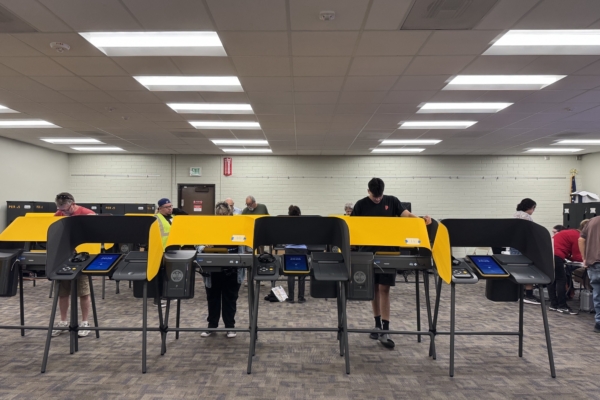
According to preliminary reports from the midterm elections in California, as of November 4, 2026, voters appear to be leaning towards rejecting Proposition 40, which proposes a one-time 5% wealth tax on individuals residing in California with a net worth exceeding $1 billion, as of January 1, 2026. While the official results are not expected to be certified until December, the current voting trends indicate that approximately 55.6% of voters are against the measure, with about 4.28 million ballots cast in opposition, outnumbering those in support by roughly 860,000 votes.
Proposition 40 was initiated and promoted by the Service Employees International Union – United Health Workers (SEIU-UHW), which argues that the wealth tax would help bridge a nearly $100 billion funding gap in California’s Medi-Cal program. However, the proposal has been met with significant controversy since its introduction, especially among leaders in the state’s tech industry.
Notable tech figures, including PayPal and Palantir co-founder Peter Thiel, have openly expressed their opposition to the wealth tax through financial contributions to anti-tax measures while also relocating their business operations out of California. Thiel, for instance, has established a new office for his private investment company in Miami, signaling a potential shift in business dynamics spurred by the proposed tax.
Similarly, Google co-founder Larry Page has moved some of his investment ventures out of California, and fellow co-founder Sergey Brin has also shifted one of his companies to avoid the implications of the wealth tax. This trend has alarmed economic experts, as reports from the Hoover Institution have highlighted that the wealth tax proposal has already led to several billionaires leaving the state, costing California an estimated $25 billion.
These departures suggest a loss not only in individual wealth but also in future state income tax revenues that would have been generated from these high-net-worth individuals. Joshua D. Rauh, a senior fellow at the Hoover Institution and a finance professor at Stanford University, believes that imposing such a wealth tax could weaken investment, reduce employment, and ultimately erode the tax base that California relies on for its financial stability.
In the lead-up to the midterm elections, the Democratic Socialists of America (DSA) publicly declared their support for Proposition 40. On their website, they rallied supporters by stating, “Join the millions of Californians calling for billionaires to pay their fair share of taxes to collectively safeguard our healthcare system.” Their advocacy for the wealth tax, framed within the context of “socialist wealth redistribution,” has sparked considerable debate within the state.
The DSA also shared a briefing for its supporters, emphasizing that California has the financial capacity to fund quality schools and healthcare services. They asserted that the critical issue lies in reallocating resources from the “wrong pockets” to the “right pockets,” with taxing the wealthy as the proposed solution to achieve this reallocation.
This debate has invoked responses from broader economic thought, harkening back to the warnings of renowned economist Friedrich Hayek, who cautioned against large-scale state-controlled redistributions, which he argued could lead to market interference and ultimately the emergence of oppressive regimes—regardless of their democratic appearances.
Fergus Hodgson, the founder and executive editor of Econ Americas, provided insights in a 2019 column titled “The Plunder of Wealth Taxes Highlights Class Struggle.” He posited that imposing a wealth tax would ultimately lead to economic outcomes that render ordinary workers poorer, drawing parallels to historical examples of wealth redistribution efforts that resulted in widespread famine, such as those seen in China during the Maoist era.
As of Wednesday afternoon, the Secretary of State’s tally in California indicated a strong likelihood that Proposition 40 could be voted down. However, these results remain preliminary, and official updates are expected continuously over the next month as the state processes the votes.