
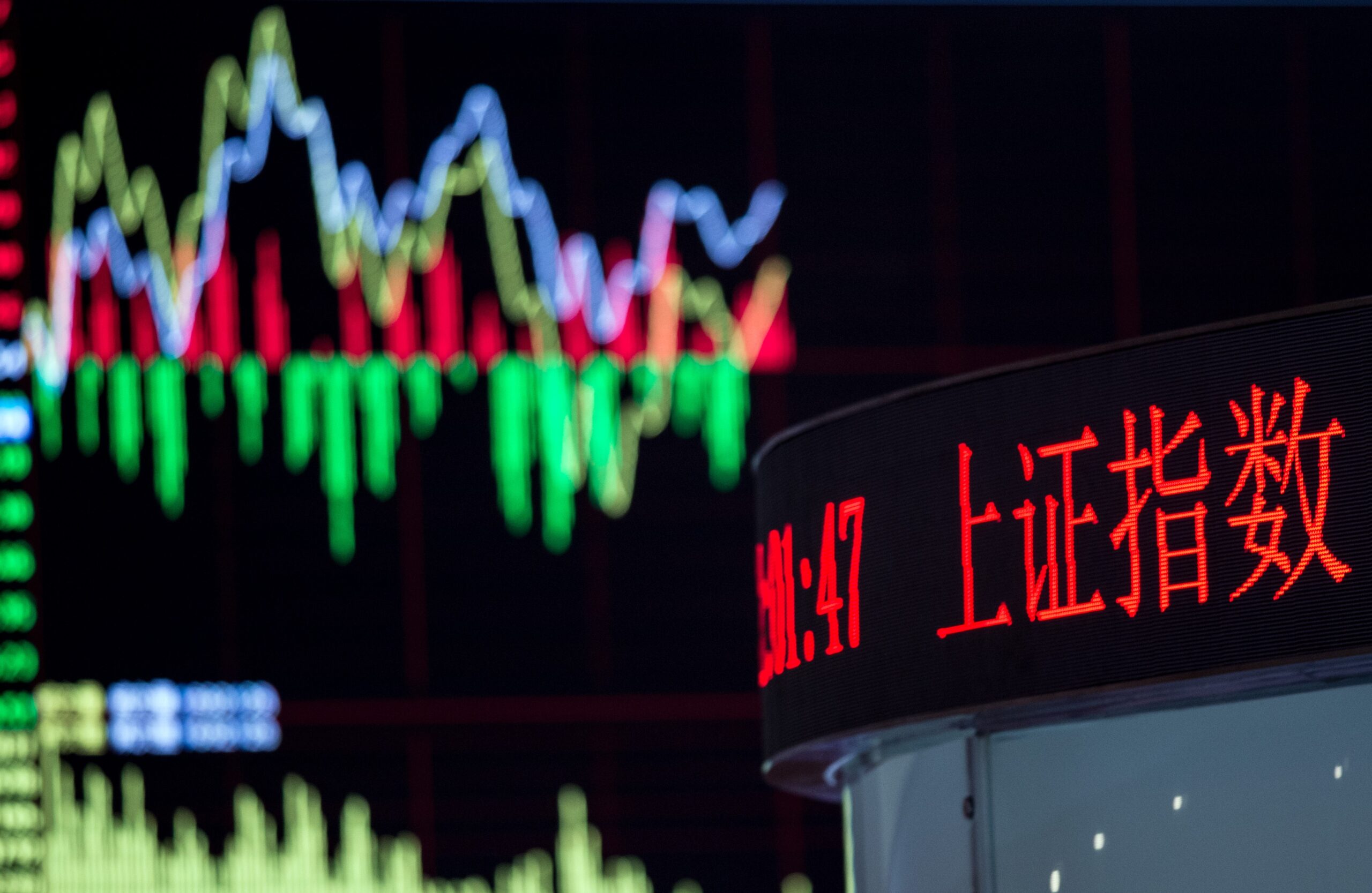
Recent fluctuations in mainland China’s stock market have raised concerns, as it predominantly continues to show a downward trend while facing increased volatility. Analysts suggest that foreign investors are currently navigating a myriad of risks that could affect their investments adversely.
On November 4, the mainland stock market experienced an afternoon rebound. By the closing bell, the Shanghai Composite Index surged by 2.16%, the Shenzhen Composite Index climbed by 4.22%, and the ChiNext Index saw an impressive increase of 6.4%.
The combined trading volume of the Shanghai and Shenzhen markets reached 2.04 trillion yuan (approximately $286 billion USD), reflecting an increase of 334.3 billion yuan from the previous trading day. More than 4,600 stocks across the market reported gains. Additionally, Hong Kong’s Hang Seng Index showed significant growth influenced by the results of the recent midterm elections in the United States.
In discussions surrounding the Chinese government’s interventions in the stock market, Shen Meng, the Executive Director of Chanson Capital, remarked to a Singaporean media outlet that while these policy tools aim to stabilize the stock market, they are merely symptomatic treatments rather than addressing deeper structural issues. He noted, “If the measures only aim to support the capital market without improving the fundamentals of the real economy, it could lead to a disconnect between market performance and economic realities. This situation tends to incentivize short-term speculative behaviors, rendering the entire capital market even more fragile and entrapped in a vicious cycle.”
A report from The Wall Street Journal on November 4 highlighted Morgan Stanley’s warning, suggesting that before any substantial rebound occurs, the mainland stock market could potentially experience a further decline of 10% to 15%. Foreign investors utilizing platforms such as U.S.-listed Chinese stocks, Hong Kong trading, and the Shanghai-Hong Kong and Shenzhen-Hong Kong Stock Connects have incurred losses amid this turbulent market environment.
Recent research indicates that foreign investors face direct risks stemming from the willingness of Chinese companies to provide them with information comparable to what domestic shareholders receive. This disparity places foreign investors at a significant informational disadvantage.
This study, published in the prestigious academic journal, The Accounting Review, featured a team of researchers including Tina Lang, Lorien Stice-Lawrence, Forester Wong, and T.J. Wong. They found that reports presented in English typically lack completeness. For instance, companies listed in mainland China with a larger pool of foreign investors were less likely to reference their operations in Xinjiang in their English-language reports, which is critical given the growing international concern regarding allegations of forced labor in the region. The study also revealed that companies receiving government subsidies tended to downplay related-party transactions in their English reports, while foreign investors often view close government ties as a governance red flag, contrary to Chinese investors’ perspectives, who tend to regard such associations as advantageous.
The researchers uncovered that foreign investors were largely unaware of the intricate connections between mainland listed companies and the Chinese government, the extensive internal party influence, and the links to firms embroiled in corruption scandals.
Furthermore, the study highlights that as Chinese companies seek to raise funds from foreign investors through U.S. listings or Hong Kong stock issuance, they emphasize compliance with financial audit standards in their English reports to alleviate any concerns among potential investors.
The researchers took their investigation a step further by conducting an experiment where they masqueraded as both local and foreign investors, sending emails to Chinese companies for information requests. The results revealed that companies were only half as likely to respond to inquiries from “foreign investors” compared to those from local investors.
The findings underscore that such selective disclosure practices diminish the liquidity of the companies’ stocks, thereby making it more challenging and costly for these companies to raise capital. They pay a heavy price for the opacity they maintain towards foreign investors. This phenomenon of selective transparency becomes particularly pronounced amid the current downturn in the mainland stock market, where Beijing simultaneously strives to stabilize stock prices while tightening its grip on the information landscape.