
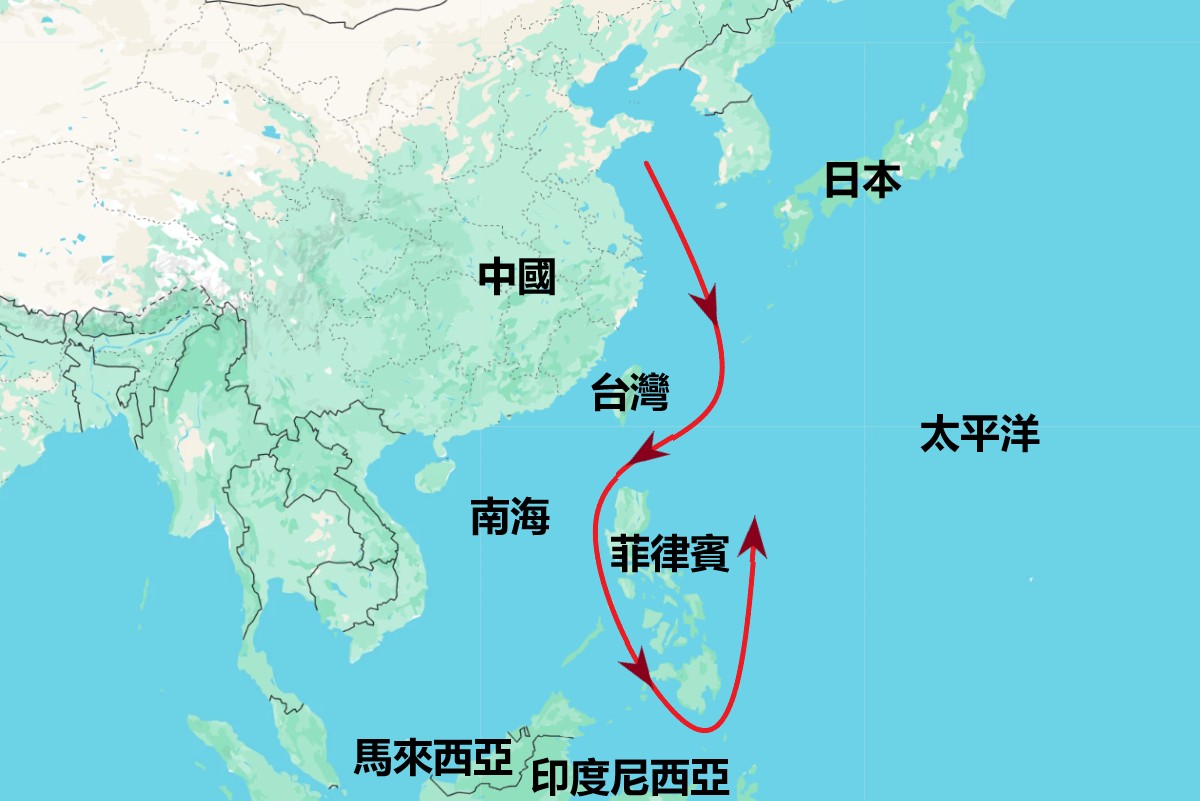
In October, the Chinese aircraft carrier Liaoning embarked on its second extended naval training mission of the year. However, rather than lingering around Taiwan and Japan, it repeatedly navigated in and out of the First Island Chain, encircling the Philippines in a puzzling route that has raised eyebrows among observers. This unusual maneuvering coincided with a significant meeting of ASEAN defense ministers in the Philippines, and the presence of the Liaoning seemed to serve as a political threat to both the Philippines and other ASEAN nations. The frequent traversing of narrow straits in adversary territory is typically a military faux pas, suggesting that internal turmoil within the Chinese military might continue to lead to disorganized training operations.
On October 14, Japan’s Ministry of Defense reported that the Liaoning and three destroyers passed through the Miyako Strait, moving from the East China Sea into the Western Pacific. Chinese state media, which usually maintain a tight lid on military details, surprisingly announced that the Liaoning task force was conducting training exercises in relevant waters of the Western Pacific on the same day.
During this period, the United States and Japan were gearing up for joint exercises dubbed “Keen Sword 27” in the Western Pacific. Attention was particularly focused on whether the Chinese carrier might engage in a standoff with U.S. Navy vessels. However, the Liaoning quickly navigated through the waters east of Taiwan. Just prior to the U.S.-Japan exercises, on October 16, the Liaoning crossed into the Sulu Sea via the Luzon Strait, re-entering the South China Sea and returning once again to the First Island Chain.
It seems that the Liaoning is aware of its limitations and is hesitant to confront U.S. naval forces directly, likely fearing that their exercises could expose weaknesses in their operational capabilities. They chose to avoid the area of the U.S.-Japan exercises but soon returned within the First Island Chain after just breaching it, indicating that their planned mission began to appear odd.
By October 19, the U.S. and Japan began their “Keen Sword 27” exercises in the Western Pacific, with the USS Roosevelt leading the fleet alongside units from Australia, Canada, France, Germany, and the Netherlands. The training included a wide array of scenarios such as maritime operations, amphibious landings, and missile defense, extending into domains like space, cyber operations, and electromagnetic warfare. Notably, Japan’s Self-Defense Forces participated with their Type 25 land-based anti-ship missiles, while U.S. Marine Corps fortifications—including land-based anti-ship missile deployments in Japan and a HIMARS rocket system in Okinawa—were showcasing a counteroffensive plan against potential Chinese aggression towards Taiwan.
If the Liaoning had intended to assertively counter these exercises, it should have remained in the eastern waters of Taiwan to simulate maritime denial or harassment actions. However, it appears that the Chinese Navy has had to come to terms with the limited capabilities of the J-15 fighter jets onboard the Liaoning, prompting a retreat from the Western Pacific rather than risk confrontation with U.S. forces.
The Liaoning could easily have traveled south along the western waters of the Philippines, avoiding the U.S.-Japan drills while still training in the Western Pacific, without needing to return within the First Island Chain and into the South China Sea.
At that moment, a strong typhoon warning was issued in the Western Pacific, suggesting the possibility that the Chinese carrier might have been wary of the risks and thus swiftly headed into the South China Sea.
The South China Sea is strategically significant for China’s Southern Theater Command, where two other aircraft carriers, Shandong and Fujian, are already stationed. If the Liaoning were transitioning from the Northern Fleet to rehearse with the Southern Fleet, there might have been some justification. However, such coordination did not occur.
After the Liaoning’s entry into the South China Sea, it trailed along the western waters of the Philippines before navigating south, breaching the First Island Chain yet again. However, instead of entering the Western Pacific again, it moved into the Sulu Sea, between the Philippines and Malaysia. Information from the Philippine military indicated that the Chinese carrier task force was located about 50 nautical miles from the Philippine coastline, underscoring the intentional display of presence by the Chinese Navy.
The repeated maneuvers of the Liaoning through the First Island Chain seem to indicate a clear intent to intimidate the Philippines.
On October 15, just a day after the Liaoning publicly declared its training exercises in the Western Pacific, the Chinese ambassador to the Philippines, Huang Qiang, made comments at a school in Manila suggesting that in the event of conflict between China and the Philippines, the Chinese military could “easily win”. He added that China would not opt for a military option and stated that the Philippines should be fortunate to have China as a neighbor.
The Philippine Department of Foreign Affairs quickly condemned the ambassador’s remarks, asserting that Huang’s language was inappropriate and could be interpreted as an overt threat. In response, the Chinese embassy claimed that the Philippines had selectively quoted and over-interpreted his comments.
Huang, who took office as the Chinese ambassador to the Philippines in December 2025, fits the mold of a “wolf warrior” diplomat. Having previously served in positions that should have endowed him with a sense of diplomatic decorum, his statements in the Philippines might either reflect a desperate bid for recognition or directive from higher authorities in Beijing.
Almost immediately after Huang’s remarks, the Liaoning began its operations along the western coast of the Philippines, moving from the South China Sea into the Sulu Sea, navigating dangerously close to the Philippine coastline.
Although China initially claimed that the Liaoning was conducting training in the Western Pacific, its swift return within the First Island Chain appears a direct challenge to the Philippines. It remains unclear whether this was part of the original training plan or a last-minute response aligned with the ambassador’s recent pronounced statements.
On October 22, the Liaoning task group passed through the narrow Basilan Strait, moving from the Sulu Sea into the Celebes Sea, situated between the Philippines and Indonesia. This strait is infamous for its narrowness, with the slimmest point measuring only 3.5 nautical miles, rife with shallows and reefs, presenting considerable risk for large vessels. The passage of the Liaoning through such a tight military corridor further elevated the stakes.
U.S. naval vessels and amphibious assault ships have often traversed the straits between the Philippine islands when moving between the Western Pacific and the South China Sea—this being an alternative route outside the safety of the Bashi Channel. As a military ally, the Philippines provides a secure environment for U.S. Navy operations, while the Chinese Air Force struggles to project power in this domain. The U.S. military maintains numerous bases in the Philippines, enabling ships to dock for resupply and receive air support from ground facilities in wartime. In stark contrast, the Chinese fleet faces quite the opposite situation.
Chinese naval assets, including the Liaoning and destroyers, repeatedly traversing various straits and inching close to the Philippine coastline, risk attack without access to aerial support once leaving the South China Sea. The Chinese fleet’s navigation through the narrow Basilan Strait places it at great risk of artillery or shoulder-fired missile attacks. With American mobile ground-based anti-ship missiles, HIMARS rocket systems, and stealth fighters in the region, the Chinese fleet finds itself severely outmatched.
The orchestrated positioning of the Liaoning carrier group appears to be an attempt at intimidation towards the Philippines, which could be seen as treating them as a hypothetical enemy. However, navigating the carrier close to the conjectured adversary’s shores or through narrow passages amounts to inviting confrontations.
The U.S. has consistently demonstrated its military capability to deter China’s threats towards Taiwan, but its aircraft carriers do not readily patrol near the Chinese coastline. When engaged in operations against Iran in the Arabian Sea, for instance, the U.S. fleet maintains a strategic distance from Iranian territory to allow ample time and space for defense against potential anti-ship missile attacks. Avoiding the overlapping coverage areas of ground-based anti-ship missiles and enemy aircraft—a fundamental principle for any commanding officer—seems to have been disregarded by the Liaoning and its escort destroyers.
The Liaoning’s path along the Philippine coast may have been intended to synchronize with the ambassador’s provocative statements in order to fulfill certain political objectives assigned by superiors in Beijing, resulting in blatant disregard for basic maritime operational principles.
Various media outlets have also raised concerns about the logistical challenges facing the Liaoning. The ships’ southbound course is more complex than in the past, creating increased difficulties regarding resupply. As a conventionally powered carrier, the Liaoning consumes significant amounts of fuel, and refueling vessels departing from Qingdao that follow the carrier down south would be impractically cumbersome. In reality, the Liaoning task group quickly bypassed the southern region of the Philippines and re-entered the Western Pacific, likely seeking to rendezvous with supply vessels quickly; failing to do so would necessitate a stymied position.
The Philippine military confirmed the rapid movement of the Chinese carrier group but did not disclose the whereabouts of the Chinese supply vessels. It is expected that China recognizes the challenges of maintaining supply ships close to the Liaoning, leading to a hasty conclusion of its circumnavigation around the Philippines.
On October 16, Japan’s Ministry of Defense reported that a Type 903 supply ship and a Type 052D destroyer, alongside a Type 054A frigate, had crossed the Miyako Strait into the Western Pacific. The Liaoning can purportedly reach a maximum speed of 30 knots, while the 903 supply ship’s maximum speed is only 20 knots, making it impossible for the supply ship to catch up with the Liaoning, which would need to wait until after the carrier had circumnavigated the Philippines to converge at sea.
Navigating back out of the First Island Chain presents logistical challenges that heighten operational difficulties for the Chinese Navy. While the task group’s somewhat bewildering travel patterns may perplex observers, this political exercise appears to lack genuine combat readiness and may reflect ongoing turmoil within the Chinese military apparatus.
During a regular press briefing on October 29, a reporter inquired why the Liaoning had traversed the Basilan Strait, likening it to an incursion into the “heart of the Philippines.” The spokesperson for the Chinese Ministry of Defense, Zhang Xiaogang, insisted that their training maneuvers “were not aimed at any specific country or target.”
On October 28, a broader ASEAN defense ministers’ meeting took place in the Philippines, inviting participation from countries such as the United States, Japan, Australia, South Korea, and India, in addition to the eleven member states. While the Philippines did invite the Chinese defense minister, Beijing sent only lower-ranking officials to represent its interests.
During the meeting, U.S. Secretary of Defense Lloyd Austin addressed the attendees, emphasizing a defense cooperation agenda focused on pragmatic collaboration and regional stability. He articulated, “We adopt a stance that we call firm, low-key, and clear. Firm enough to deter coercion and aggression, low-key enough to avoid unnecessary escalation or posturing, allowing actions to speak more than words, and clear enough for our friends, partners, and potential adversaries to understand the United States’ position and our commitment to defend our own, as well as our allies’ and partners’ interests.”
The timing of the Chinese carrier group’s maneuvers around the Philippines during the ASEAN defense ministers’ meeting seems deliberate, emphasizing a message that threatens not only the Philippines but also all ASEAN nations. As the carrier crossed through the Sulu Sea, the Philippines lay to the west while Malaysia lay to the east. Similarly, as it traversed the Celebes Sea, the Philippines remained to the west and Indonesia to the east.
The threat posed by the Chinese aircraft carrier seems to serve a dual purpose: a show of force while simultaneously revealing China’s ambitions to expand its influence across Southeast Asia. The takeover of Taiwan is a crucial initial step for China’s strategic aspirations; once accomplished, their attentions would likely shift northwards towards Japan’s Ryukyu Islands and southwards within the Philippines.
This strategy mirrors historical incidents from 1941, when the U.S. imposed an embargo on Japan following its incursions into China. Japan then aimed to secure resources in Southeast Asia, launching the Pacific War by attacking Pearl Harbor while simultaneously implementing its “Southward Advance” plan to invade the Philippines, Malaysia, and Indonesia. Indonesia, being resource-rich, was a focal point, yet Japan needed to neutralize potential threats from the Philippines and Malaysia. Given the geographical complexities of the Philippines, the U.S. had helped the local military command by bringing in General Douglas MacArthur to bolster its defenses.
In today’s context, China appears eager to replicate Japan’s historical approach with its “Southward Advance” strategy. The confounding training route of the Liaoning serves as confirmation of China’s ambitions, although they are presently hampered by capabilities. This situation not only heightens the vigilance of the Philippines but also serves as a wake-up call for other Southeast Asian nations, such as Malaysia and Indonesia, reinforcing the critical reliance on U.S. security assurances.
Established during the Cold War, ASEAN was originally intended to prevent the spread of communism; today, the moment to return to that foundational purpose has clearly arrived.