
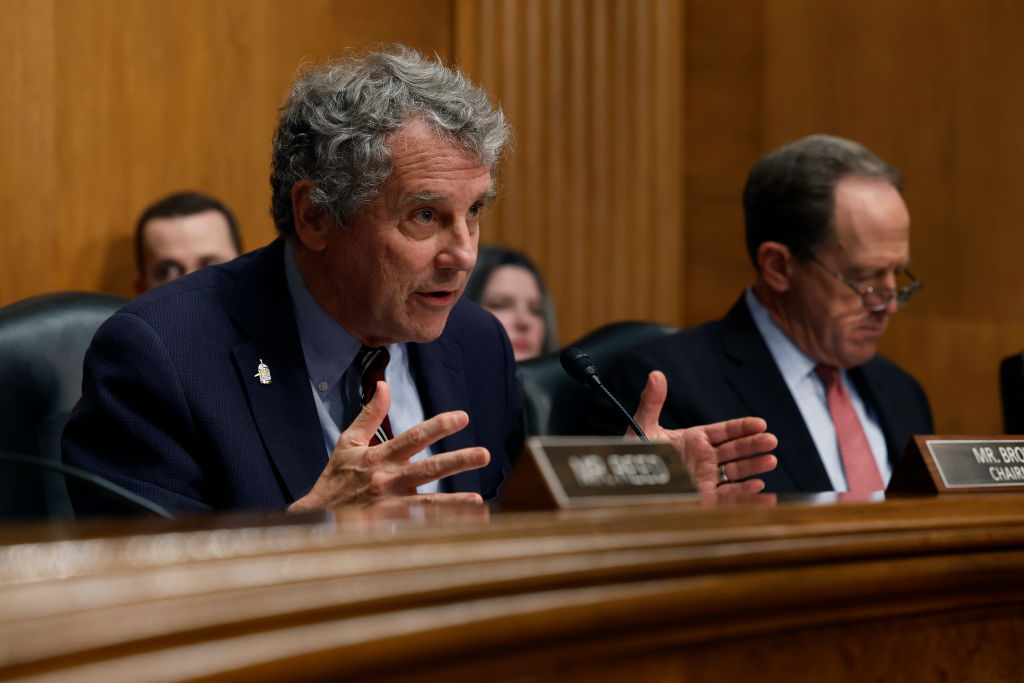
On November 3rd, a significant political event took place in the United States as former federal senator and Democratic leader Sherrod Brown achieved a victory in the midterm elections. Having previously served as the chairman of the Congressional-Executive Commission on China (CECC), Brown successfully defeated his Republican opponent, Jon Husted, in the Ohio Senate race. He is set to be sworn in come January.
Brown has had a longstanding focus on issues pertaining to China and Taiwan throughout his political career. During his time as a federal representative, he co-founded the Congressional Taiwan Caucus. Furthermore, in his previous tenure as a senator, he was an active member of the Senate Taiwan Caucus. His commitment to these issues was also demonstrated through his long service on the CECC, where he held various leadership positions, including co-chair and chairman.
After experiencing a defeat in the 2024 elections, Brown is making a return to the Senate. His previous public statements and positions regarding China and Taiwan have been thoughtfully compiled. From 2007 to 2025, he served as a senator with a keen interest in human rights and religious freedom in China. He has expressed support for sanctions against those involved in the repression in Hong Kong and has identified the extensive surveillance of the Uyghurs by the Chinese government as a justification for export controls.
On trade matters, Brown has consistently advocated for tariffs against China under Section 301, aiming to prevent Chinese electric vehicles from entering the American market. His legislative efforts also extend to technology, where he has pushed for stricter export controls on advanced chips and semiconductor equipment. He has emphasized the importance of thoroughly reviewing U.S. investments in cutting-edge technologies, such as artificial intelligence and quantum computing, to guard against their potential use by the Chinese military.
Brown has stated, “American funding and expertise should not be used to enhance the military and intelligence capabilities of the Chinese government. As we pursue the Outbound Investment Transparency Act into law, the administration must quickly implement these measures to ensure that U.S. businesses’ investments do not facilitate technology development that may be used against us.”
Regarding Taiwan, he has supported the Taiwan Relations Act, the Six Assurances, and the sale of F-16 fighter jets to Taiwan. He believes that Taiwan’s future should be determined by its people, while also maintaining the U.S. policy framework of “not supporting Taiwan independence.” In 2024, he endorsed assistance for both Taiwan and the Indo-Pacific region.
In another pivotal Senate election on the same day, Democrat Chris Pappas won against Republican John Sununu in New Hampshire. Pappas, currently a federal representative, has also reiterated strong positions regarding issues related to China and Taiwan.
On his campaign website, Pappas lists China, Russia, and Iran as authoritarian competitors, advocating for reliance on allies to protect democracy and uphold American interests and values.
When it comes to trade, he opposed general and indiscriminate tariffs in 2025, specifically criticizing the 145% rate imposed on Chinese goods at that time, arguing that such costs initially fall on American importers and are ultimately passed on to consumers.
Concerning Taiwan, Pappas has emphasized the necessity of strengthening diplomatic partnerships with the democratic ally, advocating against Chinese intimidation and bullying of Taiwan.
As a member of the Congressional Taiwan Caucus, he played a role in the reintroduction of the Taiwan Representative Office Act in June 2025. This bipartisan legislation aims to formally rename the “Taipei Economic and Cultural Representative Office in the United States” as the “Taiwan Representative Office.”
Speaking about the initiative, Pappas remarked, “As Taiwan faces increasingly severe security and sovereignty threats, we must continue to strengthen our diplomatic partnerships with democratic allies. This bipartisan legislation will appropriately recognize Taiwan’s de facto embassy, demonstrating our ongoing support. We must stand together with democratic allies against authoritarian regimes and counter China’s attempts to intimidate and bully Taiwan and other nations.”
In the context of U.S.-China technological competition, he has expressed support for the CHIPS and Science Act, emphasizing the importance of bringing semiconductor production back to the United States to help the country “outpace China.”
On human rights issues, Pappas contributed to launching the STOP CCP Act, declaring that the Chinese Communist Party must be held accountable for state-supported actions against Uyghur Muslims and long-standing human rights abuses. The legislation involves financial and visa sanctions against high-ranking officials connected to the repression in Xinjiang, the erosion of autonomy in Hong Kong, and coercive actions against Taiwan.
In summary, both Sherrod Brown and Chris Pappas are set to play influential roles in shaping U.S. foreign policy regarding China and Taiwan, reflecting a robust commitment from the Democratic Party to engage with these complex international issues.